By using this site, you agree to the Privacy Policy and Terms of Use.
Accept
World of SoftwareWorld of SoftwareWorld of Software
  • News
  • Software
  • Mobile
  • Computing
  • Gaming
  • Videos
  • More
    • Gadget
    • Web Stories
    • Trending
    • Press Release
Search
  • Privacy
  • Terms
  • Advertise
  • Contact
Copyright © All Rights Reserved. World of Software.
Reading: QCon London 2026: From DVDs to Global Streaming How Netflix’s Commerce Architecture Actually Evolve
Share
Sign In
Notification Show More
Font ResizerAa
World of SoftwareWorld of Software
Font ResizerAa
  • Software
  • Mobile
  • Computing
  • Gadget
  • Gaming
  • Videos
Search
  • News
  • Software
  • Mobile
  • Computing
  • Gaming
  • Videos
  • More
    • Gadget
    • Web Stories
    • Trending
    • Press Release
Have an existing account? Sign In
Follow US
  • Privacy
  • Terms
  • Advertise
  • Contact
Copyright © All Rights Reserved. World of Software.
World of Software > News > QCon London 2026: From DVDs to Global Streaming How Netflix’s Commerce Architecture Actually Evolve
News

QCon London 2026: From DVDs to Global Streaming How Netflix’s Commerce Architecture Actually Evolve

News Room
Last updated: 2026/03/17 at 1:34 PM
News Room Published 17 March 2026
Share
QCon London 2026: From DVDs to Global Streaming How Netflix’s Commerce Architecture Actually Evolve
SHARE

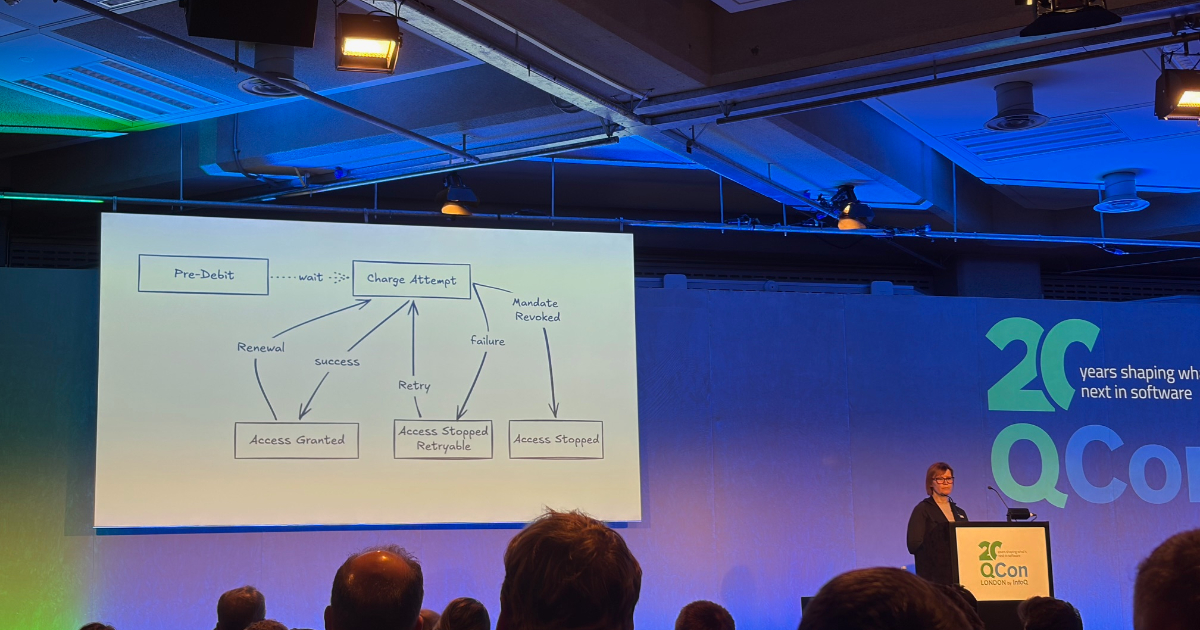
At QCon London 2026, Kasia Trapszo, a principal engineer at Netflix, leading architecture for the company’s commerce platform, presented on how Netflix’s billing and payment systems evolved from a US-based DVD rental business to a global streaming platform supporting over 130 countries.

The talk, titled “From DVDs to Global Streaming: How Netflix’s Commerce Architecture Actually Evolved,” traced a series of pragmatic, incremental changes rather than a single clean redesign, offering practical lessons on recognizing when early architectural assumptions are no longer valid.

Trapszo explained that Netflix’s original commerce system was built around straightforward assumptions: customers paid with credit cards, billing was predictable, and real-time authorization enabled immediate entitlement decisions. Payment succeeds, customer gets access; payment fails, access stops. These assumptions held while Netflix operated as a US-centric DVD-by-mail service, but began to break as the business expanded internationally.

The first major inflection point came with Brazil, where most customers used debit cards not enabled for online transactions. The primary payment method introduced asynchronous payment confirmation that could take days to validate. This forced a fundamental architectural shift from purely real-time processing to a hybrid model supporting both real-time and delayed signals, introducing new concepts such as validation windows, grace periods, and provisional access. Fraud detection also had to evolve from real-time authorization filtering to behavioral detection over time.

In 2016, Netflix launched in approximately 130 countries simultaneously. To enable the rapid rollout, the team made deliberate architectural shortcuts, dividing the world into billing zones rather than fully localizing each country. Trapszo described how this simplified model created mismatches between geography and payment reality. One example involved St. Pierre and Miquelon, a French territory near Canada, which was initially treated as Canadian and therefore payment was instructed in Canadian Dollars, causing all transactions to fail. The strategy was to launch quickly, observe real demand, and prioritize deeper localization based on production learnings.

Regulatory changes in India between 2020 and 2022 presented another challenge. The Reserve Bank of India prohibited merchants from storing credit card credentials. The solution required adopting mandates with pre-approved amounts, 3D Secure authentication, and pre-debit notifications. 

The introduction of multi-household subscriptions, allowing subscribers to add extra member slots for people outside their household, fundamentally changed the billing relationship from single-account to multi-account dependencies. Trapszo noted that the changes required for data systems, metrics, and dashboards were actually larger than those to the commerce system itself.

As complexity grew, the team scaled from a few engineers under a single manager to a restructured organization with clear domain boundaries. Trapszo described a deliberate decision to duplicate vendor integration code rather than create shared components, enabling each team to move independently and much faster. “Some duplication is cheaper than coordination,” she noted.

Netflix’s entry into live events in 2024, including the NFL games and the Jake Paul vs. Mike Tyson fight, introduced entirely new signup patterns. Previous models assumed predictable, cyclical signups distributed across time zones, but live events created massive spikes concentrated in very short periods. The team introduced graceful degradation strategies, prioritizing customer access to live viewing over immediate financial reconciliation, which could happen later. The Jake Paul fight validated the approach (despite its delay), with signups exceeding predictions by morning before the evening event.

Trapszo ended the session with a quote:


Great systems don’t survive because they were perfectly designed.


They survive because they keep evolving as reality changes.

Sign Up For Daily Newsletter

Be keep up! Get the latest breaking news delivered straight to your inbox.
By signing up, you agree to our Terms of Use and acknowledge the data practices in our Privacy Policy. You may unsubscribe at any time.
Share This Article
Facebook Twitter Email Print
Share
What do you think?
Love0
Sad0
Happy0
Sleepy0
Angry0
Dead0
Wink0
Previous Article At 30% off, the Sony WH-1000XM5 just became your next top-quality treat At 30% off, the Sony WH-1000XM5 just became your next top-quality treat
Next Article Before Nvidia, There Was This Bottleneck Before Nvidia, There Was This Bottleneck
Leave a comment

Leave a Reply Cancel reply

Your email address will not be published. Required fields are marked *

Stay Connected

248.1k Like
69.1k Follow
134k Pin
54.3k Follow

Latest News

Over 500 million Google Calendar users just got a major upgrade that solves the time zone problem
News
AI Flaws in Amazon Bedrock, LangSmith, and SGLang Enable Data Exfiltration and RCE
Computing
From NHS doctor to scaleup founder – Farzana Rahman, CEO, Hexarad
News
Cybersecurity startup Native, led by AWS vets with roots in Seattle, comes out of stealth with M
Cybersecurity startup Native, led by AWS vets with roots in Seattle, comes out of stealth with $42M
Computing

You Might also Like

Over 500 million Google Calendar users just got a major upgrade that solves the time zone problem
News

Over 500 million Google Calendar users just got a major upgrade that solves the time zone problem

3 Min Read

From NHS doctor to scaleup founder – Farzana Rahman, CEO, Hexarad

1 Min Read
Microsoft Authenticator Review: A Beginner-Friendly, No-Frills Approach to MFA
News

Microsoft Authenticator Review: A Beginner-Friendly, No-Frills Approach to MFA

3 Min Read
Technology accelerating crime, boosts case for national police service says NCA chief | Computer Weekly
News

Technology accelerating crime, boosts case for national police service says NCA chief | Computer Weekly

6 Min Read
//

World of Software is your one-stop website for the latest tech news and updates, follow us now to get the news that matters to you.

Quick Link

  • Privacy Policy
  • Terms of use
  • Advertise
  • Contact

Topics

  • Computing
  • Software
  • Press Release
  • Trending

Sign Up for Our Newsletter

Subscribe to our newsletter to get our newest articles instantly!

World of SoftwareWorld of Software
Follow US
Copyright © All Rights Reserved. World of Software.
Welcome Back!

Sign in to your account

Lost your password?