

By using this site, you agree to the Privacy Policy and Terms of Use.
Accept
World of SoftwareWorld of SoftwareWorld of Software
  • News
  • Software
  • Mobile
  • Computing
  • Gaming
  • Videos
  • More
    • Gadget
    • Web Stories
    • Trending
    • Press Release
Search
  • Privacy
  • Terms
  • Advertise
  • Contact
Copyright © All Rights Reserved. World of Software.
Reading: QCon London 2026: Wrangling Telemetry at Scale, a Guide to Self-Hosted Observability
Share
Sign In
Notification Show More
Font ResizerAa
World of SoftwareWorld of Software
Font ResizerAa
  • Software
  • Mobile
  • Computing
  • Gadget
  • Gaming
  • Videos
Search
  • News
  • Software
  • Mobile
  • Computing
  • Gaming
  • Videos
  • More
    • Gadget
    • Web Stories
    • Trending
    • Press Release
Have an existing account? Sign In
Follow US
  • Privacy
  • Terms
  • Advertise
  • Contact
Copyright © All Rights Reserved. World of Software.
World of Software > News > QCon London 2026: Wrangling Telemetry at Scale, a Guide to Self-Hosted Observability
News

QCon London 2026: Wrangling Telemetry at Scale, a Guide to Self-Hosted Observability

News Room
Last updated: 2026/03/19 at 5:00 PM
News Room Published 19 March 2026
Share
QCon London 2026: Wrangling Telemetry at Scale, a Guide to Self-Hosted Observability
SHARE

At QCon London 2026, Colin Douch discussed building and operating self-hosted monitoring stacks, surveyed the current tooling landscape, and explained how to build a coherent observability setup rather than treating logs, metrics, and traces as separate pillars.

Douch, site reliability engineer at DuckDuckGo and formerly observability tech lead at Cloudflare, opened the session by challenging the audience:

Do you ever feel the complexity demon creeping up to you? We’ve all developed hacks to try and escape it, but it’s always there. Sometimes you have to confront it, and when you do, you need observability.

Highlighting a common paradox in modern observability, Douch explained that while observability tooling is meant to simplify debugging complex systems, the observability stack itself often becomes equally complex. While many organizations outsource the problem to SaaS vendors, the session focused on the realities of running observability infrastructure internally and what teams should understand before committing to it. Douch warned:

Should I run my own Observability stack? No, at least not until you have exhausted each and every other option.

After stressing the challenges of self-hosted observability (“you need at least an extra 2-3 full-time engineers and significant money”), Douch outlined the typical components of a self-hosted observability stack.

Douch suggested using Prometheus, his preferred choice despite its horizontal scaling challenges, or VictoriaMetrics for metrics, and highlighted that exemplars are an underused feature of modern metrics systems.

He stressed the importance of structuring logs and storing them in a columnar database, suggesting VictoriaLogs or Loki, given their different approaches and design philosophies. While developers could cut out the middleware and ingest logs directly into the database, Douch advised against it unless one is already running. He also warned:

Sprinkling in logs leads to a soup of unusable data that makes it nigh on impossible to solve problems.

In practice, self-hosted observability often consists of loosely coupled systems built around projects such as metrics collectors, distributed tracing frameworks, and log aggregation tools. While this modular ecosystem provides flexibility, it also introduces operational overhead.

Douch also reviewed the current ecosystem of open-source tooling commonly used to assemble such stacks. Noting that “traces are just a fancy name for logs with some pre-agreed structure,” he endorsed OpenTelemetry for traces, arguing the complexity is worth it, but advised against using it for metrics or logs, recommending Prometheus Text Exposition and JSON instead.

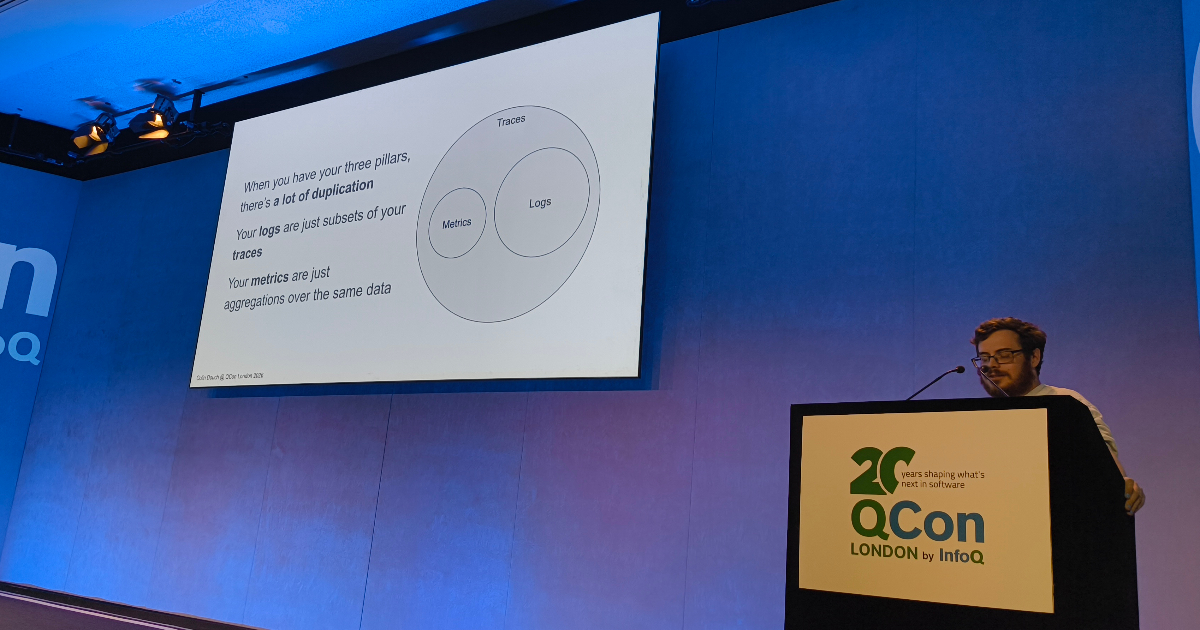
Douch then discussed sampling, the advantages and disadvantages of head and tail sampling, and collectors. Rather than treating logs, metrics, and traces as independent data silos, he argued that the value of observability comes from connecting these signals. While the three pillars overlap significantly, logs are a subset of traces, and metrics are aggregations over the same underlying data.

Colin Douch at QCon London 2026

Throughout the talk, Douch emphasised that building an observability platform is less about selecting a single tool and more about designing a coherent telemetry pipeline.

Sign Up For Daily Newsletter

Be keep up! Get the latest breaking news delivered straight to your inbox.
By signing up, you agree to our Terms of Use and acknowledge the data practices in our Privacy Policy. You may unsubscribe at any time.
Share This Article
Facebook Twitter Email Print
Share
What do you think?
Love0
Sad0
Happy0
Sleepy0
Angry0
Dead0
Wink0
Previous Article AMD Preps More GFX12.1 Enablement For Linux 7.1, Initial VCN 5.0.2 & JPEG 5.0.2 IP AMD Preps More GFX12.1 Enablement For Linux 7.1, Initial VCN 5.0.2 & JPEG 5.0.2 IP
Next Article Got space junk? Portal and Paladin team up to create an orbital trash disposal service Got space junk? Portal and Paladin team up to create an orbital trash disposal service
Leave a comment

Leave a Reply Cancel reply

Your email address will not be published. Required fields are marked *

Stay Connected

248.1k Like
69.1k Follow
134k Pin
54.3k Follow

Latest News

Security Basics for AI-Generated Websites: How to Build Safely with AI on WordPress
Computing
Best LG deal: Save 0 on the LG 27-inch Ultragear QHD OLED gaming monitor
Best LG deal: Save $250 on the LG 27-inch Ultragear QHD OLED gaming monitor
News
‘Seeking connection’: the video game where players stopped shooting and started talking
News
Deterministic + Agentic AI: The Architecture Exposure Validation Requires
Computing

You Might also Like

Best LG deal: Save 0 on the LG 27-inch Ultragear QHD OLED gaming monitor
News

Best LG deal: Save $250 on the LG 27-inch Ultragear QHD OLED gaming monitor

3 Min Read
‘Seeking connection’: the video game where players stopped shooting and started talking
News

‘Seeking connection’: the video game where players stopped shooting and started talking

11 Min Read
5 Clever Bluetooth Gadgets For Your MacBook – BGR
News

5 Clever Bluetooth Gadgets For Your MacBook – BGR

9 Min Read
YC Once Again Tops Ranks Of Most Active Fintech Investors In Q1 Even As Deal Count Drops
News

YC Once Again Tops Ranks Of Most Active Fintech Investors In Q1 Even As Deal Count Drops

5 Min Read
//

World of Software is your one-stop website for the latest tech news and updates, follow us now to get the news that matters to you.

Quick Link

  • Privacy Policy
  • Terms of use
  • Advertise
  • Contact

Topics

  • Computing
  • Software
  • Press Release
  • Trending

Sign Up for Our Newsletter

Subscribe to our newsletter to get our newest articles instantly!

World of SoftwareWorld of Software
Follow US
Copyright © All Rights Reserved. World of Software.
Welcome Back!

Sign in to your account

Lost your password?