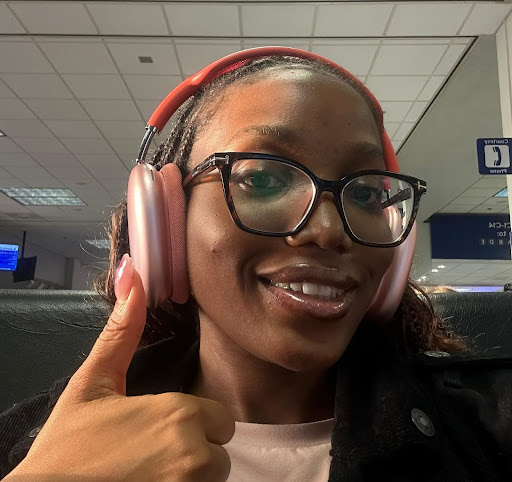
Lotachi Anidi is a Nigerian design entrepreneur who has spent more than six years building fintech products. From an early designer at Binance to a founding designer at Nestcoin, a Coinbase-backed company.
Her products serve millions across frontier markets, solving financial access problems that traditional banking systems consistently overlook. At Nestcoin, she leads design for Onboard, a global banking app that evolved from a crypto wallet into a comprehensive financial infrastructure.
But her most ambitious project is Behind the Ship, an interview series profiling African design leaders whose work defines modern tech. It has reached over 20,000 viewers across 12 episodes. Born in Enugu, Nigeria, Lotachi taught herself design while studying electrical engineering because she wanted to build things that mattered. That resourcefulness shaped her high-agency approach to everything. From championing user acquisition strategies at billion-dollar companies to launching her own media platform with zero budget.
- Explain what you do to a 5-year-old.
I make it really easy for grown-ups to give money to anybody, even if they live far away.
When grown-ups send money to family in other countries using old ways, it’s like mailing a dollar bill by the time it gets there, someone took 50 cents. I make an app where you send that dollar, and your family gets almost all of it, instantly.
- What is the most exciting and challenging part about leading design at a fintech company like Onboard?
Nobody has cracked global payments powered by crypto rails. The infrastructure is early, compliance is a nightmare, and the regulatory landscape in the global south is hostile. Traditional finance locks us out for a reason. But at Onboard, we’re choosing the hard route and taking on that challenge anyway. Leading design means that it is my job to take that complexity and ambiguity, abstract it down, and make it so simple that anyone—even our parents—can send money instantly. For too long, design has been missing from business decisions.
At Onboard, I am championing a partnership with stakeholders to give design a seat at the table. Because design is how we build trust, clarity, and freedom into modern banking for people the world decided weren’t profitable enough to serve. My design decisions directly impact whether someone gets access to global banking or stays locked out.
- How can anybody build “high-agency” in a design world where AI is democratising access today?
With AI, the barrier to building is at an all-time low. Anything can be generated on demand. So everyone’s asking: will AI take our jobs? But here’s the good news: if you look at it like this, tools don’t actually matter. It’s your POV. Your lived experience. Your taste matters. What can’t be replicated is your conviction, your context, your why. That’s what gives you leverage. Therefore, lean into your superpowers as a designer—eye for craft, digging deep to find root causes, and first principles thinking.
Experiment with AI, build out your ideas, solve problems for yourself, and (maybe) apply to Y Combinator. But do it in public. Tell your story, all of it. And you might find a problem worth spending your life’s work on. Or you discover something that resonates with people in a way you didn’t expect. Either way, you’re building agency. You actually have more control over how your ideas exist in the real world than ever before.
- Beyond AI, in what ways has design evolved, and what did you do to get ahead?
Design has moved from making things work and look pretty to becoming a core strategic tool. The best designers today aren’t order-takers. They understand business, they have a POV, and they’re willing to push back. I’ve made it my mission to champion that shift, both at Onboard and in public.
I started a talk show, Behind the Ship, to show that design thinking and storytelling matter. I push designers and myself to make their work visible, to read beyond design, to understand the business problem we’re actually solving. And I’m vocal about it. If I’m not convinced about a direction, I say so. I don’t accept the status quo just because it’s comfortable.
- What is the wildest decision you’ve made about your career, and did it pay off?
I took a pay cut to join Onboard because I believed in the founding team and the mission to create universal access to world-class financial services. It was a bet, and it’s still unfolding. I believe the payoff is already clear. With the years I have spent focused on that one problem, I’m positioned as one of the pioneer experts shaping the future of payments on this side of the world via stablecoins and on-chain finance. I’ve had the opportunity to actually define and lead the design team from the ground up, not just execute someone else’s vision. That’s invaluable.
- Onboard Flex cards are talked about now on social media; what were the key trade-offs you made to the design direction to ensure things just worked?
Adding a card offering focused on contactless, tap-to-pay purchases meant being intentional about positioning and naming. We started with “Premium,” but I pushed for “Flex” instead. It positions the card for lifestyle use cases, keeps our options open when we do a more premium offering, and tells a story our users connect with.
Another trade-off was clarity. We needed users to know the difference between the default card (Classic) and Flex right away, and to make an effective comparison on one view, regardless of their device. So we designed for that constraint first.
We also had a KYC constraint that limited who could access the card initially. Instead of explaining the limitation, we built exclusivity into the launch. The constraint became a feature in how we marketed it.
But the biggest trade-off was restraint. Everyone wanted multiple colourways for Flex after the initial launch. I pushed back. Here’s my reasoning: card branding is a strong opportunity to own a motif and have it register in our customers’ minds. Introduce too many options too early, and you dilute the brand. It was tempting, even for me, but we needed to show restraint and intention.
- Why did you decide to start Beyond the Ship? Why does it matter to you?
Traditional media has always focused on CEOs. Behind the Ship is going in the other direction. We spotlight and interview the makers and designers whose names you might not know, yet whose work shapes how modern tech looks, feels, and works. We believe that in the age of AI, where anyone can build, design, and craft, it matters more than ever. And we want to champion and inspire the rise of the next generation of design founders.
- What’s your career’s biggest ‘GOAT moment’? Tell us in a short story.
My GOAT moment was getting rejected at the final stages by Spotify and Revolut. I didn’t think I’d even get their attention, but I went through the entire interview process with both of them. Getting that far was already a win. It proved I could compete at that level.
But here’s the thing: when I didn’t get the offer, I realised I was actually relieved. Because what I really wanted wasn’t to join a massive company and execute someone else’s vision. What I wanted was what I’m doing now at Onboard, exercising my muscles as a design leader, building from zero to one. Building something from nothing. Shaping culture and product from the ground up.
- What’s your hot take on how design will continue to matter to Africa’s tech ecosystem (or not)? And how should newbies position themselves?
Design from Africa has been largely invisible, but that’s changing. And the newbies positioning themselves right now will own their market. Here’s what I’d tell them: don’t wait to be hired by a big company. Build something. Solve a problem you actually care about. And tell your story. Document your process, your failures, your thinking. Do it in public.
- What’s one thing you’re good at but don’t enjoy, and one thing you enjoy but aren’t good at?
I’m good at writing and storytelling, but the process is painful. Getting myself into the zone takes so much friction, procrastination, overthinking, and rewriting. It’s exhausting. But I do it because it matters. On the flip side, I love singing, music, and writing lyrics. And I’m not good at it yet. But I have zero doubt that I will be. So watch out lol.