Despite suffering an estimated 1.2 million casualties in Ukraine since 2022, Russian forces continue to replenish their ranks at a pace that roughly matches battlefield losses. Attempts to explain this phenomenon by focusing on coercion or financial incentives are incomplete.
In fact, enlistment bonuses for soldiers have been reduced or eliminated across many Russian regions since 2025. Meanwhile, Ukrainian intelligence indicates that approximately 76 percent of captured Russian troops are contract personnel who volunteered to join the invasion. An equally consequential factor driving Russia’s recruitment resilience is being overlooked: Propaganda.
Emerging evidence underscores this dynamic. A recent study conducted by Kyiv-based NGO LingvaLexa together with Ukraine’s Office of the Prosecutor General analyzed survey data from over one thousand Russian prisoners of war. Researchers found a clear correlation between adherence to Russian propaganda narratives and readiness to fight for the Kremlin.
Russian soldiers who endorsed Moscow’s propaganda messaging were up to six times more likely to view the invasion of Ukraine as legitimate. They were also nearly twice as likely to express a willingness to return to combat, and were significantly more inclined to dehumanize Ukrainians. Nearly half embraced the so-called “Russian World” imperial ideology promoted by the Kremlin, complete with notions of violence and self-sacrifice.
These findings offer a clear indication that Russian propaganda is not only shaping how soldiers interpret the war, but also helping to determine whether they are willing to fight, endure, and re-enlist once they have been released from wartime incarceration. In effect, propaganda acts as a force multiplier, sustaining Russian battlefield capacity even as the costs of Putin’s invasion continue to escalate.
This is consistent with Russian military thinking. Moscow has long treated the information environment as a warfare domain equal in importance to kinetic operations, and has worked to integrate narrative control, ideological framing, and psychological conditioning into its broader strategy.
In contrast, while NATO increasingly recognizes the strategic importance of the information space, Western policy responses still tend to treat propaganda primarily as a communications challenge. As a result, Kremlin propaganda is seen as something to counter via messaging, debunking, or media literacy initiatives.
The evidence from Ukraine suggests this approach is insufficient. If propaganda helps the Russian military to generate manpower, sustain morale, and normalize violence, then it must be understood not as peripheral to the war effort, but as part of its core infrastructure.
This misdiagnosis is reflected in current accountability efforts worldwide, which remain fragmented, insufficiently responsive, and narrowly focused. Existing legal frameworks offer important precedents but provide no comprehensive model.
From Nuremberg to the International Criminal Tribunal for Rwanda, international law has established that propaganda-related conduct can give rise to criminal responsibility including for persecution, direct and public incitement to genocide, and other international crimes. However, these examples do not offer a comprehensive framework for addressing propaganda as an organized system embedded within the architecture of military aggression.
As a result, investigations into Russian propaganda have largely focused on the most visible public figures like television hosts and media commentators. While these actors play an important role, this approach risks overlooking the broader machinery that produces and coordinates propaganda at scale.
In reality, Russia’s propaganda apparatus functions less like a collection of individual voices and more as a structured system with defined roles and hierarchies. It encompasses political supervisors, media executives, editors, producers, and a wide network of cultural and institutional actors. Directives are generated within centralized coordinating structures and disseminated across television, digital platforms, educational institutions, and beyond, ensuring alignment with state objectives.
Understanding this system requires moving beyond questions of whether individual statements are false or inflammatory. The more consequential legal and policy question is whether propaganda actors contribute to enabling and sustaining military aggression. In many cases, these individuals are not merely expressing opinions; they are participating in a coordinated infrastructure that aligns information operations with Russian state objectives.
Eurasia Center events

At present, Russian propaganda is still being treated as ordinary speech to be answered through debate, rather than as a strategic weapon of hostile state influence. In modern information warfare, this distinction is increasingly untenable. By the time false or manipulative narratives are publicly contested, their impact in terms of shaping perceptions, normalizing violent aggression, and influencing behavior, may already be entrenched.
Addressing this challenge requires a shift from reactive to systemic responses. If propaganda functions as a force multiplier for military aggression, countering it must go beyond debunking individual claims and move toward disrupting the structures that produce and disseminate it.
Several policy implications follow. Accountability must extend beyond public-facing figures to the wider chain of responsibility, including those who design and coordinate Russia’s messaging. Governments and international institutions should also develop clearer frameworks for investigating and prosecuting hostile state propaganda-related conduct, particularly where it contributes to aggression and other international crimes.
Responses to hostile state disinformation should be integrated into national security policies. Treating propaganda solely as a public communications issue underestimates its role in shaping battlefield outcomes and sustaining violence. Given the transnational nature of these operations, effective responses will require stronger international coordination in evidence collection, legal strategy, and enforcement.
Russia’s war against Ukraine demonstrates that propaganda plays a more important part than ever in modern warfare. Extensive propaganda ecosystems are crucial in shaping perceptions, motivating recruitment and participation, and legitimizing violence, including atrocities against civilians. Recognizing propaganda as part of Russia’s infrastructure of military aggression is an essential step toward countering it effectively.
Anna Vyshniakova is an international criminal lawyer and head of LingvaLexa. Jais Adam-Troian is an assistant professor of psychology at Heriot-Watt University Dubai and a fellow at the NATO Stratcom Center of Excellence. Kristina Hook is assistant professor of conflict management at Kennesaw State University and a nonresident senior fellow at the ’s Eurasia Center.
The views expressed in UkraineAlert are solely those of the authors and do not necessarily reflect the views of the , its staff, or its supporters.

The Eurasia Center’s mission is to enhance transatlantic cooperation in promoting stability, democratic values, and prosperity in Eurasia, from Eastern Europe and Turkey in the West to the Caucasus, Russia, and Central Asia in the East.
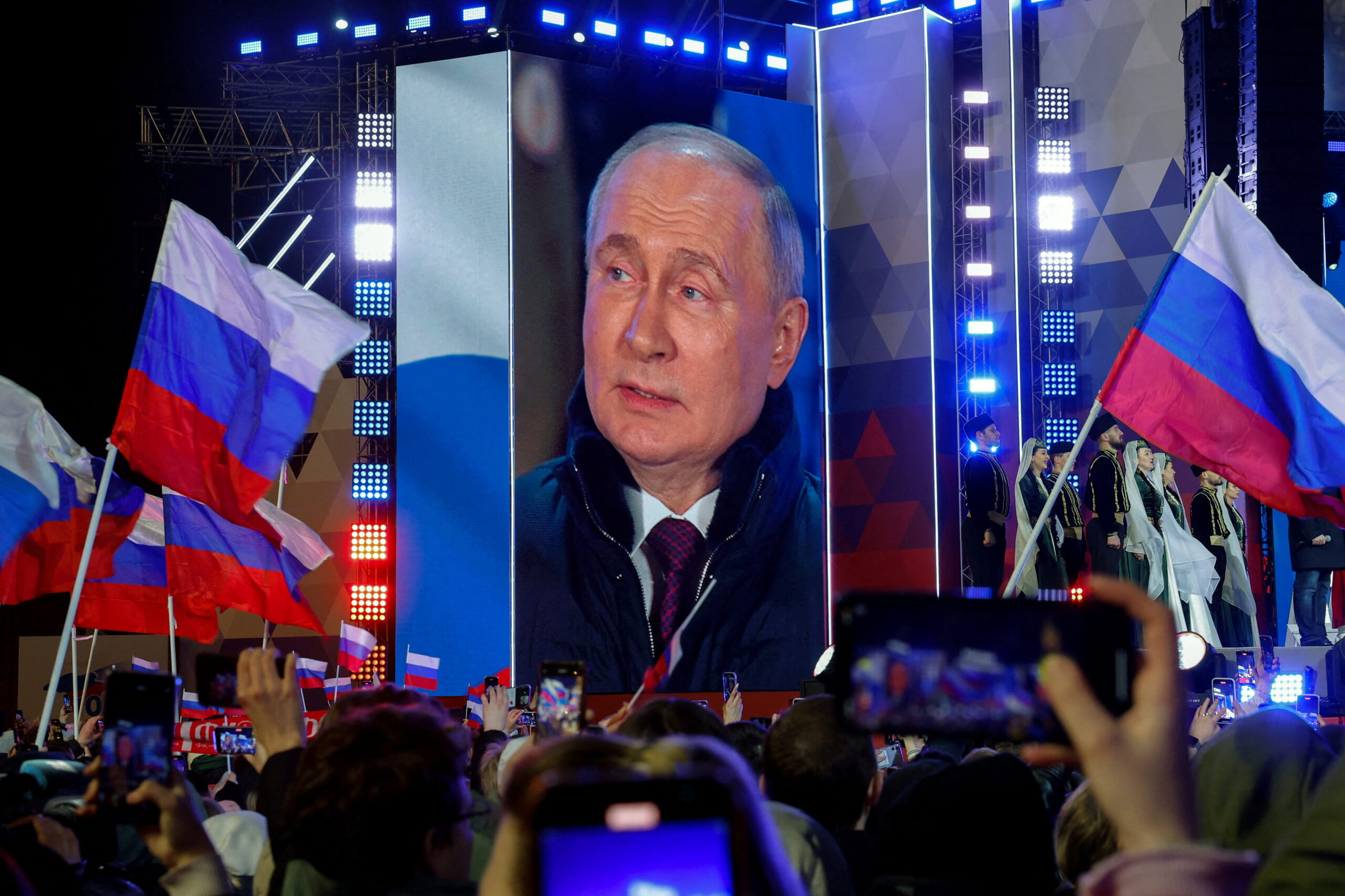
Image: Russian President Vladimir Putin, who was declared winner of the presidential election by the country’s electoral commission, is seen on a screen on the stage as he attends a rally, which marks the 10th anniversary of Russia’s annexation of Crimea from Ukraine, in Red Square in central Moscow, Russia. March 18, 2024. (REUTERS/Maxim Shemetov)