

With its vast columns of tanks and attempts to seize key airbases, the initial Russian blitzkrieg invasion of Ukraine in February 2022 looked very similar to military operations conducted by Soviet forces throughout the second half of the twentieth century. Almost four years on, the invasion has evolved into something strikingly different, with military realities now being shaped by new technologies that are redefining the way wars are fought.
The most important innovation of the past four years has been the expanding use of drones on the battlefield. While drones have featured in a range of different conflicts since the turn of the millennium, Russia’s invasion of Ukraine is widely recognised as the world’s first drone war. Initially, the smaller and more innovative Ukrainian military held the initiative in the deployment of drones, but the Russians have learned important lessons from early setbacks and are now steadily eroding Ukraine’s advantage.
Ukraine’s emphasis on drone warfare reflects the country’s underlying strengths and weaknesses. In terms on manpower, firepower, and funding, the Ukrainians simply cannot hope to compete with Russia. This has made cheap and potentially plentiful drones a particularly attractive option for Ukrainian military planners as they look to compensate for Russia’s far greater resources while also reducing their country’s dependence on military support from Western partners.
At the start of the full-scale invasion, Ukraine’s vibrant tech sector represented an important asset that the authorities in Kyiv were quick to mobilize. This tech prowess helped cement the country’s strategic focus on drones, which could be designed and produced domestically to compensate for a lack of more conventional weapons.
Since 2022, the number of Ukrainian companies developing drones has skyrocketed, while annual output has risen to millions of units. This has allowed Ukraine to establish a “drone wall” along the front lines of the conflict, making any buildup of enemy forces extremely challenging. Over the past year, around three-quarters of all Russian casualties have been as a result of Ukrainian drones.
At sea, Ukraine has used drones to sink multiple warships and break the Russian navy’s Black Sea blockade, forcing Putin to withdraw the bulk of his remaining fleet from Russian-occupied Crimea. Ukraine’s growing drone capabilities have also made it possible to bring Putin’s invasion home to Russia with an escalating campaign of deep strikes on military and industrial targets across the Russian Federation.
Russia has responded to Kyiv’s groundbreaking use of drone warfare by studying Ukrainian tactics and technologies, while also dramatically expanding its own domestic drone manufacturing base. The Kremlin has been aided in this by allies including China and Iran, who have provided vital components along with the blueprints for key drone designs.
The Kremlin strategy has focused on mass producing a limited range of models for use on the battlefield and in the bombardment of Ukrainian cities. This methodical approach has paid dividends. By the end of 2024, it was already becoming clear that the drone war was turning in Russia’s favor. This trend has only intensified over the past year.
One of Russia’s most important innovations has been the widespread use of fiber-optic drones. These drones are controlled by a wire connected directly to the operator, making them immune to jamming technologies and extremely difficult to intercept.
Russian commanders first began using large quantities of fiber-optic drones during fighting in late 2024 to push Ukrainian troops out of Russia’s Kursk region. The drones proved highly effective at disrupting Ukrainian logistics by targeting supply vehicles. This was widely seen as a crucial factor behind the success of the operation.
Russia has now replicated and scaled up these tactics throughout southern and eastern Ukraine, creating a drone wall of its own while reaching deeper and deeper into Ukrainian-controlled territory. Fiber-optic drones are being used to ambush supply vehicles far behind the front lines, forcing Ukraine to become increasingly reliant on ground robotics to supply combat units and evacuate the wounded.
In addition to striking Ukrainian logistics, Russian drone forces are also prioritising attacks on their Ukrainian counterparts, forcing Ukrainian drone crews to pull further back from the line of contact to ensure safety. This distance gives Russian operators room to move their own teams forward, increasing their ability to dominate the battlefield.
Eurasia Center events

Russia’s Rubicon drone unit has emerged during 2025 as a prominent symbol of the Kremlin’s rapidly evolving and increasingly effective drone warfare strategy. Highly trained and well funded Rubicon teams are leading the campaign to cut Ukraine’s supply lines and widen the kill zone.
Crucially, Rubicon pilots pass their experience on to newcomers and provide extensive training that is helping to improve the effectiveness of other Russian army drone units. According to Ukrainian drone commander Yurii Fedorenko, Rubicon can rapidly scale up drone units using manpower and financial advantages that Ukraine cannot replicate.
In the drone war between Russia and Ukraine, the Kremlin is betting on mass and hoping that a combination of smart choices, specialised production, extensive training, and sheer numbers will eventually overwhelm Ukraine’s technological edge. In contrast, Kyiv continues to rely on a highly decentralised ecosystem of volunteer groups, startups, and military workshops producing a wide variety of different drone models. This diversity helps to drive innovation but also creates coordination challenges.
The current effectiveness of Russia’s drone units does not mean the drone war has shifted decisively in Moscow’s favor, but recent trends do expose a gap that Ukraine must urgently close. In order to counter Russia’s increasingly centralised and well-resourced drone formations, Kyiv needs to adopt key elements of the Rubicon model. This means scaling up training pipelines, sharing front line experience more systematically, and ensuring Ukrainian drone units have all the resources they need to hunt down Russian operators and regain the initiative.
Since 2022, the Russian military has been widely mocked for its primitive “human wave” tactics and generally poor performance in Ukraine. However, the progress made by Russia in drone warfare indicates an army that is fully capable of learning, adapting, and innovating. Moscow has not been able to achieve any major technological breakthroughs, but Russian military strategists have significantly strengthened their country’s position by concentrating on scale, training, and relentless battlefield experimentation.
This progress should be a major wake-up call for European leaders. Small numbers of suspected Russian drones are already causing chaos and disruption across Europe. The longer the war in Ukraine lasts, the more advanced Russia’s drone capabilities will become.
David Kirichenko is an associate research fellow at the Henry Jackson Society.
The views expressed in UkraineAlert are solely those of the authors and do not necessarily reflect the views of the , its staff, or its supporters.

The Eurasia Center’s mission is to enhance transatlantic cooperation in promoting stability, democratic values, and prosperity in Eurasia, from Eastern Europe and Turkey in the West to the Caucasus, Russia, and Central Asia in the East.
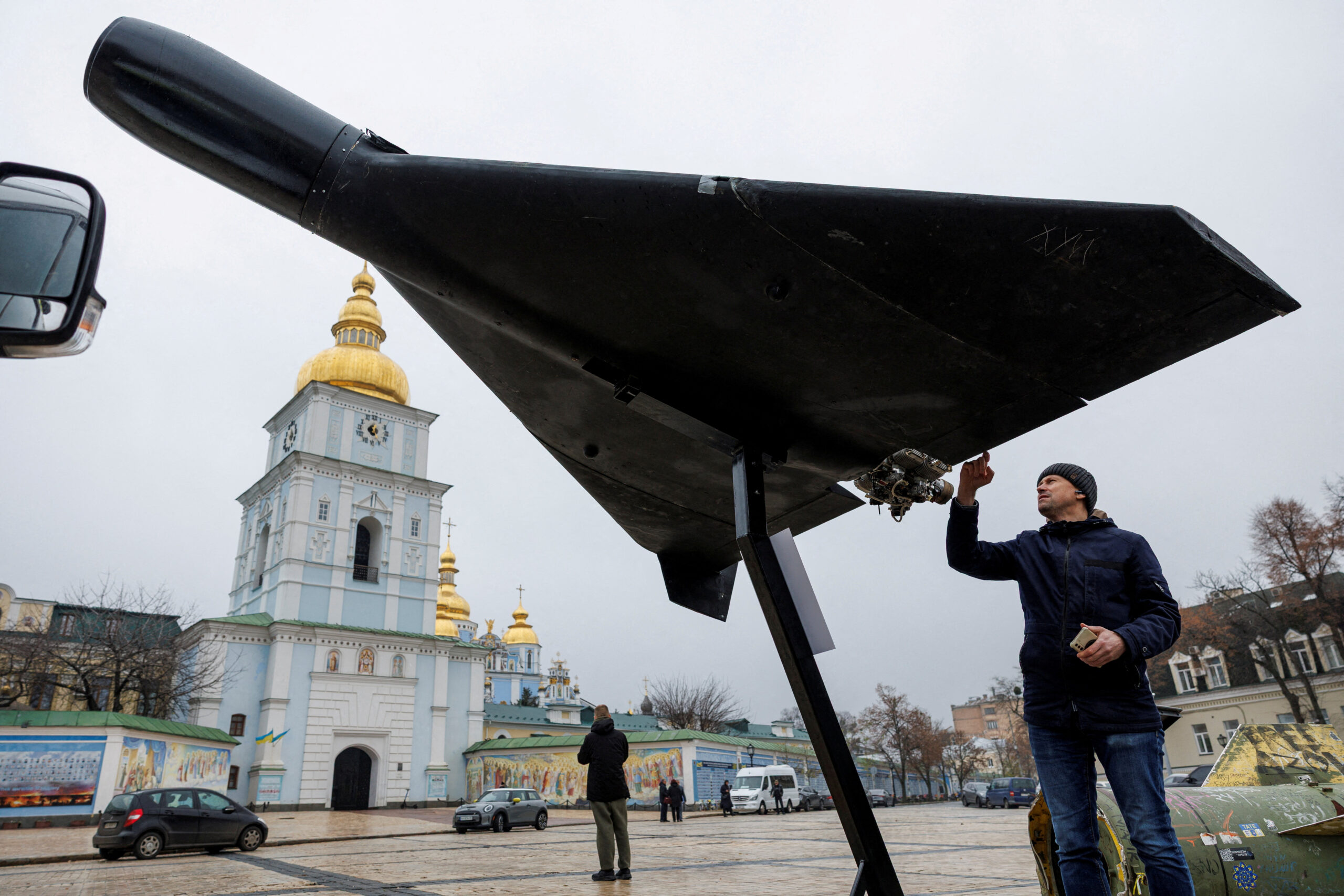
Image: A resident touches a Russian-Iranian Shahed-136 (Geran-2) kamikaze drone installed in front of Saint Michael’s Cathedral as a part of an exhibition displaying destroyed Russian military vehicles and weapons, amid Russia’s attack on Ukraine, in Kyiv, Ukraine November 26, 2025. REUTERS/Valentyn Ogirenko/File Photo


