Price: One Clear Winner
There are three Galaxy S26 phones and three iPhone 17 models; adding storage to any model increases the price. The Galaxy S26 starts at $899.99, the S26+ starts at $1,099.99, and the S26 Ultra starts at $1,299.99; all Galaxy S26 models come with at least 256GB of storage.
The Apple iPhone 17 starts at $799, the iPhone 17 Pro starts at $1,099, and the iPhone 17 Pro Max starts at $1,199. All iPhone 17 models come with at least 256GB of storage. If it’s just dollars and cents, the iPhone 17 beats the Galaxy S26 head-to-head on its starting price for the base model and ultra-premium model. The S26+ is 99 cents more expensive than the iPhone 17 Pro.
Samsung’s Galaxy S26 Ultra maxes out at $1,799.99 for a 1TB model, while a 1TB Apple iPhone Pro is $1,499, and the Pro Max is $1,599. Additionally, Apple offers a 2TB model (Samsung has no 2TB S26 models) at $1,999.
If it’s just about the numbers, Apple wins here.
Winner: iPhone 17
Design: Similar, But Still Subjective
The Galaxy S26 series and iPhone 17 line are rounded rectangular slabs with rounded corners. Samsung further refined the Ultra, boosting its visual similarities.
The rear panels hold the camera assembly, which features three lenses in a pill-shaped section.
Left to right: Samsung Galaxy S26, S26+, and S26 Ultra (Credit: Eric Zeman)


The 6.3-inch Galaxy S26 measures 5.89 by 2.82 by 0.28 inches (HWD), and weighs 5.89 ounces; the 6.7-inch Galaxy S26+ is 6.24 by 2.98 by 0.29 inches and weighs 6.70 ounces; and the Galaxy S26 Ultra is 6.44 by 3.07 by 0.31 inches, and weighs 7.55 ounces.

Left to right: Apple iPhone 17 Pro Max, iPhone Air, iPhone 17 Pro, and iPhone 17 (Credit: Eric Zeman)
On the iPhone front, the iPhone 17 is 5.89 by 2.81 by 0.31 inches and weighs 6.24 ounces. The iPhone 17 Pro is 5.91 by 2.83 by 0.34 inches and weighs 7.27 ounces. The biggest iPhone is also the heaviest as the iPhone 17 Pro Max is 6.43 by 3.07 by 0.34 inches, and weighs 8.22 ounces.
The iPhone 17 has two rear cameras, while the iPhone 17 Pro has a large rectangular plateau that houses its three main cameras.
Every one of these phones is IP68-rated, so they are virtually dust and waterproof. For materials, the Galaxy S26 and iPhone 17 lines use aluminum frames. Samsung covers the S26 and S26+ with Corning Gorilla Armor, while the Ultra is covered with Gorilla Armor 2. Every iPhone 17 screen is covered by Apple’s Ceramic Shield 2.

Left to right: Samsung Galaxy S26 Ultra, S26+, and S26 (Credit: Eric Zeman)
Samsung offers the same color palette for all Galaxy S26 phones: Black, Cobalt Violet, Sky Blue, and White are widely available, while Silver Shadow and Pink Gold are online exclusives.

Apple iPhone 17 Pro (Credit: Eric Zeman)
The iPhone 17 is available in Black, Lavender, Mist Blue, Sage, or White. The iPhone 17 Pros come in three colors: Cosmic Orange, Deep Blue, and Silver.
If you are looking for compactness, the Galaxy S26 devices are slimmer and lighter than their iPhone 17 counterparts. At the end of the day, design is subjective.
Winner: Tie
Displays: Innovation Wins Out

Left to right: Samsung Galaxy S26 Ultra, S26+, and S26 (Credit: Eric Zeman)
The base Samsung flagship now features a 6.3-inch display (up from 6.2), while the S26+ uses a 6.7-inch display, and the Ultra has a huge 6.9-inch screen. All three devices support variable refresh rates up to 120Hz. The S26 has a pixel density of 411 pixels per inch (ppi), the S26+ has 516 ppi, and the Ultra has 500 ppi. All three panels support an always-on mode and reach up to 2,600 nits in brightness.

Apple iPhone 17 Pro Max (Credit: Eric Zeman)
The iPhone 17 and 17 Pro feature 6.3-inch panels, and the Pro Max boasts an enormous 6.9-inch display. All the new iPhones feature screens with a pixel density of 460 pixels per inch (ppi), an always-on display, an anti-reflective coating, a 1Hz to 120Hz refresh rate, and a peak brightness of 3,000 nits.
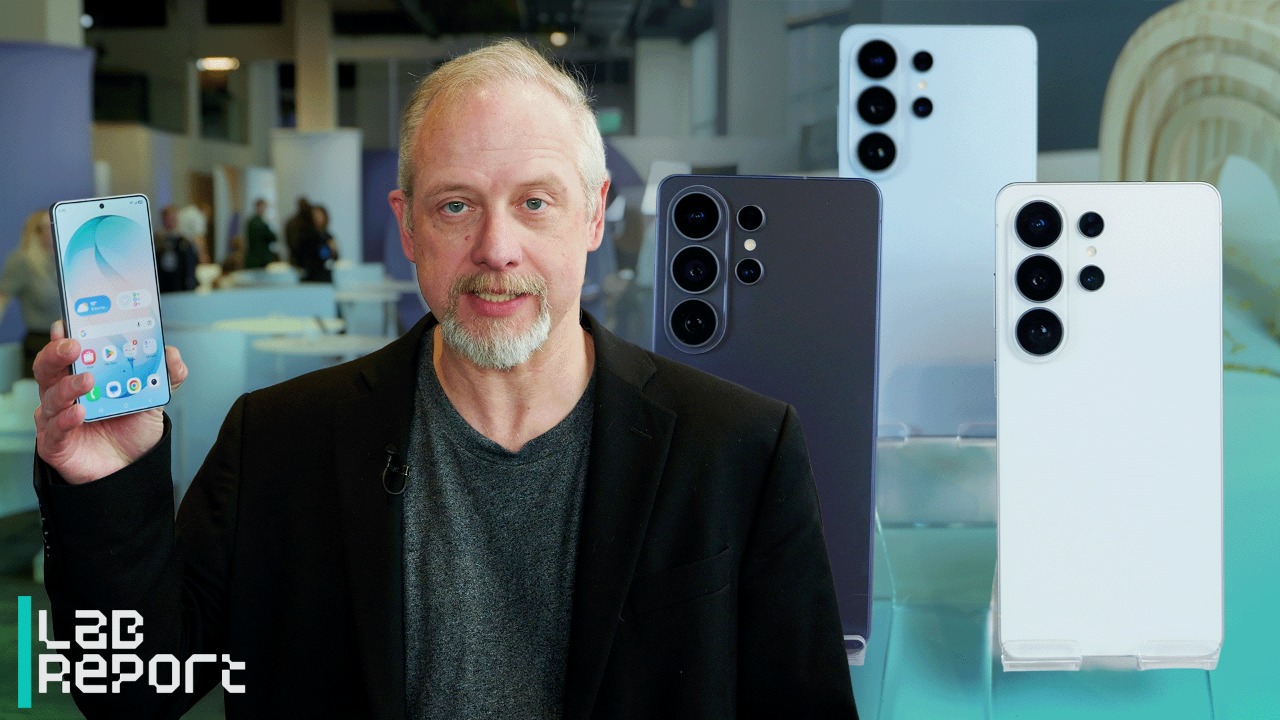

Samsung Galaxy S26 Ultra First Look: The AI Powerhouse Plus a New Display
Apart from those specs, Samsung added a feature called Privacy Display to the Galaxy S26 Ultra. With a tap, the screen’s viewing angle narrows, so people cannot clearly see the screen over your shoulder. This feature can also be applied on an app-by-app basis and/or just to notifications, obscuring part of the screen.
It’s been a long time since we’ve seen practical innovation on slab displays, so Samsung gets the win here. That being said, all of these screens should produce crisp details and smooth animations.
Winner: Galaxy S26
Performance: Expect Them All to Be Fast

Left to right: Samsung Galaxy S26 Ultra, S26+, and S26 (Credit: Eric Zeman)
Every Galaxy S26 model is powered by a Qualcomm Snapdragon 8 Elite Gen 5 for Galaxy, a customized chip not found in the competition. All models offer at least 12GB of RAM, but the 1TB S26 Ultra comes with 16GB of RAM.
We have yet to test the S26 line firsthand, but we expect it to perform similarly to the RedMagic 11 Pro gaming phone, which uses a standard Qualcomm Snapdragon 8 Elite Gen 5 processor. The RedMagic 11 Pro did extremely well on our battery of benchmarks.
The iPhone 17 features an Apple A17, while the Pros use the A19 Pro processor. It’s too early to make a judgment here, but expect greatness from all of these devices.

Get Our Best Stories!
A Smart, Bold Take on the Wireless World

By clicking Sign Me Up, you confirm you are 16+ and agree to our Terms of Use and Privacy
Policy.
Thanks for signing up!
Your subscription has been confirmed. Keep an eye on your inbox!
Winner: Too early to tell
Cameras: Top-Notch Hardware Across the Board

Left to right: Samsung Galaxy S26 Ultra, S26+, and S26 (Credit: Eric Zeman)
Samsung uses the same camera hardware for both its S26 and S26+. They feature a 50MP main shooter, a 12MP ultra-wide lens, and a 10MP telephoto lens with a 3x optical zoom. Considering these are the same cameras in the Galaxy S25 line, we have a good idea of their performance, but their final images will depend on software processing.
The Galaxy S26 Ultra has a 200MP main camera, a 50MP ultra-wide lens, a 50MP telephoto camera with 5x optical zoom, and a 10MP telephoto lens with 3x optical zoom. Every S26 has the same front-facing camera, a 12MP shooter.

Apple iPhone 17 in blue and lavender (Credit: Eric Zeman)
The Apple iPhone 17 features a 48MP main camera and a 48MP ultra-wide lens. Apple claims a 2x optical zoom in and 2x optical zoom out, but the 17 does not have a telephoto camera. The iPhone 17 Pros feature three 48MP rear cameras with a main, ultra-wide, and telephoto lens. All three devices feature an 18MP Center Stage front-facing camera capable of taking vertical or horizontal selfies regardless of phone orientation.
For video capture, the S26 line can record up to 8K resolution at 30 frames per second (fps), while the iPhone 17 can record at up to 4K resolution and 60fps, and the iPhone 17 Pro records at up to 4K resolution at up to 120fps. Both Samsung and Apple tout their Ultra and Pros as cinema-level cameras.
Historically, Samsung and Apple cameras have produced excellent photos and video. However, it is too early to make a call without more data.
Winner: Too early to tell
Batteries: On the Large Side

Left to right: Samsung Galaxy S26, S26+, and S26 Ultra (Credit: Eric Zeman)
Here’s the battery breakdown between the two phones, though Apple does not release battery capacity information.
Recommended by Our Editors


-
Galaxy S26, 4,300mAh battery, charges at up to 25W wired, 15 wirelessly
-
Galaxy S26+, 4,900mAh battery, charges at up to 45W wired, 20W wirelessly
-
Galaxy S26 Ultra, 5,900mAh battery, charges at up to 60W wired, 25W wirelessly
-
iPhone 17, charges at up to 30W wired, 25W wirelessly
-
iPhone 17 Pro, charges at up to 30W wired, 25W wirelessly
-
iPhone 17 Pro Max, charges at up to 30W wired, 25W wirelessly

Apple iPhone 17 Pro Max (Credit: Eric Zeman)
We have yet to test the Galaxy S26’s batteries, but we have tested the iPhone line. The iPhone 17 lasted 24 hours on a single charge, the iPhone 17 Pro lasted 27 hours and 42 minutes, and the 17 Pro Max reached 32 hours and 11 minutes.
Additionally, the iPhone 17 series supports Apple’s MagSafe magnetic charging solution, while the Galaxy 26 line lacks magnets. Again, it’s too early to determine a winner here.
Winner: Too early to tell
Galaxy S26 vs. iPhone 17: Software

Samsung Galaxy S26+ (Credit: Eric Zeman)
Samsung’s Galaxy S26 line runs Android 16 with One UI atop it, while the iPhone 17 series runs on iOS 26. Apart from their basic similarities, they are separated by their AI capabilities. Samsung has made progress with its Galaxy AI suite of AI tools while continuing to partner with Google and Perplexity to get things done. On the S26, Audio Eraser cleans background noise from videos locally, the Gallery app handles prompt-based photo edits, and Now Brief delivers a personalized snapshot of what matters to you.

Apple iPhone 17 Pro Max (Credit: Eric Zeman)
Meanwhile, Apple Intelligence brings helpful features like Visual Intelligence (similar to Google’s Circle to Search), notification summaries, and two-way translation on phone and FaceTime calls. The Siri experience is still a work in progress.
If you don’t care about AI features, then it comes down to your OS preference.
Winner: You
The Rest: Details Always Matter

Samsung Galaxy S26 Ultra with S Pen (Credit: Eric Zeman)
The Galaxy S26 Ultra includes an S Pen stylus that resides within its body. No other phone in this comparison even supports a stylus (not counting capacitive ones).
All iPhone 17s include an assignable Action Button and a touch-sensitive Camera Control that does what its name suggests. No Galaxy S26 has an extra button or physical camera controls.
Every iPhone 17 supports both mmWave and sub-6GHz 5G, as do the S26+ and S26 Ultra. The base Galaxy S26 is limited to sub-6GHz 5G only.
The S26 does not support magnetic wireless charging. The iPhone 17 lineup does.
Winner: Your call
Verdict: Which Phone Is Right for You?
We’ve yet to fully test the Galaxy S26 line, so I can’t give you definitive buying advice for now. However, consider the following when choosing:
-
If you have an older device like a Samsung Galaxy S20 or iPhone 13, any of these devices should be terrific upgrades.
-
If you want the most storage possible on a phone, the iPhone 17 Pro Max is the only phone that comes with 2TB.
-
If that Privacy Display demo wowed you, only one phone has this technology, and it’s the S26 Ultra.
In the meantime, learn more about the differences between the Galaxy S26, S26+, and S26 Ultra, or those between the iPhone 17, Air, 17 Pro, and 17 Pro Max, to help make your decision. And check back soon to read our full reviews of the phones in Samsung’s S26 lineup.