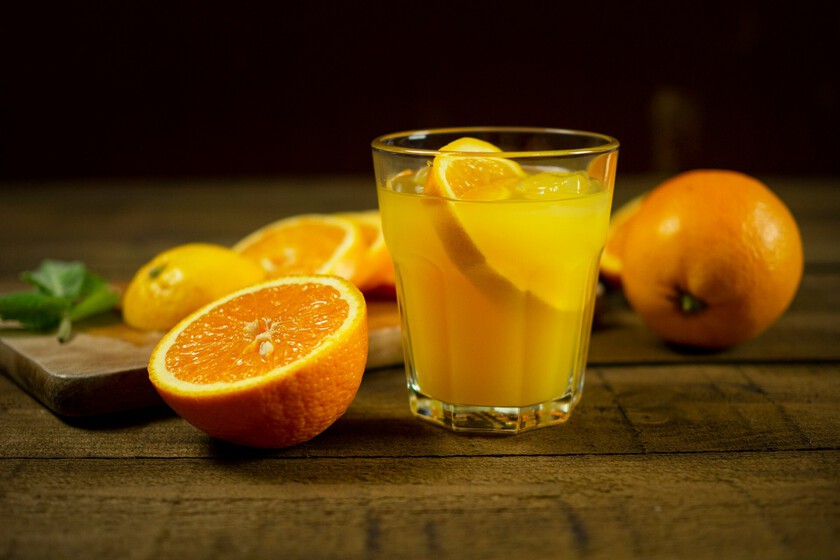
One of the most characteristic images of the ideal breakfast is undoubtedly the freshly squeezed orange juice that they try to place in any cafeteria thanks to it being an icon of health and vitamin C. However, in recent years it has been seen that the way to get the most out of this fruit is to leave it whole and without squeezing it.
The juice is different. A juice, whether natural or bottled, is not the same as fruit, no matter how much they try to sell it to us that way. And the difference is precisely in what ends up in the trash, better known as the food matrix, which has a large number of benefits that we are constantly throwing away.
The matrix rotates. To understand why juice is not the same as fruit, we must understand how our digestive system works in the presence of food. In the case of eating whole fruits, what we eat is a complex “matrix” that has water and fructose ‘trapped’ inside. This is a network of insoluble and soluble fiber that forces our body to work a little in order to absorb the nutrients in between.
The fact of having to ‘search’ for nutrients among the fiber favors a much slower digestion that makes the sugars pass through the body in a more ‘controlled’ manner and not abruptly. But when you squeeze the fruit, this matrix ends up destroyed and the sugars are released from its prison, making it much easier for the body to trap them.
The consequences. For the WHO, intrinsic fructose, the sugar in the fruit itself, is now called ‘free sugars’ since they have nothing to hold them back. In this way, when drinking the juice, gastric emptying is very rapid because there are no solids to process and the result is a large amount of glucose and fructose that reach the bloodstream. Something that represents stress for the body that is not prepared for it.
The glucose curve. While eating whole fruit generates a much more moderate and sustained curve, juice causes an acute glycemic peak, followed by reactive hypoglycemia that awakens hunger shortly after. Although anyone in these cases may think that logically the amount of sugar in both the juice and the fruit is the same, so the behavior of the organism should be identical.
But the reality is quite different, since science has been able to show that although the amount of sugar is identical, the insulin response is significantly greater in the liquid version. For metabolic purposes, the pancreas does not distinguish much between industrial orange juice, homemade one or a sugary soft drink: it detects a flood of energy that it must manage immediately.
What the data says. In this context, science already pointed out in 2014 a figure that should make us rethink breakfast: a greater intake of fruit juice was associated with a 14% greater risk of developing type 2 diabetes. On the contrary, the consumption of whole fruits (especially blueberries, grapes or apples) is systematically associated with a reduction in risk.
The fructose trap. Beyond glucose, which is like the main enemy against health that many of us have in mind, another enemy must be highlighted: liquid fructose. In this case, when it suddenly reaches the liver, it converts its excess into fat, generating uric acid as a byproduct, raising blood pressure and the risk of gout.
In parallel, inflammatory pathways are activated that contribute to insulin resistance in the long term. But the key data is found in a 2025 Chilean analysis that concluded that, although 100% natural juices are “neutral” in small doses, they are consistently inferior to whole fruit in preventing major diseases.
The satiety factor. There is a very interesting relationship between juices and obesity in the act of chewing, as pointed out by different Japanese studies that have shown that the act of chewing not only crushes the food, but also sends satiety signals to the brain. But when we are drinking we skip these control signals to stop eating when the body says it is fine.
If we start talking about figures, a glass of juice requires more or less 2-3 oranges (depending on the size), and it is very easy to drink it in forty seconds. But it is much more difficult to eat three oranges in a row, chewing slice by slice, since we are giving the body time to assimilate that sugar.

It is not absolute evil. Obviously, juice is not poison for the body, but different nuances must be taken into account. Reviews published in 2024 and 2025 suggest that 100% natural juices may have a place in a healthy diet under very specific conditions.
The dose in this case is very important, since it has been seen that small quantities (less than 150 ml per day) do not increase cardiovascular risk and can provide vitamins. The problem is that the usual consumption size is usually double or triple that amount. Furthermore, the context matters since a high-performance athlete who takes that quick energy shot is not the same as a sedentary person already prone to diabetes.
However, general public health advice increasingly aligns with the radical stance: if you have the choice, always choose whole fruit.
Images | Mateusz Feliksik
In WorldOfSoftware | It turns out that a longevity expert has said something that makes sense. And the reason is the juices