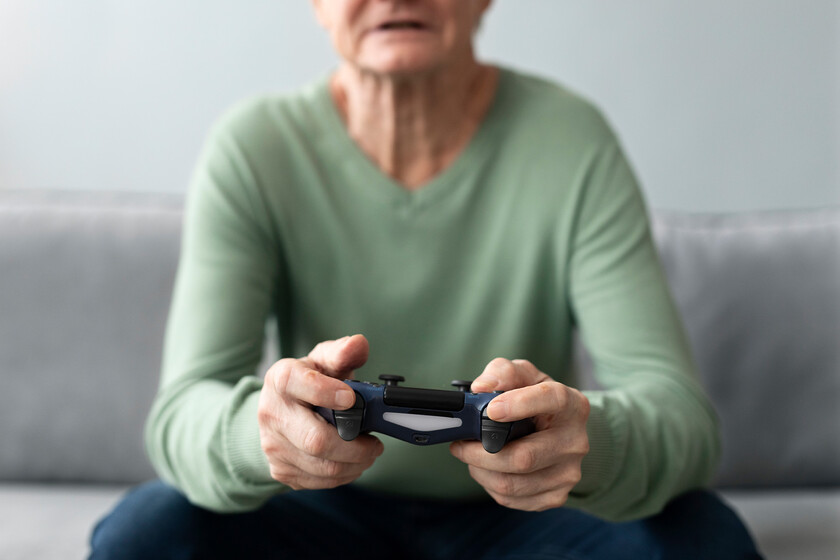
There is something strangely comforting about dissonance. Sometimes, while I’m fighting with a crochet hook trying to make a scarf not end up looking like a dish towel, I like to turn on the TacticalGramma channel in the background. Michelle is 59 years old, a proud grandmother, and while I clumsily count wool stitches, she is annihilating entire squads in Call of Duty: Black Ops 7 with a precision that any teenager would want for themselves.
The scene has that visual irony: technology has not come to isolate us in a basement, but to rescue our neurons from rust. For decades, the social narrative sold us that video games “rot” the brain; Today, science is beginning to suggest that, if you want to reach 60 with good mental agility, perhaps you should take control.
The brain clock. A study published by Nature has managed to compare the health of neuronal connections with the person’s real age – what is known as brain clocks. The team led by Carlos Coronel-Oliveros has discovered that players who are experts in strategy titles like StarCraft II They have a mental structure that is much more resistant to the passage of time.
On average, the brains of these players function with the agility of someone four years younger, according to a statistical estimate based on neuroimaging models. An efficiency phenomenon that neuroscience calls Brain Age Gap (BAG).
When Sudoku is no longer enough. While classic brain games are isolated and repetitive tasks, an action video game forces the brain to manage an avalanche of information in real time. This level of constant demand—planning movements, reacting to attacks, and filtering out distractions simultaneously—forces neurons to reorganize.
To reach this conclusion, the research team used research techniques whole-brain modelingcombining fMRI with machine learning algorithms capable of detecting subtle patterns in connectivity. The results showed more efficient integration in the so-called “frontoparietal hubs”, key regions for attention and executive function that are usually among the first to deteriorate with age.
Changes in brain hardware. This apparent rejuvenation has a physical reflection in the structure of the brain. Science has found that, just as a muscle develops with exercise, certain key areas of players become denser and more robust. Studies in Scientific Reports and Translational Psychiatry reveal that those who regularly play action titles have more “gray matter” in regions responsible for coordination, attention and making quick decisions. It is as if the brain has widened its information highways to react sooner and better to each stimulus.
But the most useful change is the refinement of our visual “filter.” Research in PLOS ONE shows that players develop a superior ability to ignore unnecessary noise. It’s not that they see more, it’s that their brain has learned to process only the information that really matters to win the game, optimizing the energy expenditure of the visual cortex.
The ‘learning to learn’ factor. What is truly significant is not being more precise within the game, but the impact on the ability to continue learning. A study in Communications Biology showed that training with action video games accelerates the speed at which people learn new tasks, even when they are unrelated to the game.
As psychologists Daphne Bavelier and C. Shawn Green explain, these games train the brain’s attentional control. The result is improved cognitive adaptation, valuable in an ever-changing technological world. But experts still debate the degree of “far transfer”—that is, the extent to which being a keyboard whiz makes you better at managing a real crisis or a complex spreadsheet.
When the benefit runs out. Even so, it is advisable to lower your enthusiasm. Most of these studies are correlational: they do not allow us to say with certainty whether playing transforms the brain or whether certain already “agile” brain profiles are more inclined to enjoy video games. Furthermore, the effects vary depending on age and life context.
Side B is not minor either. Researchers warn that excessive exposure can cause cognitive fatigue and sleep disturbances. The World Health Organization recognizes gaming disorder as a real problem when gaming becomes a compulsive behavior. The neural benefit depends on the balance that if the challenge stops being stimulating and becomes automatic or addictive, the protective effect disappears.
Not just any game will do. Another key point is that not all video games produce the same effects. The strongest benefits are seen in action and real-time strategy games, which require quick decisions and multitasking. As experts point out, once a game stops being difficult and becomes mechanical, brain plasticity stagnates. Speed and time pressure seem to be essential ingredients for keeping machinery in shape.
There is something hopeful about seeing someone like TacticalGramma master a digital environment. The science doesn’t say that video games are a panacea, but it does suggest that brain aging doesn’t have to be a one-way path to decline. Perhaps the secret to a healthier brain is not in a pill, but in our ability to continue to face what is difficult and accept the frustration of constant learning. For now, I’m going to leave crocheting for a while.
Imagen | Freepik
WorldOfSoftware | The art of self-deception: why our brain defends our mistakes even if it knows we are wrong