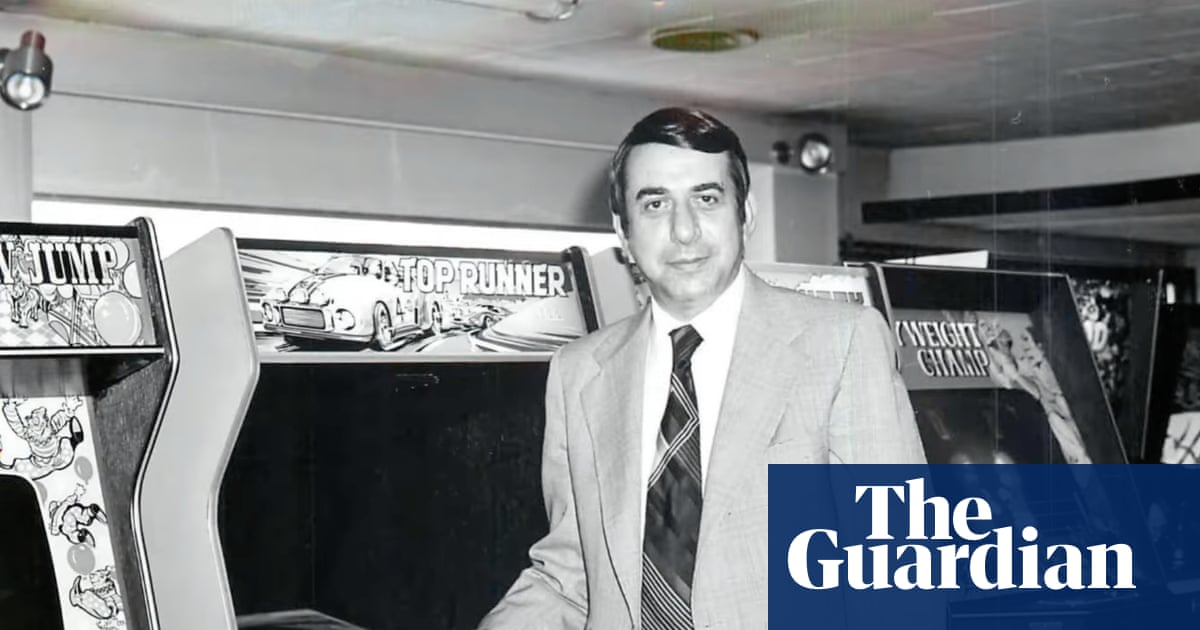
It is difficult to think of a more influential figure in the arcade game industry than David Rosen, who has died aged 95. The co-founder of Sega, who remained a director of the company until 1996, was instrumental in the birth and rise of the video game business in Japan, and in the 1980s and 90s oversaw the establishment of Sega of America and the huge success of the Mega Drive console.
As a US Air Force pilot during the Korean war, Rosen found himself stationed in Japan, and once the conflict was over, he stayed on, intrigued by the country and seeing possibilities in its recovering economy. In 1954 he set up Rosen Enterprises and noticing that Japanese civilians now required an increasing number of new ID cards he started importing photo booths from the US to answer the demand. From here he expanded to pinball tables and other coin-operated machines, importing them for installation in shops, restaurants and cinemas. In 1965, he merged the company with another importer, Nihon Goraku Bussan, whose coin-op business Service Games was shortened to Sega for the new venture.
For the next 15 years, Sega innovated in the arcade sector, switching from importing games to designing its own, and moving on from jukeboxes and pinball tables to electromechanical arcade games such as the submarine shooting sim Periscope and, in 1972, Killer Shark, a shark hunting game which would briefly feature in Jaws. Sega also began to set up its own arcades allowing the company close control over every facet of its business.
One of Rosen’s great skills was in finding and employing people who instinctively understood where games were heading. In 1979, he spotted rising industry star Hayao Nakayama, director of Esco Trading, another arcade company. As Rosen explained to me in 2013: “Nakayama was very active as a distributor at the time – he was someone I felt was very astute and was quick to adapt to what was happening in the industry, and I wanted him – we did it via an acquisition of his company. By assimilation, we had him and the staff join us.” Nakayama would go on to be the president of Sega Japan during its heyday from 1983 to 1998.
During this time, Sega rose from a competitor alongside fellow arcade manufacturers Namco, Capcom, Taito and Konami, to an industry leader. Its sleek, stylish coin-ops of the 1980s – Outrun, Space Harrier and AfterBurner – changed the image of arcades from nerdy hideouts to cool aspirational hangouts, while 1990s titles Virtua Racing and Virtua Fighter established the company as a technological powerhouse.
From the late-1970s, Rosen pursued a new market: home TV games. He encounter a major rival, Nintendo, which dominated with its Color TV-Game console, and later the Nintendo Entertainment System. When Rosen returned to the US in the early 1980s, he was determined to take a slice of the global console industry from his Kyoto-based competitor. “Nintendo was responsible for the revival of the home console market after the Atari collapse of 1983,” he told me. “We wanted to see if we could make a device that would be competitive. Unfortunately our first attempt failed to compete. It was just made up of off the shelf parts, it wasn’t until 1986 that we brought out the Master System …”
This machine would struggle in the US but was huge in Europe and South America, and Rosen spotted a niche. While Nintendo was all about family entertainment, the titles doing well on the Master System were teen-focused brawlers, such as Golden Axe and Shinobi. When it came to release the new Sega Mega Drive console in Japan in 1988, Rosen insisted on changing its name to Genesis for the US launch, emphasising a new beginning and a more mature outlook. He also brought in Michael Katz an experienced exec from Mattel and early console company Coleco.
“We were up against the wall in terms of time,” he said. “I had known Michael from some of the other endeavours he was involved in, he had all this experience from Coleco and he certainly knew the players. I thought he could help launch the product and at the same time bring structure to the company, which he did.” Spurred on by Rosen’s vision, Katz marketed the Genesis as a games console for teenagers, not children, using TV ads which combined video game visuals with flashing images and rock music and the immortal phrase: Genesis does what Nintendon’t. When Tom Kalinske took over as CEO Sega of America in 1990, he oversaw a new series of equally famous ads which almost always ended with someone screaming “Sega!”
Rosen would stay active in the company in various senior roles until retiring in 1996. Although Sega’s home console business would falter in this period due to the rise of the Sony PlayStation, the company’s arcade supremacy remained for the rest of the decade. I spoke to him in 2013 while writing the book Sega Mega Drive Collected Works. As a lifelong Sega fan, my hour-long chat with him that day was a career highlight. He talked fondly about his time in Japan, the people he worked with and his journey through the industry. He told me with considerable glee that while out and about in his home town of Los Angeles, strangers would still shout ‘Sega!” at him when passing on the street.