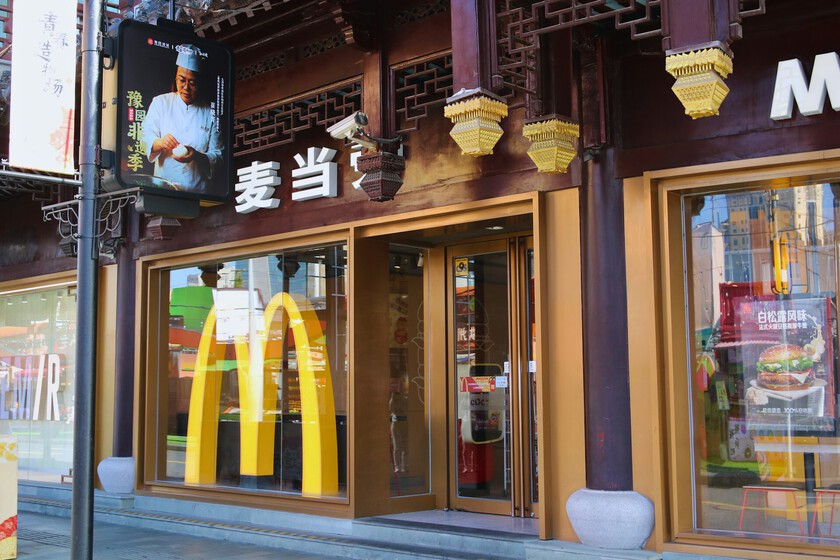
Eating alone outside the home has its own particular casuistry and I know this because I have had to travel without companions many times, enough to develop a filter of places that do and others that don’t. Among those running for office, there is no shortage of leaning on one side of a tavern bar to have a quick pintxo at a small table at Starbucks, passing by a more or less discreet table at McDonalds for a quick refueling.
I want to eat my burger alone. About looking for a small table or one little corner It has its logic: eating has its intimate and shameful part reinforced by the feeling of “not wanting to bother” because well, although in theory any restaurant is suitable for a person to eat, in practice they may not be interested in having a table of two or four wasted with only one diner. On the other hand, you can also enjoy your food at your leisure. In China’s McDonald’s, these individual positions are already among the most sought-after.
The arrangement itself is not new (and it does not necessarily have to seem like a punishment) nor does it have to go hand in hand with those seats shaped like bicycle saddles or reducing them to a minimum to save space, but with high tables with a screen that gives a feeling of false intimacy for solitary diners. The phenomenon has been widely reported on social networks such as Xiaohongshu or Weibo, the counterparts of Instagram and Twitter: the Shanghai news outlet Kankan News collects some of the best in a video.
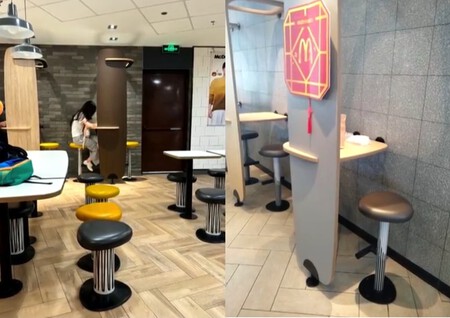
The McDonalds screens. Kankan news
What false intimacy hides. In short: these screens make it very easy for you to avoid having to act Swedish to avoid the uncomfortable situation of meeting an acquaintance and having to greet them until you meet them. You sit there discreetly and eat without interaction.
The Shanghai media collects testimonies from psychology professionals who explain the phenomenon: social interaction is risky for them compared to chats, where you can edit or delete what you say; and as a refuge after the inevitable social exposure after work, where they have the obligation to be friendly and smile due to social imposition.

To the youth Chinese society ignores social interaction. The China Youth Daily interviewed 2,000 people between 18 and 35 years old and the result was overwhelming: 64% feel lost when they meet people offline. The percentage is even higher in this 2023 survey of 1,438 Chinese people born between the decades of 1980 and 2000: more than 80% reported feeling anxious in social interactions.
Time magazine has put it in perspective because the phenomenon is much more than eating alone: Chinese society has gone from traditionally living with family nearby (even sharing a roof) to the younger generations embarking on their lives alone after leaving their homes in rural areas to work in big cities. The maximum and most tragic expression is the success in downloads of the app “Are you dead?”.
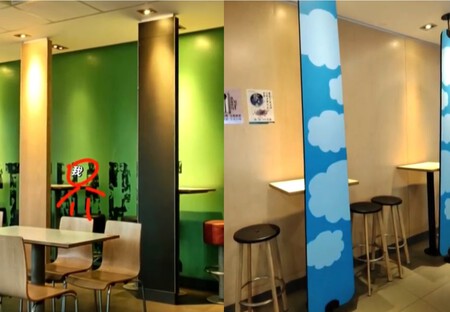
The McDonalds screens, part two. Kankan news
The economics of social phobia is here. China has seen a dramatic shift in the number of people living alone, with more than 100 million single-person households, according to the China National Bureau of Statistics’ annual report for 2024. By 2030, they estimate the number will rise to 150-200 million.
And the economy is adapting to this paradigm shift: according to the research firm iResearch, the economy of social anxiety in China already moves approximately 172 billion dollars in initiatives such as carts with “Do not disturb” signs to keep out product promoters in Freshippo supermarkets (owned by Alibaba), gyms and 24-hour stores without staff where everything is managed with QR codes without crossing a word with anyone.
In WorldOfSoftware | The future of delivery lies in group orders with your neighbors: China is already experiencing it
In WorldOfSoftware | China is filling up with “quadricycles” that do not require a driving license. And they are a problem for road safety
Cover | Bruna Santos