
In financial services, the challenge isn’t showing up on social media. It’s doing it right — while staying on top of compliance, security, and trust.
In this guide, we’ll cover how financial services use social media, what platforms are worth your time, and what it takes to build a strategy in 2026.
Key takeaways
- Gen Z is turning to social media for financial advice. It’s where they learn the basics, follow financial creators, and research brands.
- Each social media platform has its own job. LinkedIn is best for executive voices, X for real-time commentary, TikTok for snappy videos, and YouTube for longer-form content.
- Finance brands must stay compliant on social media. Teams need clear posting rules, approval workflows, and social media policies.
- Hootsuite makes it easier to manage social media safely. Teams can monitor brand mentions, control permissions, automate approvals, and archive content — all in one place.
Financial services use social media for marketing, customer service, sales, and more.
In practice, social media shows up in a few core ways:
- To educate: Financial brands can build credibility through thought leadership and helpful content, from bite-sized TikTok videos to longer LinkedIn posts.
- To support marketing: Social media is an easy way to promote content, reach new audiences (like Gen Z), and connect with people at every stage in the customer journey.
- To generate leads: Social media opens up new avenues to meet prospects. Brands can start conversations, build brand awareness, and turn connections into leads over time.
- To provide customer support: Many financial companies use social media to offer real-time support. Customers can ask questions, raise issues, and get help across social media channels.
- To listen: Through the power of social listening, teams can track trends, see what customers are talking about, and watch competitor activity.
TL;DR: For financial brands, social media is a cross-functional tool that helps marketing, sales, and customer experience teams all at once.
#1 Social Media Tool for Financial Services
Grow your client base with the tool that makes it easy to sell, engage, measure, and win — all while staying compliant.
Book a Demo
Financial services should use social media because it plays a growing role in how people learn about finances and decide who to trust.
Here are the main benefits of using social media in financial services:
1. Reach new audiences
If you want to reach younger generations, social media matters.
Gen Z already uses social platforms to learn about money, and they’re starting to hit major milestones that deserve financial advice.
In fact, 47% are already saving for retirement. And 86% use a financial services website or app to check balances and pay bills.
Social media is often the first place this audience goes for financial information, so it’s important to show up early.
2. Strengthen relationships
When it comes to finances, people want to work with someone they know and trust. Social media makes it easier to build those relationships over time.
This kind of relationship-building is known as social selling.
For instance, you might see when someone starts a new job, retires, or launches a business. (LinkedIn makes these moments easy to spot.)
If a connection shares good news, send a quick congratulations. If they post a question or concern, share a useful resource. Just don’t rush into a pitch.
Ultimately, social selling is about building relationships. Sales are a longer-term goal.
3. Highlight brand values and build trust
People aren’t just focused on returns anymore. They want to understand how their money is being invested and what it supports.
That’s why interest in sustainable investing is at an all-time high. According to a recent Morgan Stanley report, 99% of Gen Z and 97% of millennials say they’re interested in this type of investment.
When people understand a brand’s values, they feel more confident in who they’re working with.
Trust in financial services has improved over the past decade. Even so, it’s still one of the least trusted industries, according to the 2026 Edelman Trust Barometer.

Source: 2026 Edelman Trust Barometer
Social media gives financial brands a chance to close that gap. It’s a place to explain decisions, talk about values, and respond to real concerns in real time.
4. Humanize your brand
People want to deal with trusted financial experts, not brands that feel cold and distant. Social media offers the opportunity to sound more human.
Getting your company’s executives on social media can be a great place to start. In fact, 82% of people are more likely to trust a company when its senior executives are active on social media.
5. Gain key industry and customer insights
Try using social media for financial services industry research. This is a good way to stay on top of what’s happening in your field.
Are competitors launching new financial products? Is a topic starting to pick up speed? Social media can act like an early warning system.
Social listening tools can help you spot these trends faster. They surface what people are talking about, and where sentiment is shifting.
You can also use social listening to learn more about your target audience, including demographics, interests, and pain points. What do your customers care about? What are they confused by? What do they want more of?
Don’t forget your own data, either. Social media analytics show you what’s working and what’s not. Over time, those insights help you adjust your strategy and focus on what actually resonates.
6. Reduce effort and costs
Social media works best when everyone — teams, departments, and individual advisors — work from the same playbook.
That usually involves a shared social media management platform.
A shared content platform, like Hootsuite Amplify, gives employees access to pre-approved, compliant content that’s ready to post. For brands, that means peace of mind knowing messaging is on point and on brand.
With the right tools in place, social media becomes a lot less stressful.
7. Provide unified digital customer service
As financial services brands become more digital, customer service needs to keep up.
Customers want to reach out on the platforms they already use. That might be Facebook, Instagram, or messaging apps like WhatsApp. When questions come up, they don’t want to jump between channels just to get help.
Social customer service tools help you manage messages across all channels. It’s a good idea to connect those conversations to your CRM, which helps with compliance, response times, and record-keeping.
With Hootsuite Inbox, you can bridge the gap between social media engagement and customer service — and manage all of your social media messages in one place. This includes:
- Private messages and DMs
- Public messages and posts on your profiles
- Dark and organic comments
- Mentions
- Emoji reactions
… and more.
The all-in-one agent workspace makes it easy to:
- Track the history of any individual’s interactions with your organization on social media (across your accounts and platforms), giving your team the context needed to personalize replies
- Add notes to customers’ profiles (Inbox integrates with Salesforce and Microsoft Dynamics)
- Handle messages as a team, with intuitive message queues, task assignments, statuses, and filters
- Track response times and CSAT metrics

Plus, Inbox comes with handy automations:
- Automated message routing
- Auto-responses and saved replies
- Automatically triggered customer satisfaction surveys
- AI-powered chatbot features
8. Drive business results
Social media plays a real role in how people make financial decisions.
It starts with young adults. 42% of Americans under 30 say they get financial advice from social media, according to a new Gallup poll. And 23% follow a personal finance content creator (known as finfluencers).

Source: Gallup
Even people who already work with an advisor are turning to social. Roughly 45% of U.S. consumers who have a financial advisor use social media to learn more about financial planning.
For financial services, the opportunity isn’t just to show up on social media — it’s to show up with helpful content at every stage of the customer journey.
The best social media platforms for financial services include LinkedIn, X (Twitter), TikTok, and YouTube.
Each platform offers a different audience, content style, and conversation. So, picking the right platform will depend on your unique audience and goals.
Let’s take a look at each platform and what it does best.
LinkedIn has over 33 million finance-minded members. That’s a lot of people who work in, think about, or study finance.
The platform also reaches 2.8x more business decision-makers than other major business sites, including The Wall Street Journal and Forbes. So you’re not just reaching a big audience, you’re reaching people who make real decisions.
LinkedIn is best for:
- Amplifying executive voices
- Sharing insights and longer perspectives
- Reinforcing expertise and trust
- Supporting lead generation
- Recruiting
People come to LinkedIn to learn. That’s what makes the platform ideal for thought leadership and long-form educational content.
Leaders can take it one step further by linking out to a longer piece of marketing content (think: blog post or research report) to drive traffic — like in the example below:

Source: Solita Marcelli
X (Twitter)
X is a fast-moving platform used for live conversations and real-time updates.
It’s best for:
- Commenting on news and industry trends
- Sharing observations from events and conferences
- Sharing company updates
The platform rewards clear opinions and strong POVs. For example, when leaders share what they’re noticing in real time, they often spark bigger conversations (which = more engagement).
You can see this in action from Patrick Collison, CEO of Stripe, who drops a few observations on changes he’s seeing in the industry.

Source: Patrick Collison
TikTok
TikTok is becoming hard to ignore, especially for finance brands that want to reach younger audiences.
It’s best for:
- Explaining topics in simple, everyday language
- Increasing brand awareness with storytelling
- Reaching new audiences via the algorithm
Quick disclaimer: TikTok content works best when it feels native to the platform. That means casual language and humor, like in this video from Cash App:

Source: Cash App
YouTube
YouTube is the leading platform for long-form videos, making it home base for content like podcasts, explainers, and more.
It’s best for:
- Educational videos
- Product walkthroughs and demos
- Interviews, webinars, podcasts, and discussions
Because YouTube content has a longer lifespan than most social posts, it also plays an important role in SEO and trust-building.

Source: Coinbase
Financial services teams can build an effective social media marketing strategy by following four core steps:
- Implement a social media policy
- Focus on compliance
- Archive everything
- Conduct a social media audit
1. Focus on compliance
FINRA, FCA, FFIEC, IIROC, SEC, PCI, AMF, GDPR — all the compliance requirements can make your head spin.
That’s why it’s critical to have compliance processes and tools in place, especially to guide independent advisors’ use of social media.
Get your compliance team involved as you develop your financial services social media strategy. They’ll have important guidance on the steps you need to take to protect your brand.
It’s also important to have the right chain of approvals in place for all social media posts. For example, FINRA states:
“A registered principal must review prior to using any social media site that an associated person intends to use for business.”
2. Archive everything
This falls under compliance, but it’s important enough that it’s worth calling out on its own.
Financial firms are required to keep records of communications related to their business. According to FINRA, those records need to be stored for at least three years.
Hootsuite’s integrations with compliance solutions like Brolly and Smarsh automatically archive all social media communications. You’ll have your social media content stored in a secure and searchable database, complete with the original context.
3. Conduct a social media audit
In a social media audit, start by listing every social profile your team uses. That includes official brand accounts, team accounts, and any department-specific pages.
At the same time, hunt down any impostor or unofficial social media accounts so you can have those shut down.
While you’re at it, note the platforms where you don’t have a presence yet. Even if you’re not ready to post, it’s often smart to claim your brand handles early.
We created a free social media audit template to help keep all your research organized as you tackle this work.
4. Implement a social media policy
A social media policy guides social media use within your organization. That includes accounts for your advisors and agents.
To build a strong policy, loop in the right teams early. That usually includes:
- Compliance
- Legal
- IT
- Information security
- Human resources
- Public relations
- Marketing
All these teams should have input. This will help you maintain a consistent brand identity while reducing compliance challenges.
Your policy should also spell out roles and approvals. Who can post? Who needs to review content? How does a post move from draft to published? Clear answers upfront help avoid confusion and slowdowns later.
Finally, don’t forget about security. Social media comes with real risks. Your policy should cover basics like password rules, access controls, and how often tools and software should be updated.
It may not be the most exciting part of social media, but it’s one of the most important.
Bonus: Download a free bundle of social media tools designed specifically for financial services — including post ideas and templates for social media policies, strategies, and reports.
How often should you post on social media in financial services?
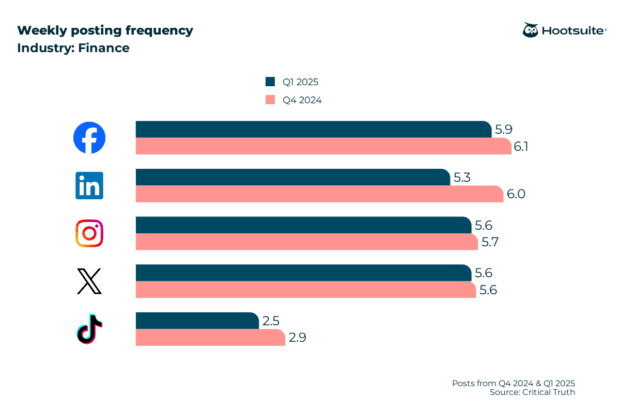
Our research found that financial institutions post on Facebook more often than on other social platforms — an average of 5.9 times a week. Instagram and LinkedIn follow, with an average frequency of 5.6 and 5.3 posts per week.
That said, every financial institution’s ideal posting schedule is unique, and you should test different posting frequencies to find out what works best for your audience. Use these industry-specific stats as a starting point.
Average engagement rates in financial services
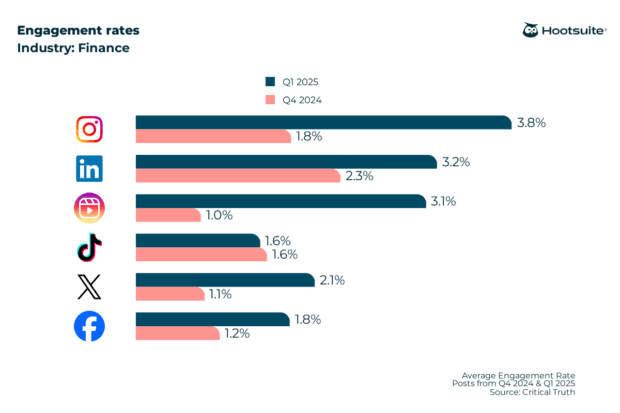
Here are the industry averages across all major social networks as of March 2025:
- Instagram: 3.8%
- LinkedIn: 3.2%
- Instagram Reels: 3.1%
- TikTok: 1.6%
- X (Twitter): 2.1%
- Facebook: 1.8%
Follower growth rate in financial services
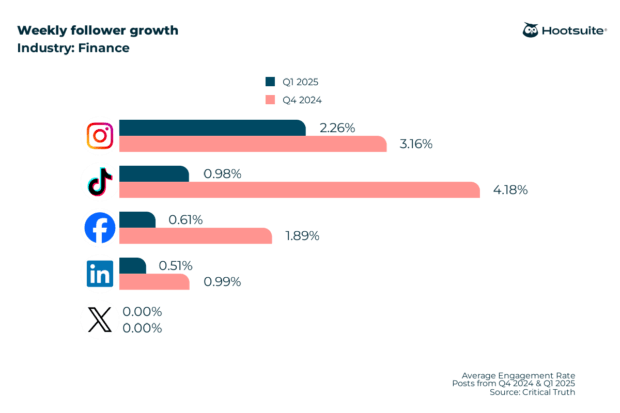
Here are the industry averages for FinServ brands in 2025:
- Instagram: 2.26%
- TikTok: 0.98%
- Facebook: 0.61%
- LinkedIn: 0.51%
- X (Twitter): 0%
For more FinServ-specific research, including the best times to post, the most engaging content formats, and network-specific breakdowns of the stats above, check out our dedicated post on social media benchmarks for financial services.
The best social media marketing campaigns in financial services tend to focus on education, storytelling, and showing up consistently.
Here are a few examples to see what that looks like in practice.
1. Current x MrBeast
Current is a financial services company that primarily offers mobile banking services through an app. To build brand awareness, they partnered with high-profile influencers, including Hailey Bieber and Logan Paul.
In particular, they developed an ongoing collaboration with the influencer MrBeast.
Two of the resulting social videos reached the number 1 top trending video spot on YouTube. As a result of the campaign, Current saw a 700% increase in money requests through the app and became the number 5 finance app in the Apple App Store.

Source: MrBeast
2. BNY Mellon #DoWellBetter
BNY Mellon created the #DoWellBetter campaign to spotlight the positive impact its clients are making.
Featuring beautiful portraits and video interviews, the campaign showed how smart investing and thoughtful wealth management helped clients create positive change.

Source: bnywealth
This is a good example of how financial brands can use client stories to build a more human connection on social media.
3. Vanguard Group #GettingSocial
Investment company Vanguard Group runs a weekly social video series to share clear, helpful insights on investing and other financial topics.
The consistency is a big part of why it works. Posting on a regular schedule helps followers know what to expect and gives them a reason to come back each week.
These short-form videos deliver useful takeaways without asking for a big time commitment — perfect for busy audiences.

Source: Vanguard Group
Vanguard also supports this content with social ads on similar topics. That way, people see both educational and conversion-focused content working together.
FAQ: Social media in financial services
How do financial services companies use social media safely and compliantly?
Financial services companies use social media safely by using a tool like Hootsuite. It allows teams to set up approval workflows, control who can post, monitor brand mentions, and archive content for compliance. This makes it easier to use social media safely.
What social media platforms work best for financial services marketing?
The best social media platforms for financial services depend on the goal. LinkedIn works well for professional insights and executive voices. X is useful for real-time updates. TikTok helps explain ideas in engaging, short videos. YouTube is best for longer, more in-depth content.
What are social media best practices for banks, insurance companies, and financial institutions?
The best social media practices in finance focus on education, consistency, and caution. Teams share helpful content, follow a clear approval process, and avoid posting anything that could create risk.
How do financial services teams manage social media risk and compliance?
Financial services teams manage risk by creating approval workflows, social media policies, and access controls. Many also use tools that track activity and store records automatically, so nothing gets missed.
What are examples of successful social media strategies in financial services?
Successful strategies focus on being helpful and consistent. This includes sharing thought leadership and educational content, using leaders as trusted voices, responding to customers on social channels, and matching content to each platform.
Hootsuite makes social media marketing easy for financial service professionals. From a single dashboard, you can manage all your networks, drive revenue, provide customer service, mitigate risk, and stay compliant.