As cryptocurrency adoption accelerates globally, the gap between traditional finance and Web3 remains one of the industry’s most persistent challenges. While blockchain infrastructure has matured dramatically, the simple act of converting fiat to crypto and back continues to create friction for millions of users and businesses.
Ramp Network has spent eight years addressing this fundamental problem, building the financial pipes that connect 150+ countries to the crypto economy.
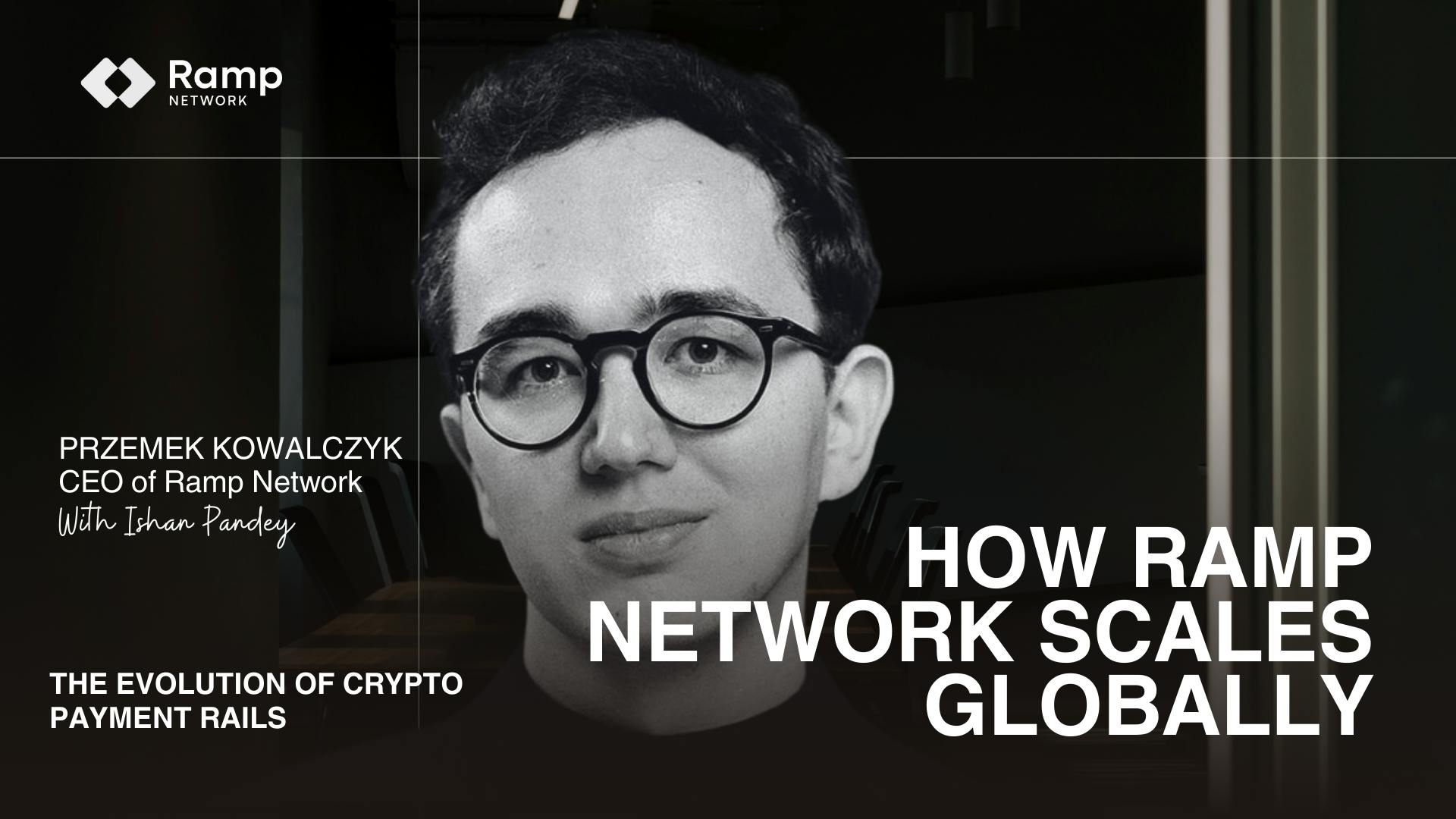
In this interview, we sit down with Przemek Kowalczyk, co-founder and CEO of Ramp Network, to discuss the technical and business complexities of crypto onboarding, the evolution of payment infrastructure, and what it takes to build compliant, user-friendly financial products in an industry that moves at breakneck speed.
Ishan Pandey: Hi Przemek, welcome to our “Behind the Startup” series. With a background spanning physics, computer science, and data science at BCG, what led you to identify crypto onboarding as the problem worth solving for the next eight years?
Przemek Kowalczyk: In the 21st century, humans live in what is effectively a global village, yet we still interact through highly formalised, centralised institutions and intermediaries – often not acting in our best interest. Crypto introduced a vision of cooperating far more easily at a massive scale. It promised new ways to solve problems society still struggles with today: how to prove and share identity in an AI age that can fabricate almost anything, how to fund under-supported public goods like open-source software, or how to send money to family members living under authoritarian regimes.
I’ve always subscribed to that vision and wanted to help bring that future closer to reality. Over time, it became clear that crypto on-ramping was consistently the key blocker to adoption. People could see the potential, but without a simple, reliable way to enter the ecosystem, progress stalled. Adding the small but essential pebbles that make the path into crypto easier to walk was, and still is, our mission.
That perspective was reinforced during my time at BCG, where I worked on large-scale systems and saw firsthand that distribution and infrastructure often matter more than pure innovation. It became obvious that fiat-to-crypto conversion was the core bottleneck holding the entire ecosystem back. If people couldn’t move between the traditional financial world and crypto reliably, nothing else could scale.
That’s what led me to focus on onboarding. I believe infrastructure, not narratives alone, is what turns new technology into something people actually use. If we can remove friction at the entry point, we can help accelerate the entire ecosystem forward, one small but meaningful step at a time.
Ishan Pandey: You founded Blockchain Hub Warsaw before Ramp Network. How did building a non-profit community around Poland’s blockchain ecosystem inform your understanding of the friction points users and businesses face when interacting with crypto?
Przemek Kowalczyk: Community is fundamental to building anything genuinely new and innovative. A single founder or a single startup is never enough. Progress happens much faster, and is far more enjoyable, when you build alongside others who challenge your assumptions and share their experiences.
Building Blockchain Hub Warsaw gave me direct exposure to crypto startups trying to market to everyday consumers, most often unsuccessfully. Even highly motivated users would drop off at the exact same moment, when they asked – “Ok, looks cool! But how do I buy this “Ethereum” to use this product?”, “Why is it so complicated to start?”.
That experience made one thing very clear. Education alone wasn’t enough. You could explain the technology perfectly, but if the tools were confusing, unreliable, or felt untrustworthy, people simply wouldn’t move forward. The barriers were practical, not conceptual.
The community also highlighted how important trust really is. Local payment methods, clear regulatory status, and predictable user flows mattered just as much as the underlying technology. That feedback directly shaped Ramp Network’s early focus on user experience and compliance. We learned that if you want adoption, you have to meet people where they are, not where the technology wishes they were.
Ishan Pandey: Eight years is a significant timeframe in crypto, almost an eternity. How has the fundamental problem of fiat-to-crypto conversion evolved since you started Ramp Network and what core challenges remain unsolved today?
Przemek Kowalczyk: When we started, fiat-to-crypto conversion was slow, expensive, and often unreliable. Payments failed frequently, settlement took days, and users were pushed toward centralized exchanges even when they simply wanted to interact with an app or protocol.
A lot has improved since then. Payment methods are faster, compliance frameworks are clearer, and stablecoins have changed how value moves on-chain. But the core challenge remains the same: making access simple, predictable, and global. Today, the problem is less about whether users can onboard, and more about whether the experience feels trustworthy and seamless enough to become habitual. That’s still the gap we focus on closing.
For us, that insight increasingly points toward something more account-like rather than purely transactional. People don’t want to think in terms of onboarding or offboarding. They want a place where they can hold value, move it, and use it when needed. That’s the direction we’re exploring with our app, built around a stablecoin account that brings buying, selling, swapping, sending, and withdrawing into a single flow, powered by the same infrastructure we’ve spent years building.
Ishan Pandey: Operating across 150+ countries means navigating drastically different regulatory environments, payment infrastructures, and banking relationships. What are the biggest operational complexities most people don’t see when building a global on/off-ramp solution?
Przemek Kowalczyk: The complexity is mostly invisible to end users, which is exactly how it should be. Every country has its own payment rails, banking expectations, risk thresholds, and regulatory interpretations. What works in one market may fail entirely in another.
Behind a single “Buy” or “Sell” button, you’re coordinating identity checks, fraud prevention, liquidity, FX, local payment methods, and compliance rules that change constantly. The hard part isn’t just building those systems, but keeping them reliable at scale. Doing this well means investing heavily in partnerships, monitoring, and operational resilience, not just code.
Ishan Pandey: Regulatory compliance in crypto is notoriously complex and constantly shifting. How does Ramp Network balance the need for seamless user experience with the stringent requirements of financial regulators across different jurisdictions?
Przemek Kowalczyk: We design compliance as part of the product, not something bolted on at the end. If compliance feels intrusive or confusing, users lose trust. But if you build flows that are clear, predictable, and proportionate, regulation doesn’t have to come at the expense of usability.
Our approach is to build modular systems that adapt to local requirements while keeping the core experience consistent. Regulation varies by region, but user expectations don’t. The goal is to meet regulatory standards fully in the background, while users experience something that feels as close as possible to modern digital payments.
Ishan Pandey: Looking ahead, what do you see as the next major evolution in crypto payment infrastructure? What bottlenecks need to be solved before crypto payments can truly compete with traditional payment rails for everyday transactions?
Przemek Kowalczyk: The next phase is abstraction. Users shouldn’t need to think about chains, gas fees, or settlement mechanics. They should just move value. Stablecoins are already pushing us in that direction, especially for payments and everyday use cases.
The remaining bottlenecks are reliability, cost predictability, and integration into familiar financial tools. Crypto payments need to feel boring in the best possible way. When sending digital value feels as normal as using a card or bank transfer, that’s when crypto infrastructure truly competes with traditional rails.
Ishan Pandey: For founders building in the intersection of traditional finance and Web3, what lessons from your eight-year journey would you highlight as most critical for long-term success?
Przemek Kowalczyk: User first. Always start from what people actually need, not from what technology looks exciting at a given moment. In finance especially, users don’t want novelty for its own sake. They want systems that work, that feel safe, and that don’t surprise them in bad ways.
That mindset leads to building for durability rather than chasing hype cycles. Regulation shouldn’t be treated as an external obstacle, but as a design constraint that helps shape better, more trustworthy products. Distribution and trust end up mattering far more than clever features if you want anything to scale beyond early adopters.
Over time, we also learned to prioritise reliability before adding new functionality. Staying close to users, especially during quieter market periods, is often where the most valuable insights come from. Infrastructure businesses don’t grow overnight, but they compound steadily. If you build patiently and focus on the fundamentals, they tend to last much longer than faster, flashier projects.
Don’t forget to like and share the story!
:::tip
This author is an independent contributor publishing via our business blogging program. HackerNoon has reviewed the report for quality, but the claims herein belong to the author. #DYO
:::
n