Humanoid robotics has been feeding the same promise for years: the more a robot resembles a person, the more useful and more natural it will be at our side. That is why we have learned to associate humanoids with increasingly stylized bodies, increasingly realistic movements, and an aesthetic that seeks to erase the border between machine and assistant. However, this race towards similarity is not the only possible direction. In this context, proposals have begun to appear with a different objective: to design robots that do not try to impress with their strength or agility, but rather with their ability to be safe and approachable.
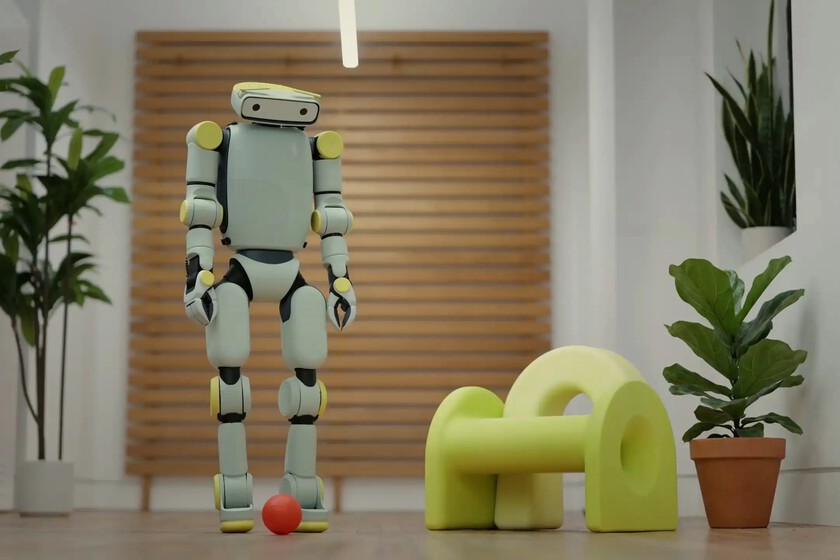
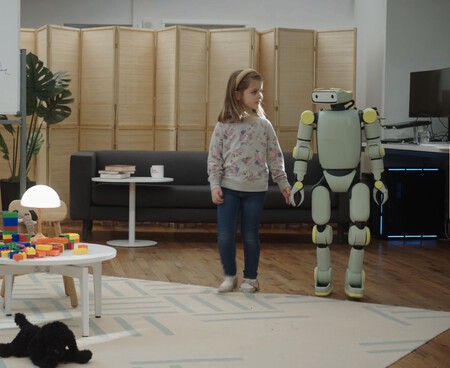
the robot. Fauna Robotics has presented Sprout, a humanoid robot with a different approach than the one that usually dominates the conversation. Instead of promising a “person robot,” the company insists on something more concrete: building a humanoid capable of being close to people and functioning safely in human spaces. His idea is that the future of robotics is not only played in the factory, but in homes, schools, offices and places of passage, where interaction matters as much as mechanical capacity. And there, they maintain, the resemblance to a human being is not everything: to earn a place in that environment, Sprout needs to move with control, avoid dangerous situations and communicate in an understandable way, with gestures and signals that invite you to approach, not to move away.
Soft, human-scale design. Sprout measures 107cm and weighs 22.7kg, compact enough for one person to move and handle. That scale is not accidental. Fauna Robotics describes it as a lightweight, quiet and soft-touch robot, with a padded exterior that prioritizes safe contact. The company ensures that the design avoids pinch points and sharp edges, two important details when a robot shares space with humans. And he finishes the idea with an unusual decision in this category: an expressive face, with articulated eyebrows and a facial LED matrix that is not there to decorate, but to communicate intention.
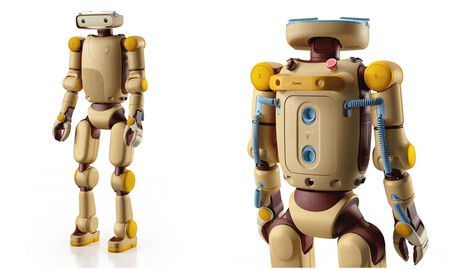
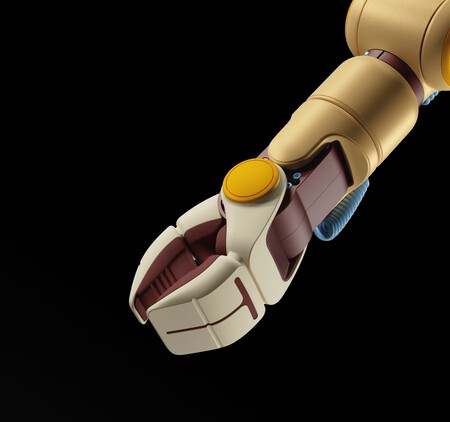
In detail. The automaton has 29 degrees of freedom, that is, a high number of possible joints and movements to walk and manipulate objects. It also mounts a computer based on NVIDIA Jetson AGX Orin with 64 GB of memory and a 1 TB SSD, designed to execute perception and control on board. In sensors, it includes stereoscopic vision, several depth sensors to measure distances and an inertial sensor in the torso for orientation and balance. In locomotion we talk about legs with 5 degrees of freedom and low-impact feet. The battery is interchangeable, with between 3 and 3.5 hours of autonomy.
Instead of delivering a body and letting the buyer figure out the rest, the company says its humanoid already integrates ready-made movement, control, and social behaviors, as well as perception, navigation, and mapping to operate in the physical world. To this he adds conversation guided by interaction and dynamic expressions, which are the basis of his “social” approach. It is a way to lower the entry bar: if the robot already moves, orients itself and reacts, the developer’s job becomes the interesting one, creating applications, testing voice interfaces or exploring new forms of human-robot interaction.
Designed for others to build on top of. Fauna Robotics’ strategy with Sprout is, for now, less “home robot” and more “tool for creating robots.” The company first offers it as a platform for developers, researchers and universities, a type of buyer who often ends up stuck in the same bottleneck: having a good idea, but not the budget or time to build a complete humanoid. Sprout seeks to resolve that starting point. Fauna presents it as a modular canvas on which to develop manipulation, task planning and interaction, with an almost community approach: someone solves a problem, shares it, and the next team can focus on the next step.
A new category? If we look at the most well-known humanoids, it is quick to see that shape is only part of the story. Atlas, from Boston Dynamics, stands out for its electric version that aims for industrial uses. Optimus, from Tesla, moves in the field of general purpose, with the idea of taking on repetitive or unsafe tasks. Figure 02, from Figure AI, also targets industry and the commercial workforce, with testing at a BMW plant. In China, Unitree pushes democratization with the G1, a low-priced humanoid aimed at education and research, while Walker S2, from UBTECH, is already being tested on the border with Vietnam. In Europe, 1X’s Neo (Beta) represents the ambition for a safer home robot. Sprout falls close to that last idea.
Price and availability. Sprout does not present itself as a consumer robot, and that also shows in how it is offered. Fauna Robotics frames it within an edition aimed at creators and developers (Creator Edition). As for the price, it is offered for $50,000. From there, it is advisable not to fill in the gaps: the company does not detail a public calendar for mass deliveries nor does it propose, for now, a deployment for homes in the style of an appliance.
Images | Wildlife Robotics
In WorldOfSoftware | Google had a practically unsolvable dilemma with AI and its search engine. So you have chosen to create a subscription