

Kaitlyn Cimino / Android Authority
I’ve been thinking a lot about projectors lately, partly because I’m in the middle of a projector review marathon, but also because I have a small child and a very healthy sense of parental paranoia. I don’t want to create a home theater. Instead, after testing a handful of surprisingly powerful projectors, I’m increasingly intrigued by what they offer in terms of flexibility. In short, I’m starting to wonder if a portable projector might be a safer route for my family’s living room entertainment than a constantly present massive black screen.
Would you trade your TV for a Google TV projector?
732 votes
TVs are a parent’s paranoia at its peak

Kaitlyn Cimino / Android Authority
TVs are heavy, rigid, and exactly the kind of thing toddlers inevitably pull on or crash into at full speed. Even properly placed stands can wobble, and while tip-over straps help, every time my toddler cruises near the entertainment center, my anxiety goes with her. The obvious solution is to just mount the TV to the wall, and for many households, that’s perfectly reasonable. But it’s not universally easy, affordable, or even possible. Some rentals don’t allow wall mounts. Older homes and apartments can have unconventional construction. In my case, we have single-wall construction, which means mounting would require major reinforcement.
“Every time my toddler cruises near the TV, my anxiety goes with her.”
Even when wall mounting is an option, it can involve professional installation, permanent holes, and a level of commitment that doesn’t always align with how often family spaces change once kids enter the picture. Right now, my 75-inch TV sits on the sturdiest, bottom-heavy dresser I could find on Facebook Marketplace, with both the TV and dresser secured to the wall. And yet, I still find myself worried that my toddler will eventually try to climb the drawers or drag an ottoman over to high-five Elmo.
A projector, by contrast, doesn’t involve a giant slab of glass or oversized furniture. Knocking over a ~5- to 10-pound device might still give someone a bonk, but it’s very unlikely to do the damage a 75-inch flat-screen can. More importantly, it’s a hazard that can be easily tucked away when not in use.
Is a light, portable solution better?

Kaitlyn Cimino / Android Authority
What makes a portable projector appealing is its flexibility. When it’s on, you get a big, immersive picture. When it’s off, the room goes back to being a room. There’s no fixed focal point dictating furniture placement, and no constantly glowing display drawing your kid’s attention. My daughter doesn’t even watch TV yet, and she’s already obsessed with it (mostly because she enjoys her own reflection in the dark glass like a tiny narcissist).
Being able to put the projector on a shelf when it’s not in use means one less thing for anyone to get hurt on, and one less pricey thing for anyone to break. It’s safer, more convenient, and versatile. Instead of being locked to the couch, I can set up screenings wherever makes the most sense on a given night, whether that’s in the family room on a blank wall or on the ceiling for a movie night in bed. A projector also eliminates the need for a TV stand, opening up more room for play. Just imagine how much bigger my blanket forts could be.
Modern projectors are powerful enough to replace a TV, and flexible enough to disappear when not in use.
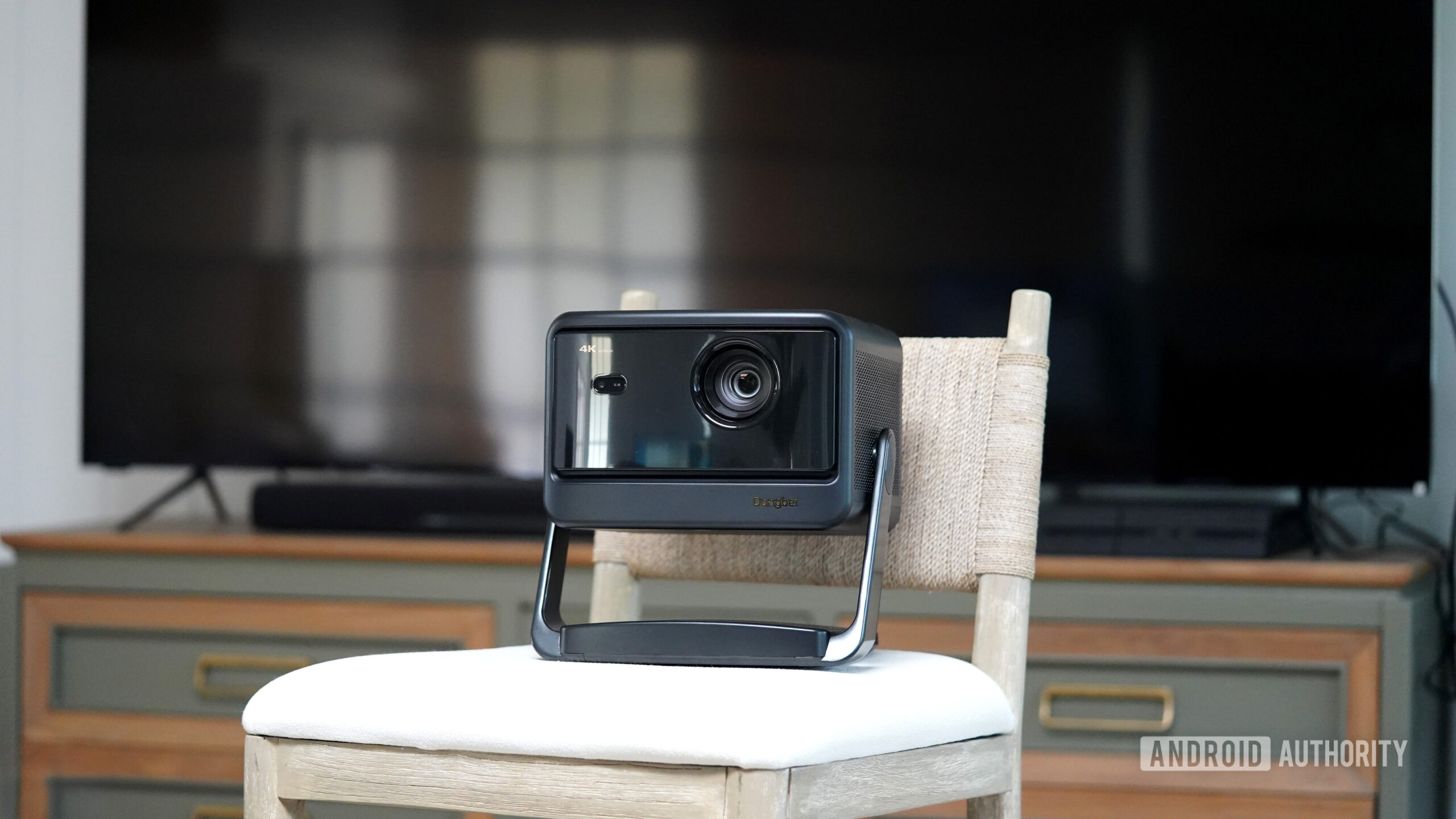
Testing a range of compact devices has helped clarify what actually matters in my space. Models like the Dangbei DBOX02 Pro have been bright enough to hold their own in my well-lit living room and sharp enough to stream sports, while still being small enough to stow away and easy to reposition on demand. With its mid-century modern design, the Epson LifeStudio Flex Pro proved that a projector can blend in without giving my main living space a techy, showroom vibe. And the XGIMI MoGo 4 is so compact that it’s quietly taken up residence in my bedroom, thanks in part to its convenient rechargeable stand.
If you haven’t tried a projector in a while, you’ll be shocked to find out how well they perform these days. None of these models requires permanent installation, which isn’t something I’d be opposed to, but for now, I like the idea of a mobile setup. A device powerful enough to replace a TV but flexible enough to disappear when it’s not in use is very attractive. Most importantly, it feels like a calmer, safer way to access screen time, especially while kids are learning to walk, climb, and test gravity. It’s definitely not the right answer for everyone, but for families weighing safety, space, and sanity, I think modern projectors deserve a closer look.
Don’t want to miss the best from Android Authority?


Thank you for being part of our community. Read our Comment Policy before posting.




.jpg "Can a Home Appliance Fix the Problem of Soft-Plastic Waste?")

