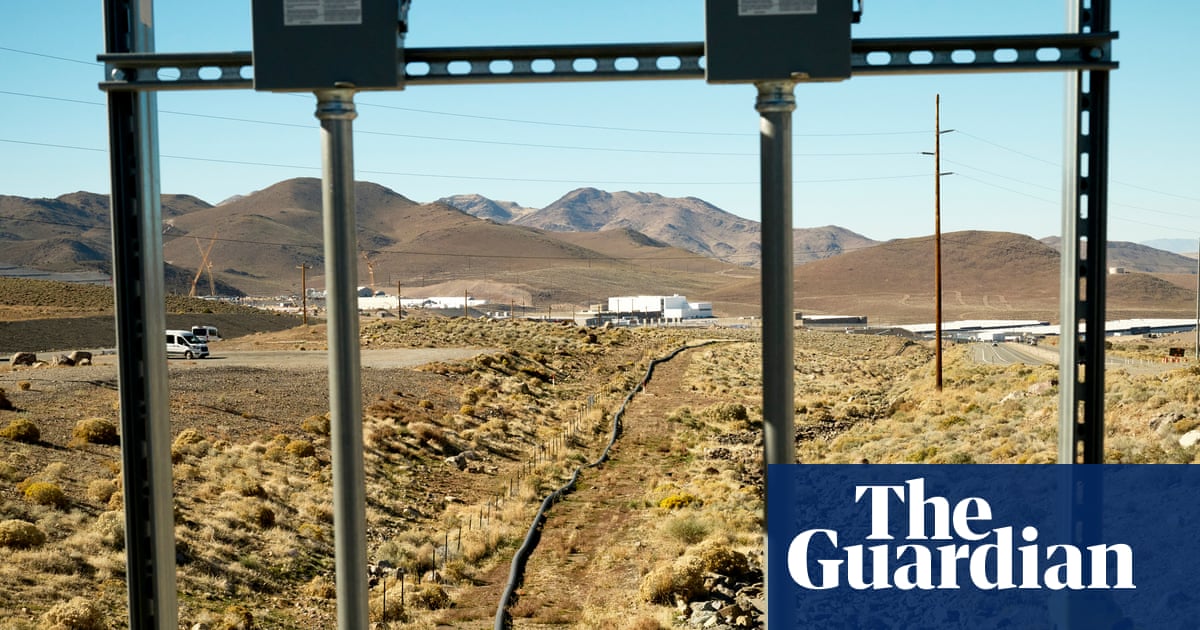
Driving down the interstate through the dry Nevada desert, there are few signs that a vast expanse of new construction is hiding behind the sagebrush-covered hills. But just beyond a massive power plant and transmission towers that march up into the dusty brown mountains lies one of the world’s biggest buildouts of datacenters – miles of new concrete buildings that house millions of computer servers.
This business park, called the Tahoe-Reno Industrial Center, has a sprawling landmass greater than the city of Denver. It is home to the largest datacenter in the US, built by the company Switch, and tech giants like Google and Microsoft have also bought land here and are constructing enormous facilities. A separate Apple datacenter complex is just down the road. A Tesla “gigafactory”, which builds electric vehicle batteries, is a resident too.
In the mid-1800s, this area was an old west boomtown. It’s situated in Storey county, where one of the largest deposits of gold and silver in the American west was discovered, lending it the epithet “the Richest Place on Earth”. It’s where Mark Twain came to be a miner, then got his start as a writer for the local newspaper. He later wrote about it in his book Roughing It, saying: “The ‘flush times’ were in magnificent flower … Money was as plenty as dust.”
The gold rush is long history, but Storey county is once again one of the fastest-growing economies in Nevada. A new boom is happening here in the high desert – fueled by artificial intelligence.
The burgeoning tech, which Silicon Valley vows will be the next frontier for humanity, is minting unfathomable trillion-dollar valuations. It’s a product that’s still being tested, and there’s uncertainty as to how exactly it will transform the economy. But that hasn’t stopped its real-world infrastructure from being built at mass capacity and record speed – a frenzy buoyed up by hundreds of billions in venture capital funding.
Microsoft, working with OpenAI, announced last month that it plans to double its datacenter footprint over the next two years. Amazon, partnering with Anthropic, just opened a major cluster with plans for more. Google, Meta and Oracle are preparing vast buildouts, as is a consortium of companies working with the Trump administration on a $500bn project called Stargate. In all, estimates by the consulting firm McKinsey and Company peg global spending on AI datacenters to total nearly $7tn by 2030 – nearly twice as much as the GDP of the UK.
The buildup comes at a cost. As the planet’s most powerful companies race to fulfill their dreams of artificial general intelligence – a futuristic version of AI that can perform tasks as well as humans – it means an ever-increasing need for computing power. AI requires far more energy and water than other internet tasks. A ChatGPT query needs nearly 10 times as much electricity as an internet search without AI. And because supercomputers run hot, they typically need intensive water-cooling systems. As datacenters continue to multiply in communities around the world – from Frankfurt to Johannesburg – AI’s thirst for power and water shows no signs of letting up.
In a place such as Storey county, which is on the frontline of the climate crisis and has an average rainfall of roughly 11in a year, some locals fear the datacenters’ demands could decimate already scarce resources.
That includes the Pyramid Lake Paiute, a Native American tribe that has lived downriver from where the industrial center now sits since long before Europeans arrived in the Americas.
“Everyone cannot keep moving to a space that has no resources. Nevada is completely over-allocated on its groundwater resources. It’s the driest state in the union,” said Steven Wadsworth, the tribe’s chairman. “Our tribe’s number one goal is protecting our resources. And it makes it difficult when we have partners upstream who are blissfully unaware.”
‘Miracle in the desert’
On a chilly fall day in October, Kris Thompson hopped into his SUV to take a drive. He has a gravelly voice and fading gray hair and works for Gilman Commercial Real Estate Service, which has been the industrial center’s exclusive brokerage firm since its founding in 1998. As he turned on to USA Parkway, the 18-mile highway that cuts through the park, he pointed out the tall yellow cranes dotting the landscape and the constant stream of semitrucks rumbling by. “You’re gonna see a lot of hard hats and heavy equipment,” he said.
“When I first came up here, there was nothing but desert dirt trails, coyotes and rabbitbrush,” Thompson said. “Nothing else was here. No roads, no water wells, no businesses, no drainage, no sewer system, nothing.”
Now, the entire area looks like a city being built from the ground up.
“How do you take 160 sq miles of desert, of high desert in the mountains, and turn that, 25 years later, into the hottest tech and datacenter development in the United States?” Thompson asked rhetorically. “They had some cowboys up there, and they were willing to think outside the box.”
One of the cowboy masterminds is Lance Gilman, who also owns the Mustang Ranch brothel. He and his partners bought most of the property from the Gulf Oil company in the late 1990s, which had planned to use the expanse of land for a corporate hunting retreat.
Gilman and his western crew were property developers who struck it big on what Thompson said “has to be the greatest real estate deal ever made on the planet”. They paid $20m to buy a vast private ranch – covering more than 100,000 acres – and created the Tahoe-Reno Industrial Center. It has no residential properties and pre-approves most industrial and commercial uses. Essentially, it can fast-track the local government permit process.
The center’s swift permitting hooked Tesla into setting up its first gigafactory there in 2014. The company bought 3,300 acres (13.4 sq km), which span an entire mountain, and immediately set to work building a 6m-sq-ft foundation (nearly 560,000 sq meters) for its battery facility. Tesla convinced the county to rename the road leading to its property “Electric Avenue”.
“That put us up on the global stage,” Thompson said of the mega manufacturing facility. “That speed is everything. In this economy, if it takes you two or three years to get a permit to start building, your product could be obsolete by that point.”
Switch, which builds and operates some of the world’s largest datacenters and rents them to a variety of clients, came next, then Google, Microsoft and more. These companies purchased thousands of acres of land to build their datacenters. Tract, which has a similar business model to Switch, purchased 11,000 total acres (44.5 sq km) and pledged to invest $100bn into its datacenter project.
A gold rush-esque boom and bust has already come for the industrial park once before. One of the biggest buyers in 2018, four years before the release of ChatGPT, was the multimillionaire Jeffrey Berns, who threw down $170m in cash to acquire 67,000 acres (271 sq km) – roughly two-thirds of the park – through his company Blockchains. His goal was to transform the place into a cryptocurrency utopia, which he described to the Guardian as having a “blockchain-based self-sovereign identity that eliminated the need for many politicians and governmental agencies”.
That plan didn’t pan out. So Blockchains sold 2,200 acres (8.9 sq km) to Tract for $250m and plans to offer long-term leases on the remaining acreage. Berns said he was now focusing on building a billion-dollar bunker in Switzerland.
Every square foot of Gilman’s land at the industrial center has been sold, according to Thompson. What’s available now are parcels that are being resold. Thompson said the fact that those cowboys were able to transform the dusty landscape into a “tech city” is nothing short of a “miracle in the desert”.
Driving through the tech city, it’s impossible to see the full extent of each company’s construction projects. Google’s complex is triple-fenced and only accessible by private roads. The same goes for other companies, some of which are buried behind desert mountains and towering walls. These businesses are notoriously secretive, citing the need to protect trade secrets, and their security patrols don’t take kindly to curious strangers.
On three separate occasions, private guards told the Guardian to move along when parked on what seemed to be public roads. In one instance, a guard drove up and walked over to the driver-side window. “What are you doing?” he asked curtly. As he peered through the window, he smiled broadly and tilted his head, showing that he was wearing Meta’s smart glasses with the red video recording light turned on.
‘We know what happens when we don’t fight for the water’
Pyramid Lake is the largest lake in Nevada. Situated at the base of several mountain ranges, the lake is owned by the Pyramid Lake Paiute Tribe and entirely surrounded by the tribe’s reservation. Tribal members have lived in the region for thousands of years. The Pyramid Lake Paiute’s petroglyphs date back 10,000 to 14,000 years BCE, the oldest in North America.
Wadsworth, the tribal chairman, recognizes the need for datacenters, but worries if the ones upriver aren’t kept in check, they could intensify threats to the lake – which is the lifeblood for the tribe. The Truckee River supplies the industrial center with water and also serves as the primary source of water for Pyramid Lake.
“It’s not like we’re out here to be a pain,” Wadsworth said. “We know the destruction.”
In the tribe’s governmental office, Wadsworth, sporting waist-length hair and a white button-up shirt tucked into slacks, walked over to a giant satellite map showing the region’s watershed – from California’s mountains to Nevada’s Great Basin. Next to the deep green of Pyramid Lake was a large, flat, white mass, the remnants of a second lake.
“We know what happens when we don’t fight for the water,” Wadsworth said, pointing to the white mass. “This lake used to be full.”
Lake Winnemucca was once fed by Pyramid Lake, but when the Truckee River was dammed in the early 1900s, Wadsworth said it took less than 30 years for Pyramid Lake to drop 80ft and Lake Winnemucca to dry.
The tribe has been fighting for decades now to protect Pyramid Lake and the native fish that inhabit it, including the endangered cui-ui and the threatened Lahontan cutthroat trout. Some of its efforts include purchasing thousands of acre-feet (one acre-foot is equivalent to 1,233 cubic meters) of water rights and bringing several lawsuits over the years. The tribe also lodged complaints with the local Truckee Meadows water authority to ensure any water the industrial park siphons from the river is replenished, according to the MIT Technology Review.
after newsletter promotion
AI datacenters need copious amounts of water. Over the last 10 years, datacenter water use has tripled to more than 17bn gallons (64bn liters) of water a year in the US, according to a Department of Energy report. Much of that is attributed to the “rapid proliferation of AI servers” and is expected to multiply to nearly 80bn gallons (303bn liters) by 2028. While the figure pales against total US water use, 117tn gallons per year in 2015, it still can mean a struggle to meet the demands of both human beings and hot computer chips.
And as datacenters continue to proliferate in water-stressed areas around the globe, which can offer cheap land and energy as well as low humidity for easier chip cooling, one of the central concerns in local communities is what happens if the water runs dry.
A large datacenter using evaporative water cooling consumes around 1m gallons a day, said Shaolei Ren, an associate professor at the University of California at Riverside. He studies AI water consumption and said non-evaporative water-cooling technology can diminish water use, but it’s a balancing act because those systems need more electricity, which, in turn, requires more water.
“Water and energy are not separable,” Ren said.
The industrial park built a reclaimed-water reservoir for its datacenter clients that went into operation in 2023. The project, which cost upwards of $100m, involved constructing a 21-mile pipeline to pump effluent from a wastewater treatment plant to the industrial park. While seen as an alternative to taking water directly from the Truckee River, Wadsworth said the effluent previously would have been treated and deposited back into the river. So the tribe still got involved to ensure the river maintained its flow.
Some environmentalists question the wisdom of putting datacenters in any drought-prone region, especially as the climate crisis accelerates.
“This place is being touted as the epicenter of the energy revolution, the data revolution, the tech revolution,” said Kyle Roerink, the executive director of the Great Basin Water Network, which works to protect water resources in the region. “But they’re never going to be making water.”
‘We just don’t have the power capacity’
The largest datacenter in the US is tucked into the industrial park. The sleek gray building with red accents is more than half a mile long, comprising 1.3m sq ft, and has the capacity for 130 megawatts of electricity – enough to power 100,000 homes a year. It’s owned by Switch, the company’s first datacenter in what is now a sprawling campus called “the Citadel”.
The entrance to the Citadel does give the impression of a fortress. It sits high on a giant pile of crushed rocks surrounded by 20ft cement walls topped with dagger-like iron stakes. Guests drive in through a metal gate and security guards in bulletproof vests hold visitors’ IDs for the duration of their visit.
The campus, which comes with its own power substation and water reservoir, has multiple gargantuan datacenters terraced up into a valley, and Switch is building several more. The company says that when the Citadel is done, it will have approximately 10m sq ft (930,000 sq meters) of datacenter space combined.
Inside Switch’s biggest datacenter, Reno 1, noisy wall-sized fans blow air over the computers to keep them cool. Rows of identical servers behind black mesh gates line long aisles, an infinite, blinking hall of mirrors. The room is dimly lit except for the servers’ blue and green LEDs as they perform incredibly complex computations.
Datacenters like this are cropping up worldwide, which means not only an intensified strain on water, but also on power. Google wrote in its latest sustainability report that it has seen a 51% increase in carbon emissions in its operations since 2019, while Microsoft had a 23% increase since 2020. Amazon and Meta also saw increases over the last few years, with rises of 33% and 64%, respectively. Some researchers say those are undercounts.
The International Energy Agency estimates total electricity consumption from datacenters worldwide could double by 2026 from 2022 levels – roughly equaling the amount used per year by the entire country of Japan. In the US, about 60% of electricity comes from burning fossil fuels, a predominant driver of the climate crisis.
“These are large cities in terms of their electricity consumption,” Ari Peskoe, the director of Harvard’s Electricity Law Initiative, said of datacenters. “And then, utilities and other power generators are having a massive buildout of natural gas-fired power plants to support this growth.”
Some companies, like Elon Musk’s xAI, have added huge temporary methane gas generators to supply additional energy to their facilities. And in datacenter-heavy regions across the US, plans to decommission coal plants have been delayed to keep electricity flowing. Research analysts for Goldman Sachs say they “expect the proliferation of AI technology, and the datacenters necessary to feed it, to drive an increase in power demand the likes of which hasn’t been seen in a generation”.
The power plant that serves the industrial center runs on natural gas and is owned by NV Energy, a utility acquired by Warren Buffett’s Berkshire Hathaway in 2013. The utility has received regulatory approval for at least four new natural gas units over the last couple of years. Meghin Delaney, a company spokesperson, said NV Energy also has several renewable energy projects and requires large energy users, like datacenters, to “cover transmission and distribution costs upfront before new projects are built”.
One of Switch’s focuses is green design and energy efficiency. The company says its datacenters are completely powered by renewable energy, and what it uses from natural gas facilities it feeds back to the grid from solar and wind projects. Jason Hoffman, the chief strategy officer for Switch, said the company had raised more than “$20bn in 100% green financing since 2024”. Switch was also a major sponsor of the reclaimed water reservoir at the industrial center.
Google, Amazon, Microsoft, Meta and Apple are also tapping into solar and wind to fuel their datacenter ambitions. Some tech giants are investing in nuclear and geothermal energy. Apple says its datacenters in the Reno area run entirely on solar power.
Tesla, Meta and Tract did not respond to requests for comment. Spokespeople for Microsoft, Apple and Amazon declined to comment but pointed the Guardian to their company’s sustainability reports. Chrissy Moy, a Google spokesperson, said the company uses air cooling in its Storey county datacenters; and despite a rise in carbon emissions, she said Google saw a 12% reduction in datacenter energy emissions in 2024, which the company attributes to “bringing new clean energy online”.
On the reservation at Pyramid Lake, Wadsworth said rolling brownouts are common during the hot summer months. “Right around 5 o’clock, everybody gets home, and the power will dip multiple times,” he said. He’s concerned it will only get worse with the deluge of datacenters, adding: “We just don’t have the power capacity to keep running all of these things.”
Wild horses
Back on the USA Parkway, Thompson steered his SUV through the industrial center’s mountains. He said about 75% of the calls he now gets are from businesses wanting to secure land for datacenters. Thompson has spent years on this land, and its development is a point of pride. So is its preservation. He looked out at the arid terrain gesturing to a cluster of scruffy pinyon pines and rabbitbrush that painted the hillside yellow with blooms. A pair of wild horses grazed nearby.
Thompson said the park and its hi-tech residents do what they can to protect the horses, which were originally brought to the Americas by Spanish conquistadors and now run wild throughout Nevada’s deserts. The horses are seen by some as controversial, as herds can overrun the hills, trampling the distinct natural landscape. But, in the industrial park, the tech companies love them, Thompson said.
“You know, these tech rogues see themselves in the wild horses,” Thompson said. “They’re independent, they’re running free, they’re self-reliant, they’re doing their own thing.” Which sometimes means a trampling stampede.