Healthcare providers spend an average of 16 minutes per patient on electronic health record (EHR) documentation—time that could be spent on patient care. This documentation burden contributes significantly to physician burnout, as a recent literature review confirms clinicians may spend nearly two hours on administrative work for every hour of direct patient interaction.
Medical speech recognition technology is transforming this reality. By converting voice to text with specialized accuracy for medical terminology, these solutions are helping healthcare organizations reclaim lost time and improve clinical workflows.
But not all solutions are created equal. Healthcare organizations face a critical choice between APIs that enable custom integration and ready-to-use software with built-in EHR connectivity. Each must meet stringent requirements: HIPAA compliance, high accuracy for medical vocabulary, and seamless workflow integration.
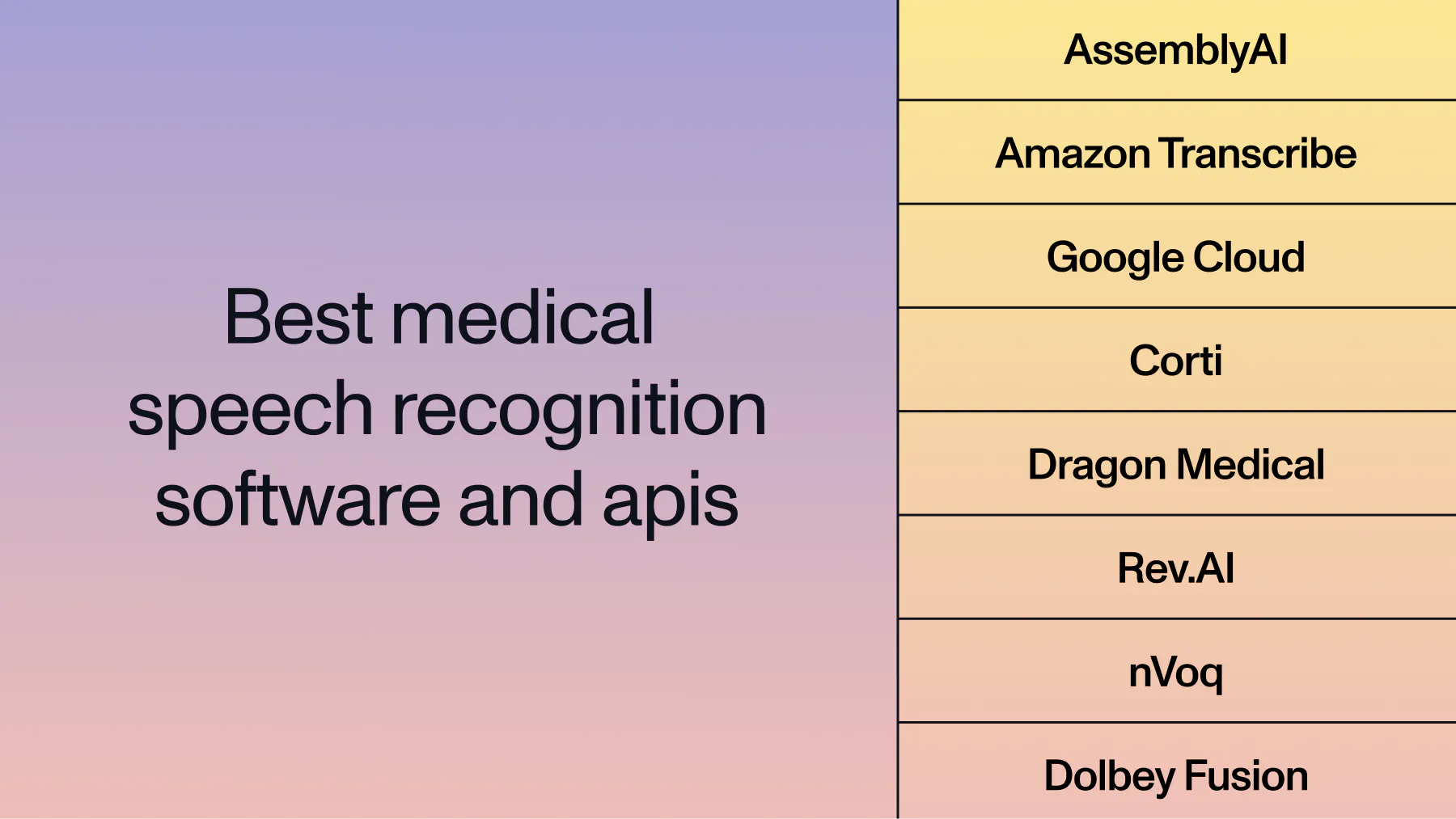
This guide examines eight leading solutions across both categories, providing the comparison data and selection framework you need to choose the right tool for your organization.
The state of medical speech recognition in 2026
Medical speech recognition technology in 2026 achieves clinical-grade accuracy with word error rates below 5% for medical terminology—meeting the threshold for reliable clinical use. Recent AI breakthroughs enable real-time transcription of complex medical conversations while handling specialized terminology, multi-speaker environments, and diverse accents. The global market reflects this maturity, growing from $1.73 billion in 2024 toward a projected $5.58 billion by 2035.
Modern systems now handle complex drug names, medical procedures, and clinical conditions with improved accuracy, though performance varies significantly between general-purpose and healthcare-specialized models.
Real-time transcription capabilities enable immediate documentation during patient encounters, while advanced speaker differentiation can parse multi-participant consultations.
The industry is rapidly moving toward cloud-based solutions that offer automatic updates and scalability without the infrastructure burden of on-premise systems. This shift coincides with the rise of API-first approaches, allowing healthcare organizations to build custom solutions tailored to their specific workflows rather than adapting to rigid software packages.
Looking ahead, the integration of ambient AI scribes represents the next frontier. These systems passively capture patient encounters, automatically generating structured clinical notes without disrupting the natural flow of conversation.
Business impact: ROI and outcomes from medical dictation software
While some benefits appear quickly, analyst reports suggest medical dictation software typically delivers measurable benefits within 3-6 months, with a full return on investment (ROI) achieved in 12-18 months. Healthcare organizations report:
- 50-70% reduction in documentation time per patient encounter
- $15,000-25,000 annual savings per physician through increased patient capacity
- 40% decrease in after-hours documentation work
- Reported outcomes show a 25-35% improvement in physician satisfaction scores
These improvements compound across clinical operations and financial performance.
Time savings and productivity gains
Advanced speech recognition reduces documentation time by 50-70% compared to manual typing. Key improvements include:
- Reclaimed patient interaction time: Physicians focus on care instead of typing during encounters
- Eliminated “pajama time”: After-hours documentation—a practice research links to burnout—drops from 2-3 hours to under 30 minutes daily
- Increased patient capacity: Same-day scheduling improves by 15-20% without extending work hours
This efficiency directly addresses physician burnout while improving both retention and recruitment.
Financial returns and cost optimization
The financial benefits manifest through multiple channels. Faster documentation accelerates the revenue cycle, reducing the lag between patient encounter and billing submission. More complete and accurate documentation also improves coding accuracy, leading to appropriate reimbursement levels and fewer claim denials.
Medical practices eliminate transcription service costs while reducing the administrative burden on support staff. These cost savings compound over time, particularly for high-volume practices, where even small efficiency gains deliver substantial returns.
Quality and compliance improvements
Beyond operational metrics, medical dictation software enhances documentation quality. Real-time transcription captures more detailed patient narratives, improving clinical decision-making and continuity of care. Standardized formatting and automatic inclusion of required elements ensure compliance with regulatory requirements.
The technology also supports better patient engagement. When providers spend less time typing and more time maintaining eye contact, patient satisfaction scores improve, a benefit confirmed by research on ambient documentation. This enhanced interaction quality strengthens the provider-patient relationship and contributes to better health outcomes.
Medical dictation software use cases by specialty
Medical specialties achieve different ROI outcomes with dictation software based on workflow complexity and documentation requirements:
Primary care and internal medicine
Primary care providers face high patient volumes with diverse conditions requiring comprehensive documentation. Speech recognition enables real-time capture of patient histories, physical exam findings, and treatment plans directly into the EHR. Companies like PatientNotes.app build on this foundation to automatically generate SOAP notes from natural physician-patient conversations.
The technology proves particularly valuable during annual wellness visits and chronic disease management encounters, where extensive documentation requirements often extend visit times. Voice-enabled templates streamline these complex encounters while ensuring all required elements are captured for quality reporting and reimbursement.
Radiology and diagnostic imaging
Radiologists dictate hundreds of reports daily, making speech recognition essential for productivity. Modern solutions offer specialized vocabularies for imaging terminology and anatomical descriptions. Voice commands allow hands-free navigation through PACS systems, enabling radiologists to dictate findings while reviewing images without interrupting their workflow.
The technology’s ability to recognize complex medical terminology and numerical measurements proves critical in this specialty. Structured reporting templates activated by voice commands ensure consistency across reports while reducing the cognitive load of repetitive documentation.
Emergency medicine
Emergency departments operate in high-pressure environments where documentation often occurs after patient care. Mobile dictation capabilities allow physicians to capture clinical information immediately after patient encounters, reducing recall errors and improving documentation accuracy.
Speech recognition handles the unique challenges of emergency medicine, including multiple simultaneous cases, frequent interruptions, and the need for rapid documentation. The technology captures critical details during trauma resuscitations and complex procedures when manual documentation is impossible.
Surgical specialties
Surgeons use dictation software for operative reports, capturing detailed procedural information immediately post-operation when memories are freshest. Voice-activated templates for common procedures accelerate documentation while ensuring all required elements are included.
The technology also supports pre-operative documentation and post-operative notes, creating comprehensive surgical records. Integration with surgical scheduling systems streamlines the entire documentation workflow from consultation through post-operative care.
Mental health and behavioral health
Mental health providers benefit from ambient documentation capabilities that capture therapy sessions without disrupting the therapeutic relationship, and a recent case study of a purpose-built AI scribe saw a 90% reduction in documentation time for clinicians. The technology maintains eye contact and emotional connection while ensuring accurate session documentation.
Privacy-conscious implementations allow selective recording, capturing only the clinician’s summary rather than the entire patient conversation. This approach balances documentation needs with patient confidentiality concerns unique to mental health settings.
Top medical speech recognition APIs
APIs provide the building blocks for custom healthcare applications, offering flexibility and control over the user experience. Here are the leading options for organizations with development resources.
AssemblyAI
Best for: Healthcare organizations building custom applications that require high accuracy for medical terminology
AssemblyAI powers healthcare’s most demanding voice applications with its state-of-the-art models like Universal-3-Pro. This model is specifically designed to handle complex medical terminology with high accuracy through advanced features like Keyterms Prompting and natural language Prompting. These features allow you to significantly improve recognition of specific drug names, procedures, and clinical conditions. You can process 30-minute consultations in 23 seconds or stream with 300ms latency using the Universal-Streaming model.
Key features:
- Universal-3-Pro model: Delivers state-of-the-art accuracy on complex medical terminology using Keyterms Prompting and natural language prompts.
- Industry’s fastest processing: Transcribe a 30-minute file in 23 seconds (RTF 0.008).
- Real-time streaming: Use the Universal-Streaming model for live transcription with ~300ms latency and intelligent endpointing.
- HIPAA-compliant: BAA available, SOC 2 Type 2 certified, and includes features for PII redaction.
- LLM Gateway: A unified API to apply advanced models from providers like Anthropic and Google for medical summarization, note generation, and other insights.
- Simple integration: Python, JavaScript, and Ruby SDKs to get started quickly.
With prices starting at $0.15/hour for the Universal-2 model and $0.21/hour for the state-of-the-art Universal-3-Pro model, AssemblyAI delivers enterprise-grade accuracy at a significantly lower cost than many alternatives. Healthcare organizations choose AssemblyAI to accelerate time-to-market while ensuring the accuracy their clinical applications demand.
Amazon Transcribe Medical
Best for: Large health systems already using AWS infrastructure
Amazon Transcribe Medical delivers specialized transcription across 31 medical specialties including cardiology, oncology, and radiology. The service operates as a stateless system that stores neither audio nor output text, addressing security concerns for sensitive patient data.
Key features:
- Support for 31 medical specialties
- Batch processing and real-time streaming capabilities
- Automatic punctuation and clinical formatting
- Native AWS service integration (S3, Lambda)
- Custom vocabulary support
- HIPAA-eligible with AWS BAA coverage
- Pay-as-you-go pricing model
The seamless AWS ecosystem integration makes it ideal for organizations already invested in Amazon’s cloud infrastructure, though English-only support may limit multi-national deployments.
Google Cloud Speech-to-Text (Medical Models)
Best for: Telehealth platforms requiring clear multi-speaker transcription
Google Cloud provides two specialized medical models. The medicalconversation model automatically detects and labels different speakers for multi-participant consultations, while medicaldictation handles single physician dictation with intelligent punctuation.
Key features:
- Dual models for conversations vs. dictation
- Automatic speaker diarization with role identification
- Context-aware medical terminology recognition
- Integration with Google Healthcare API
- REST and gRPC APIs with SDKs
- $0.0474 per minute for medical models (medicalconversation and medicaldictation)
- Full HIPAA compliance with BAA
The system’s context awareness recognizes medical relationships—understanding that “elevated troponin” relates to cardiac conditions—making it particularly effective for telehealth and multi-speaker clinical scenarios.
Corti
Best for: Radiology departments needing specialized dictation accuracy
Corti reports internal testing results showing strong performance through domain-specific training and a lexicon of over 150,000 medical terms. Built specifically for healthcare, it requires API integration and custom development for implementation.
Key features:
- 150,000+ medical terms in specialized lexicon
- Real-time cursor-following for radiology reporting
- Voice commands for hands-free navigation
- Lightweight SDK with minimal latency
- Limited to 10 concurrent streams for standard plans
- Custom formatting for departmental standards
- Domain-specific models by specialty
Enterprise pricing with custom quotes based on volume includes full HIPAA compliance with BAAs. Note that smart formatting features are still in development, and the solution requires technical integration rather than out-of-box functionality.
Top medical speech recognition software
Ready-to-use software solutions offer faster deployment for organizations without development resources. These platforms provide complete functionality out of the box.
Dragon Medical One (Nuance/Microsoft)
Best for: Individual physicians and practices wanting proven, ready-to-use software
Dragon Medical One maintains market leadership, though users should note deployment complexity including requirements for .NET 8.0 runtime, ASP.NET Core 8.0, and frequent configuration updates. The platform adapts to individual speaking patterns but may experience clipboard errors and virtual environment issues.
Key features:
- Voice commands for EHR navigation (Epic, Cerner, Allscripts)
- Cloud-based with automatic vocabulary updates
- Custom templates and macros
- Mobile apps for anywhere documentation
- User profile portability across devices
- Limited support period (12 months full, then limited)
- Accent and dialect adaptation
At $99 monthly per user with annual commitment and a $525 one-time implementation fee, Dragon Medical One suits practices comfortable with technical requirements and periodic service disruptions for updates.
Rev Medical Transcription
Best for: Organizations needing flexibility between AI speed and human accuracy
Rev offers both AI (96% accuracy) and human transcription options, though at significantly different costs. Critical procedures can use human review ($1.99/min) while routine notes leverage faster AI processing ($0.03/min).
Key features:
- Dual offering: AI ($0.03/min) vs. human ($1.99/min)
- HIPAA compliance with BAA since March 2022
- SOC 2 Type II certification
- Automated speaker identification
- Custom vocabulary training
- Multiple export formats
- REST APIs, Zapier, and webhooks
- Web and mobile app access
This dual approach lets healthcare organizations balance speed, accuracy, and cost based on specific documentation needs, though the 66x price difference between AI and human transcription requires careful budget planning.
nVoq
Best for: Home health and hospice agencies optimizing revenue cycles
nVoq specializes in point-of-care documentation for non-clinical settings, focusing on revenue cycle optimization. The platform addresses unique home health challenges with mobile-first design and field-specific features.
Key features:
- OASIS documentation for Medicare compliance
- Automated coding suggestions for reimbursement
- Compliance checking with pre-submission flags
- Visit note optimization for completeness
- Mobile-first design for field use
- Care plan and order management integration
- Offline capability for poor connectivity
- 50%+ documentation time reduction
Custom pricing based on agency size includes implementation support and training, making nVoq the targeted solution for home health agencies tackling documentation burden and reimbursement optimization simultaneously.
Dolbey Fusion Narrate
Best for: Multi-specialty practices needing unified documentation across departments
Dolbey combines nVoq engine with proprietary enhancements following “one voice profile, encrypted in cloud, available anywhere”. The platform eliminates separate systems across medical specialties.
Key features:
- Multi-specialty vocabularies in single platform
- Workflow automation for routing and distribution
- Template management with specialty customization
- Cross-platform support (Windows, Mac, iOS, Android)
- HL7 integration compatibility
- Hybrid cloud-local architecture
- 256-bit encryption with role-based access
- 24/7 technical support included
Per-user licensing model makes Dolbey ideal for medical groups seeking unified documentation across varied specialties and multiple locations without managing separate systems for each department.
How to choose the right solution
Selecting between APIs and software depends on your organization’s technical capabilities and specific needs.
Decision framework matrix
Choose an API if you have:Choose software if you need:
- Development resources
- Custom workflow requirements
- High transcription volumes with automatic scaling
- Multi-language needs
- Existing application architecture
- Quick deployment
- Out-of-box EHR integration
- Individual user licenses
- Comprehensive support/training
- Minimal IT involvement
Key evaluation criteria
Accuracy verification: Don’t accept vendor claims at face value. Request pilot access to test word error rates with your specialty’s specific terminology. Record actual clinical encounters (with appropriate consent) to evaluate real-world performance.
Compliance confirmation: Verify BAA availability before technical evaluation. Confirm security certifications meet your organization’s requirements. For practices serving international patients, check GDPR compliance if applicable.
Integration assessment: Inventory your current EHR and practice management systems. Confirm compatibility through vendor references using the same systems. Budget for potential interface development or middleware.
Total cost calculation: Look beyond subscription fees to include training time (typically 2-4 hours per user), EHR integration costs ($5,000-$15,000 for custom connections), ongoing IT support, and workflow redesign efforts. Add 20-30% above license fees for true budget planning.
Scalability planning: Ensure your chosen solution can grow with your practice. APIs generally offer better scalability for high volumes, while software solutions may require additional licenses as you expand.
Red flags to avoid
Unclear or hidden pricing structures often indicate expensive surprises. Limited medical vocabulary suggests adaptation from general-purpose systems that won’t meet clinical needs. Absence of technical support leaves you vulnerable when issues arise. Outdated security protocols put patient data at risk.
Implementation best practices and timelines
Successful medical dictation software deployment requires systematic planning and phased execution. Organizations that follow structured implementation approaches achieve better adoption rates and faster return on investment.
Phase 1: Assessment and pilot (Weeks 1-4)
- Workflow assessment: Document current patterns, pain points, and baseline metrics
- Champion identification: Select 2-3 users from different specialties as internal advocates
- Pilot metrics: Measure documentation time, after-hours burden, and satisfaction scores
- Real-world testing: Validate accuracy with specialty-specific medical terminology
- Technical validation: Complete proof-of-concept for API implementations
Phase 2: Configuration and training (Weeks 5-8)
Customize the solution to match your organization’s workflows and terminology. Build specialty-specific templates and macros that align with existing documentation standards. Configure user profiles with appropriate access levels and permissions.
Training should be role-specific and hands-on. Rather than generic instruction, provide specialty-focused sessions using actual case examples. For software solutions, this means configuring voice commands and shortcuts. For API implementations, it involves refining the user interface based on pilot feedback and ensuring seamless data flow to your EHR.
Phase 3: Phased rollout (Weeks 9-16)
Expand deployment gradually, starting with departments most likely to see immediate benefits. High-volume specialties or those with heavy documentation burdens often provide quick wins that build organizational momentum.
Provide intensive support during the first two weeks of each rollout phase. On-site or virtual “at-the-elbow” support helps users overcome initial challenges and build confidence. Establish clear escalation paths for technical issues and maintain regular check-ins with new users.
Phase 4: Optimization and scaling (Ongoing)
After initial deployment, focus on continuous improvement. Gather usage analytics to identify adoption patterns and areas needing additional support. Regular user feedback sessions reveal workflow optimizations and training gaps.
Scale successful implementations to additional departments or locations. Use lessons learned from early phases to accelerate subsequent rollouts. Establish a user community where clinicians can share best practices and custom templates.
Critical success factors
Executive sponsorship drives adoption—ensure leadership actively uses and champions the technology. Address workflow integration before technology deployment; forcing new technology onto broken processes guarantees failure. Maintain realistic expectations about the learning curve and initial productivity dips.
Organizations implementing medical dictation software typically see meaningful adoption within 60-90 days when following structured approaches. The investment in proper implementation pays dividends through higher user satisfaction, better documentation quality, and sustained usage over time.
Making the right choice for your organization
The medical speech recognition market offers proven solutions for every healthcare setting. Success comes from aligning technology with your organization’s technical capabilities and workflow requirements.
Use this comparison framework to narrow options, insist on pilot testing, and calculate total costs beyond licensing.
Whether building custom applications with APIs like AssemblyAI or deploying ready-made software, the right choice reduces documentation time, prevents burnout, and prepares your practice for the AI-powered future of healthcare.