The borders of traditional SEO have been breached. A single Google results page may now show a YouTube video, an AI answer, a Reddit thread, a Yelp listing, and an Instagram post. Meanwhile, more people are turning to generative search engines like Perplexity and ChatGPT, bypassing Google altogether.
What does this mean for small businesses? How is it affecting where their traffic comes from? And what can you do to keep web leads and traffic flowing?
We’re answering these questions, and a whole lot more, in our first-ever Small Business Website Trends Report. We surveyed over 300 small businesses from dozens of niches to learn:
- Where they’re losing traffic
- How they’re reacting to shifts in search
- Which channels are emerging as the new winners
In this report, you’ll get all the data we gathered, direct feedback from small businesses, and insights you can use to guide your own website and search strategies going into 2026.
🚨 Want this report sent directly to your inbox? Download it here!
Contents
Key takeaways and actionable insights
Small businesses are facing an ever-more fractured online marketing environment. New leads can come from their social accounts, directory listings, website, SEO efforts, or some combination of them all. And with the growing use of AI tools to research new brands and products, some SMBs are putting effort into GEO, or generative engine optimization—the practice of optimizing web pages so they’re cited in AI search answers.
Our cohort of small businesses shared how they’re managing their presence across web channels, and what they see coming in the near future. Let’s look at some of the key takeaways from their answers before we dive into all the data.
Driving and converting traffic is the single biggest website and SEO challenge
Whether we’re talking about SEO or other sources of traffic, small businesses say that getting site visitors and converting them to customers is their number one challenge. It outweighs hurdles like creating content and keeping up with algorithms.
That makes sense because getting new customers is the reason most businesses have a website in the first place. In our survey, 69% said their website is a major source of leads, and 70% sell directly from their site.
SMBs say that converting traffic is their biggest SEO challenge. A conversion-focused website with features like bold CTAs, lead-generating pop-ups, and highly visible contact details can help.
💡 Get ideas to increase website visitors now! Download 25 Ways to Increase Traffic to Your Website
Social media outpaces SEO as a traffic driver
Social media has grown into a significant source of new customers for small businesses. When asked which were their main sources of website traffic, SMBs named social media (64%) more often than even SEO (52%).
In fact, 35% of small businesses operating without a website said that the traffic and leads they get from social (and other platforms like marketplaces) are the primary reason they don’t plan on launching one.
This aligns with our Small Business Marketing Trends Report, where social media marketing and social media advertising were the top two channels for SMBs, whereas SEO ranked fourth.
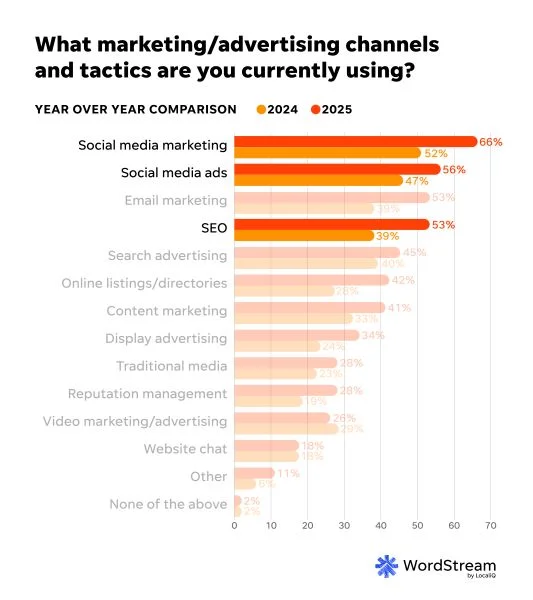
Social media marketing and social ads topped SEO as the most used promotional channels by SMBs.
It also follows consumer trends. Nearly 73% of internet users say they use social media to research brands and products. And 54% of Gen X consumers say social platforms are their primary source of product discovery.
That said, traffic and leads coming from social media can be difficult to track. It seems that many small businesses are overcoming that challenge.
This result was pretty surprising to us, as traffic and leads from social media can be notoriously difficult to track, especially for smaller businesses that may not have robust tracking systems in place. But it seems SMBs are finding a way to track this traffic—and tie it back to meaningful results. Or they’re simply having an even harder time tracking traffic and results from their SEO efforts, which can also be finicky.
Despite some traffic losses, most businesses say SEO is effective
While social is growing, SEO isn’t dead for small businesses. 72% of them said their SEO performance is very or somewhat effective. That number jumps to 89% for the largest businesses in our survey (those with 11 to 100 employees). That’s a very positive outcome. People still use search engines to find businesses, especially local ones. And those that land in the top spots on results pages will get the most attention.
Most SMBs say their SEO strategies are effective
This is despite the fact that almost half of those larger businesses (46%) report losing traffic to Google algorithm updates and AI search engines (overall, 40% of surveyed businesses indicated traffic losses).
A positive assessment of their SEO performance in the face of traffic losses suggests that small businesses have accepted the new norm of search. It could also be why they’re placing social ahead of it as a key traffic driver.
Most SMBs say their website is essential for growth
It was interesting to see that roughly a third of the businesses we surveyed don’t yet have a website. That really stands out because 94% of the SMBs that do have a site say it’s at least somewhat important to their business–and 39% called it extremely important.
The value of a website is only increasing: 61% of the brands with a site say that website traffic has become more important to their business over the last couple of years. Clearly, an attractive website that’s designed to capture leads is still a significant advantage.
Among businesses without a site, 43% do plan to launch one in the next year or two. In the meantime, they’re missing out on a key component of a comprehensive online presence. Even though social posts and YouTube videos are showing in more search results, the majority of traditional and AI search links and citations are to web pages. Without a website, you can’t tap into those critical traffic drivers.
Who we surveyed
Here’s the breakdown of the businesses we surveyed to set up some context for this report.
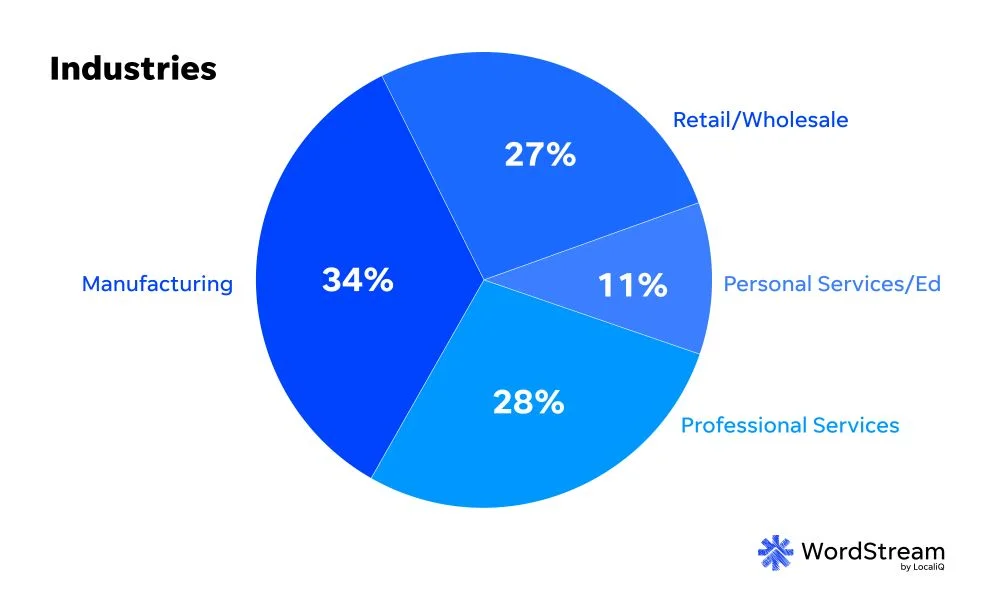
Industry breakdown
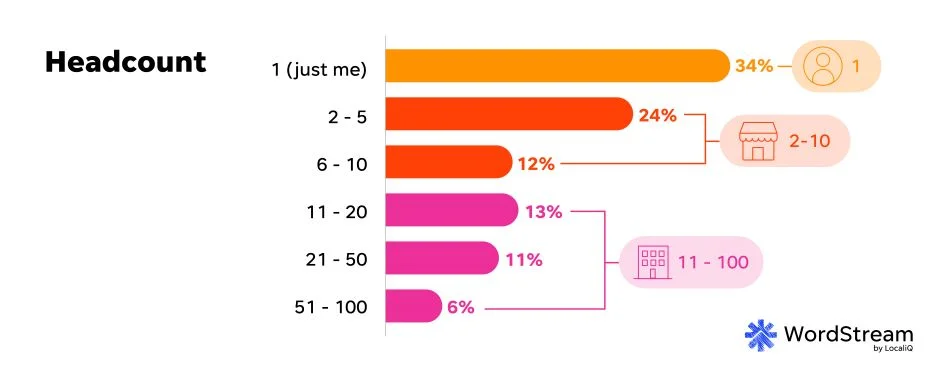
Business size by headcount
2024 revenue
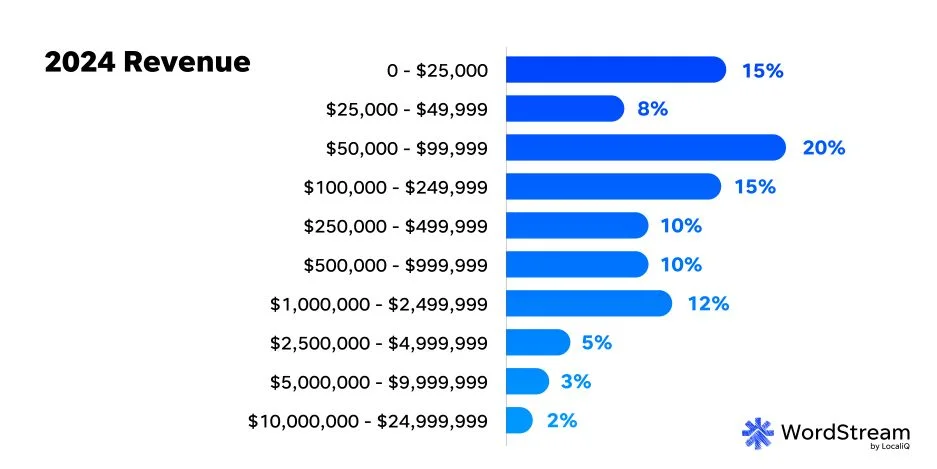
We were excited to see the diversity of small businesses represented in the survey. The cohort includes businesses working in 24 sub-industries from all over the US. Size-wise, there was a pretty even spread across employee headcount and revenue (up to the $1 million to $2.5 million range).
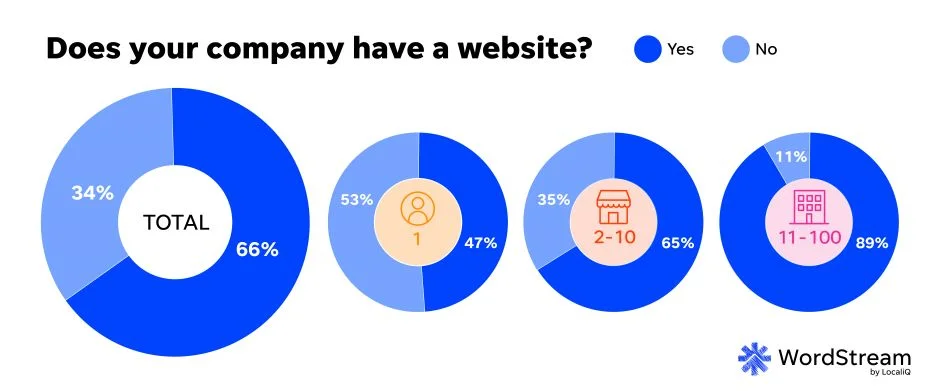
Website status
Website age
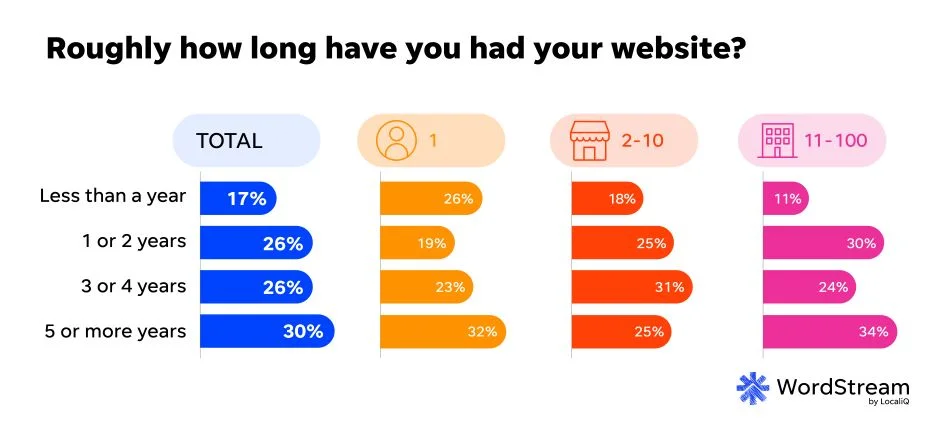
SEO requires a website to be most effective, so we needed to make sure we were hearing from businesses that had one. It’s not that surprising that over half of sole proprietors don’t have a site. But it was unexpected to see that a full 25% of businesses with multiple employees don’t.
We wanted to understand how website-less businesses were getting traffic and if they thought a website was in their future (or why it wasn’t). So we provided them with a separate set of questions. We’ll share what we learned a little later in this report.
The impact of a website for SMBs
Before we asked about SEO and GEO, we wanted to understand the stakes. That meant building some context around how important websites are to small businesses.
Importance of a website to revenue goals
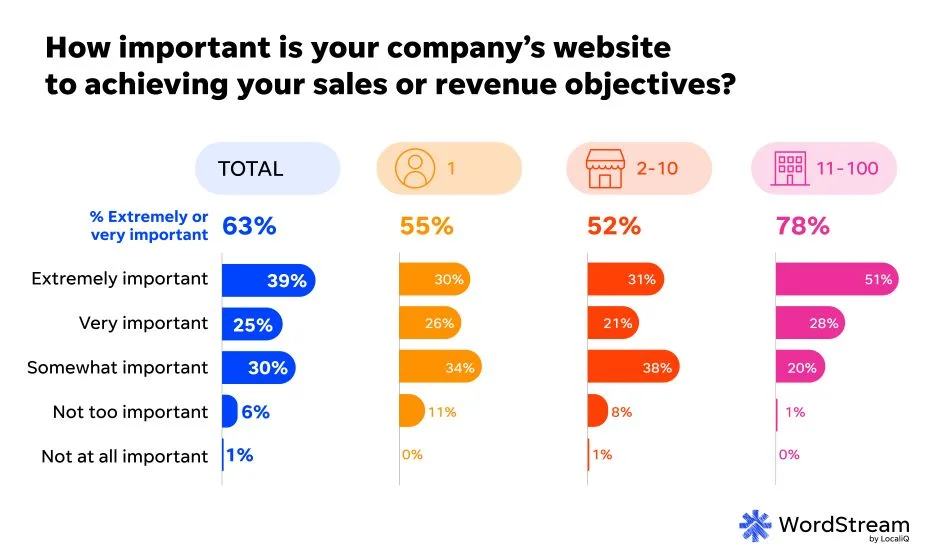
63% of small businesses with a website stated that it was extremely or very important to the growth of their business. That rate was lower for sole proprietorships (58%) and businesses with two to 10 employees (52%), but higher for the largest businesses (78%). Only 1% of all businesses said their website was not important at all.
It makes sense that a majority of businesses would feel their website was at least somewhat important. 68% of all online activity starts with a search engine, and 82% of smartphone users rely on search engines to find local businesses. Having a website is an important step in getting found through search.
Websites for direct purchases
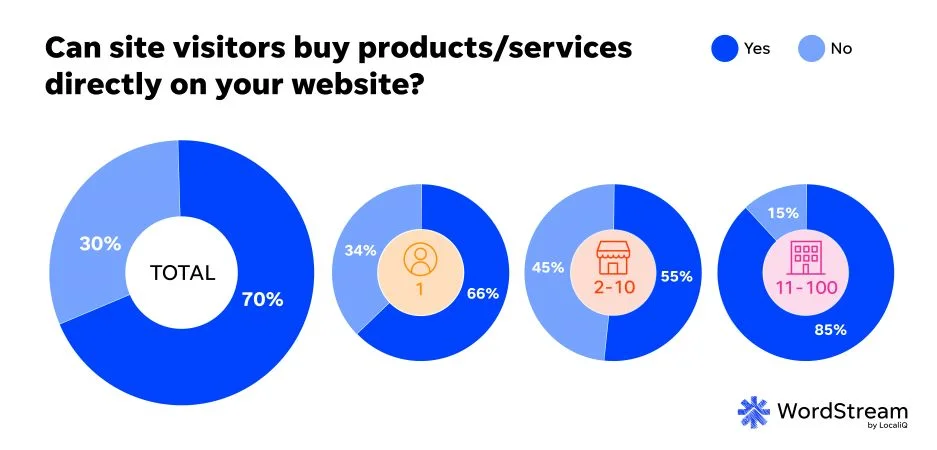
Small businesses aren’t just using their website to generate interest. 70% say that visitors can buy directly on their site. For businesses with 11 to 100 employees, that number climbs to 85% and drops to 66% for solopreneurs. Only 55% of businesses in the middle of the size pack use their website to sell directly to consumers.
It’s interesting to see the dip for the mid-sized brands. It’s possible that one-person brands were more likely to be retail-focused, while multi-person businesses are service-based and less likely to sell online. For example, 22% of respondents are in the home services industry, so they’re probably not selling anything online.
Websites for lead generation
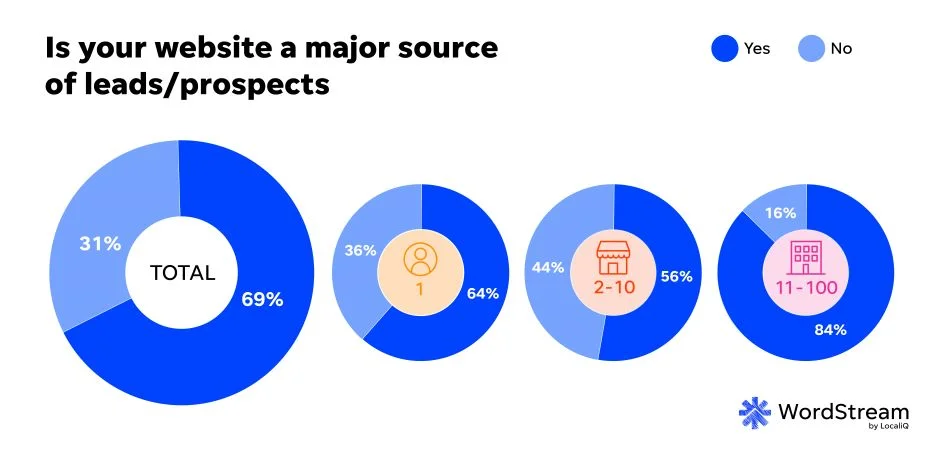
The majority of SMBs (69%) said that their website was a significant source of leads and prospects, and we saw a similar breakout by business size. Once again, businesses with two to 10 employees were the least represented (56%); the largest brands said yes the most (84%), and sole proprietors were in the middle (64%).
This one is a little more surprising since leads are different than direct sales. But it is still possible that the mid-sized, service-based businesses get a lot of leads elsewhere, like through directory listings.
Another likely culprit is the ability to attribute sales to traffic sources. Smaller businesses may have a harder time tracking leads and conversions from web traffic, while larger brands may have more robust tracking tools at their disposal.
The sustainability of current business models without website traffic
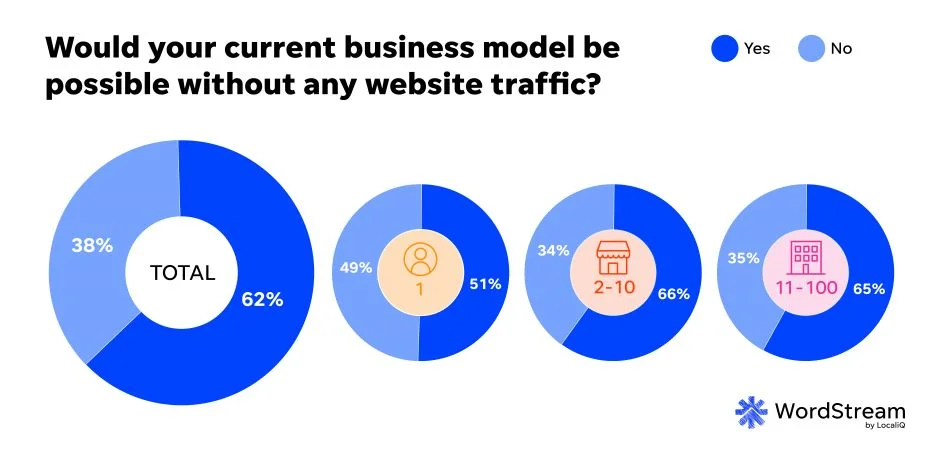
Although they say websites are important and a major source of leads, most SMBs (62%) say their business model would still work even if they didn’t have a site. It’s not so surprising now that mid-sized businesses said yes to this question the most (66%), since they are also less likely to see their site as a source of leads or direct sales. However, the spread between the groups was smaller than in the last two responses.
Barely one-half of the sole proprietors felt their business would survive without a website. This could be a question of resources. A sole proprietor wears a lot of hats—including sales and marketing. A website gives them a central point to funnel all new leads and prospects, no matter where they originate.
The importance of website traffic to SMBs
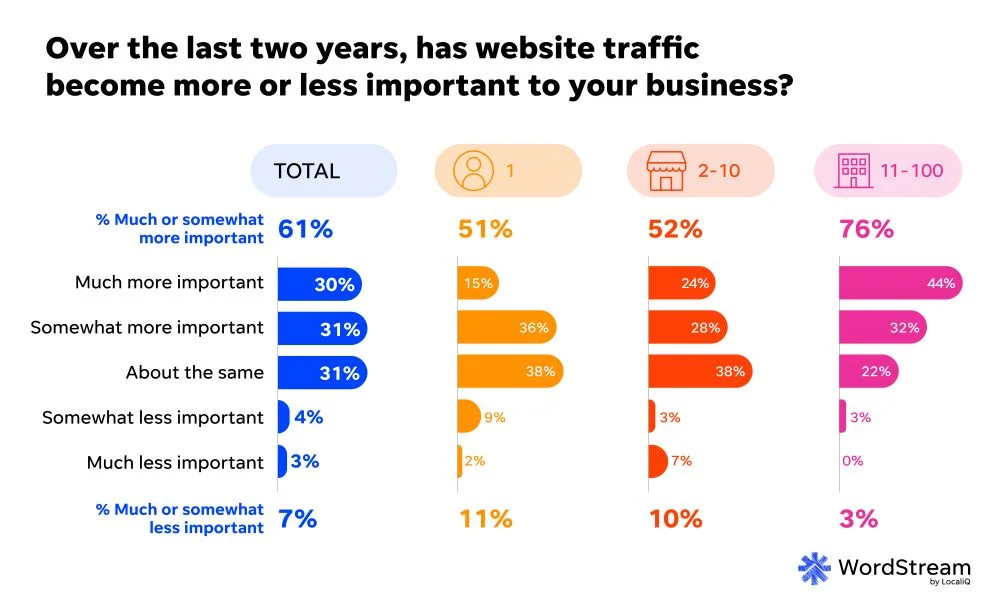
Not only do most SMBs say their website is an important factor in their growth, most (61%) also say it’s becoming more so. Conversely, just 3% said their website traffic was much less important to their business.
This makes sense, since a high percentage note that their website is a source for leads and sales. It also highlights just how important it is to optimize your site to get found on search engines and to convert more of those visitors into customers. It’s also why lead and conversion tracking are so critical. And as we’ll see next, many businesses see the ability to get leads and traffic (and by proxy the ability to track them) as the biggest challenge they face.
And for the third of businesses we surveyed that don’t have a website, they are missing out on what many others say is an important factor in their growth.
Biggest website challenges
It’s clear that most small businesses rely on their website to drive growth. We wanted to know what obstacles kept them from maximizing their results.
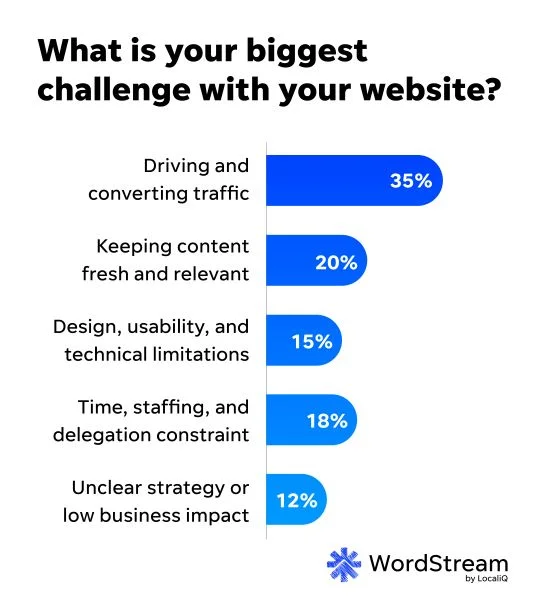
To find out, we asked the open-ended question: What is your biggest challenge with your website? The answers fell into five categories:
- Driving and converting traffic
- Keeping content fresh and relevant
- Design, usability, and technical limitations
- Time, staffing, and delegation constraints
- Unclear strategy or low business impact
Driving and converting traffic was the biggest challenge overall, with 35% of the replies falling into that bucket. Specific challenges included “Getting seen organically” and “maintaining a consistent level of traffic.”
The second most common website challenge revolved around keeping content fresh and relevant. 20% of the responses landed in this category. Maintaining a website is a labor-intensive endeavor, so it makes sense that resource-constrained small businesses feel the burden. We’ll see in a bit that most businesses are managing their SEO in-house, which adds even more items to the regular to-do list.
Challenges regarding strategy and lack of impact were noted in just 12% of the replies. Some of the replies—like “ROI analysis” and “To justify whether or not it’s worth it”—point to attribution as a concern. Given how important websites are to lead and conversion results for small businesses, it’s good to see that these were not the majority of the challenges.
SMBs’ main sources of website traffic
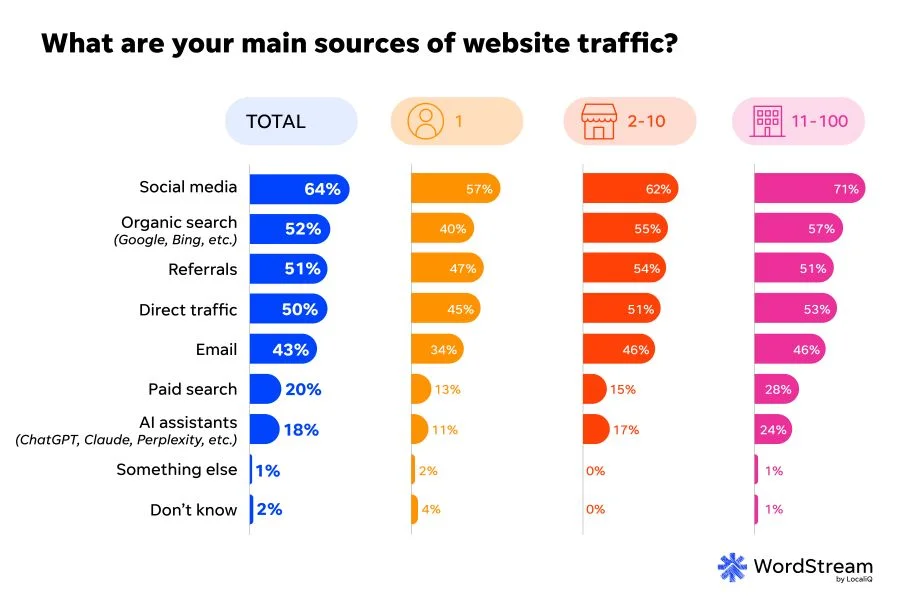
We wanted to know where organic search fell on the scale of importance for small businesses. We asked study participants to tick all the sources they considered to be the “main source” of website traffic.
Overall, the three top sources of website traffic were social media (64%), organic search (52%), and referrals (51%). It was surprising to see social media beat organic search by a fairly wide margin.
What’s more shocking is that it wasn’t just larger brands. 57% of solopreneurs and 62% of brands with two to 10 employees said social was a top traffic driver. That’s interesting because businesses of that size have fewer resources to focus on multiple channels.
On the other end of the spectrum, AI was least often chosen as an important traffic source. And that makes sense. Despite AI impacting search traffic, it’s not a huge traffic driver—many AI searches end in zero clicks. However, 18% of these businesses (including 11% of the one-person shops) believe AI sources are among their top traffic drivers. Which could be why half of all small businesses say they’re starting to monitor AI traffic, as we’ll see further in the report.
🛑 Free resource! 14 Fast & Easy Ways to Get Free Leads (+Examples You Can Copy)
The current state of SEO for small businesses
With the context and stakes in mind, let’s examine how SEO fits into small businesses’ overall marketing plans and how they’re planning to address it over the next year and beyond.
SMBs’ familiarity with SEO
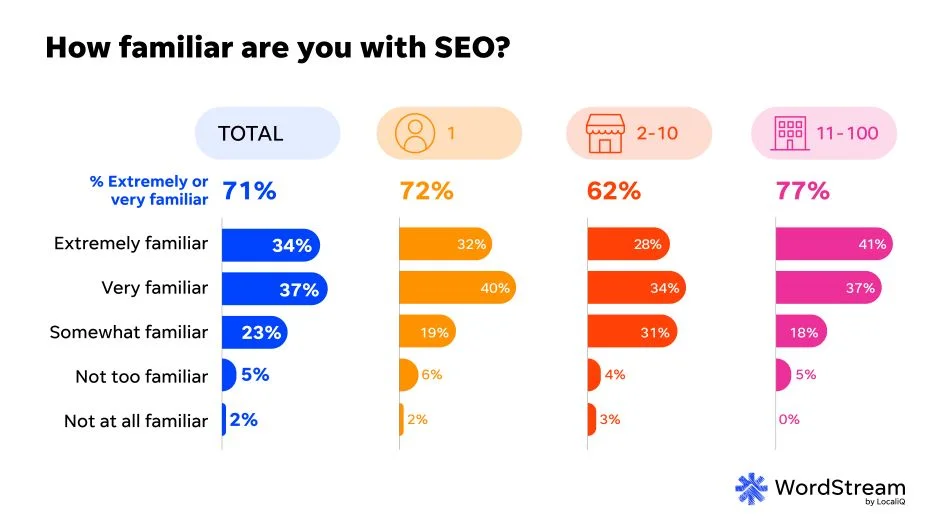
71% of small businesses are extremely or very familiar with SEO. Solopreneurs and the largest businesses in our report bring that average up, with 72% and 77% respectively, saying they have a good grasp on search engine optimization. There was a small drop for mid-sized businesses here, as only 62% of them felt the same way.
When you add the percentage in each business category that felt somewhat familiar, the numbers even out, though, and only 2% of all businesses weren’t at all familiar with SEO.
This is both a positive and an expected outcome. SEO has been around since the mid-1990s, and it’s commonly listed among the most important drivers of traffic and leads.
How SMBs manage SEO
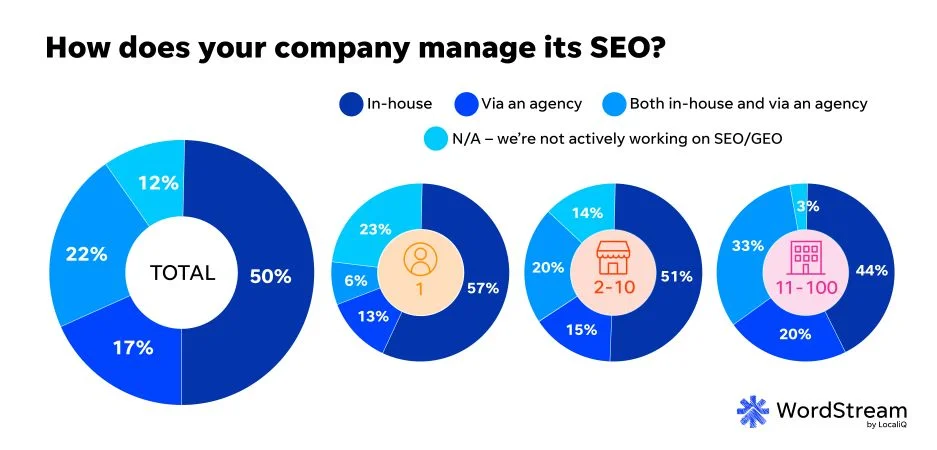
When it comes to how businesses manage SEO, half of them handle it in-house, 17% tackle it themselves, 22% use a mix, and 12% don’t manage SEO at all.
When you break those numbers down by business size, you see a big difference. Just 19% of one-person brands tap an agency to help with SEO, and 23% don’t work on it at all. That means 80% of the time, those small businesses are either wearing the SEO hat (among many others), or they don’t/can’t divert time from other duties to try and rank their site.
The percentage of businesses that tap an agency for SEO help increases with business size. 35% of mid-sized businesses and 53% of larger businesses get outside support. Larger businesses often have bigger budgets to spend on SEO, so this result makes sense.
SMBs’ perception of their current SEO performance
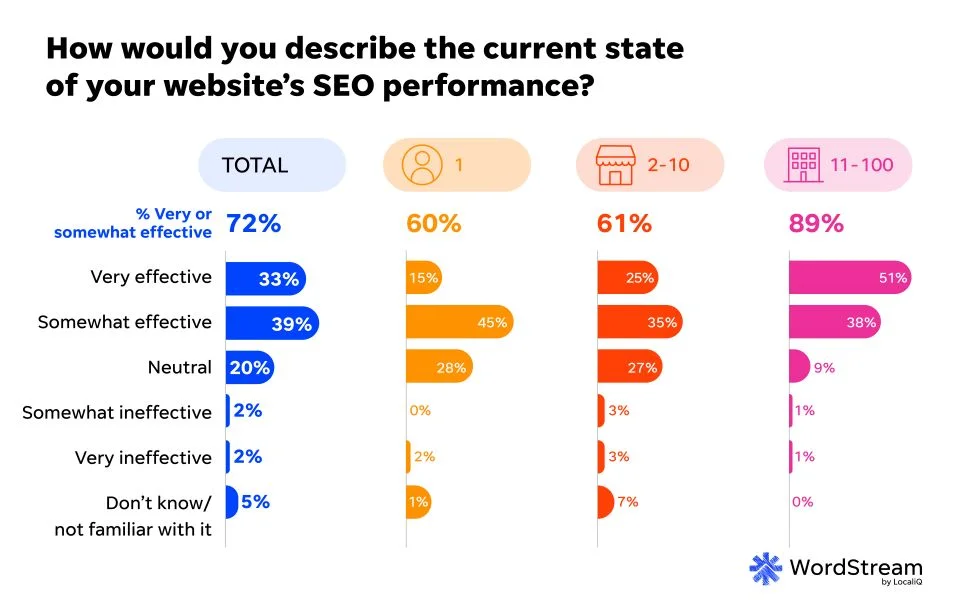
It’s great to see that most SMBs (72%) say their SEO is either very or somewhat effective. A significant 89% of businesses with 11 to 100 employees feel that way.
On the lower end, 20% are unsure or haven’t seen a clear impact on their SEO efforts; 2% say they’re very ineffective, and another 5% either don’t know or aren’t familiar with SEO. That means nearly 30% of SMBs aren’t getting good SEO results or at least can’t measure them. This increases to over 40% for sole proprietors.
That’s a big gap compared to the larger businesses (only 11%), some of which may be their competitors.
AI-caused traffic losses
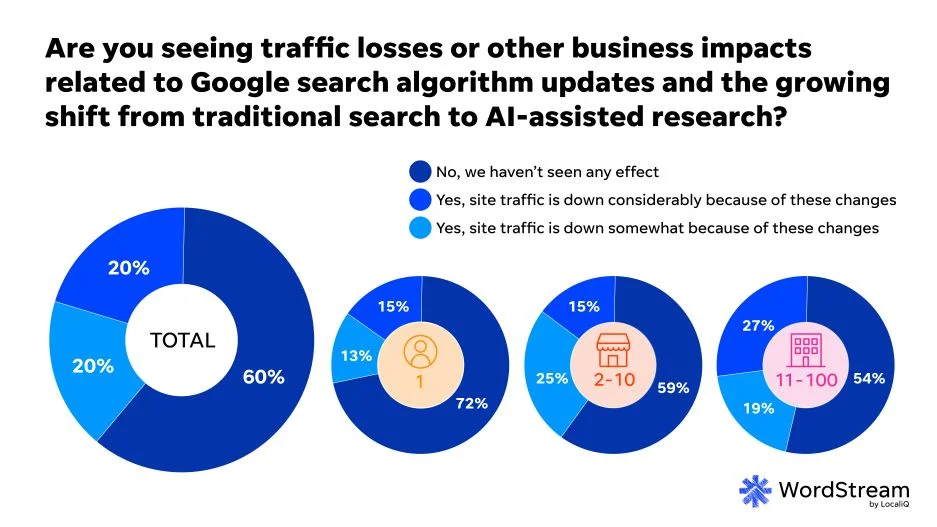
Even with the mostly positive assessment of SEO, many businesses have noticed a downward trend in site visitors—especially due to Google’s algorithm changes and the shift to AI-powered search. Overall, 40% of businesses have noted at least some traffic disruption.
The biggest businesses took the biggest hit, with nearly half of businesses with 11 to 100 employees seeing some or considerable traffic losses. One theory is that those businesses track more closely than their small counterparts and can see the changes more clearly.
Another theory is that the smaller businesses in our survey are more likely to be local and therefore rely on location-based searches to drive traffic. Google queries that include a specific location name are less likely to trigger an AI Overview. Studies show that click-through rates drop when AIOs are present, so those local businesses may be taking less of an AIO traffic penalty.
SMBs’ main SEO challenges
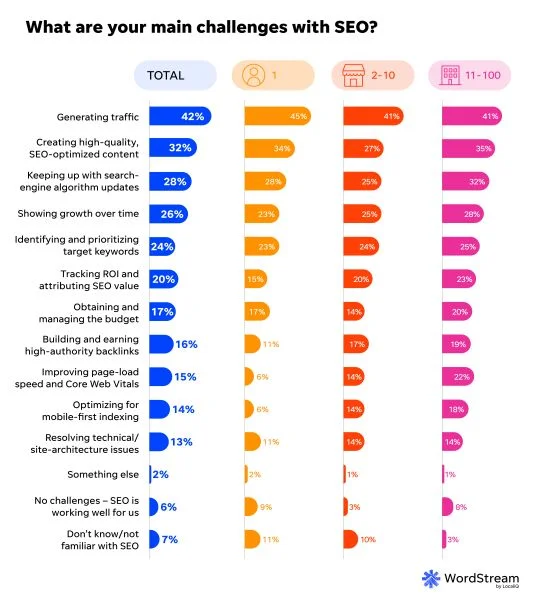
There was a consistent message from across the entire survey pool: Generating traffic is the biggest challenge of SEO. 42% of businesses said that overall, and so did at least 40% of the businesses from each category.
The next biggest SEO challenges were creating high-quality, SEO-optimized content (32%) and keeping up with search engine algorithm updates (28%). That list stayed in the same order regardless of business size. That’s very telling of the time and focus needed to wrangle an ever-evolving SEO ecosystem.
Two other significant challenges included tracking ROI and attributing SEO value (20%) and obtaining and managing the budget (17%). These speak to the difficulty of translating search engine traffic into real revenue and justifying the dollars needed to do it. That’s understandable, since clicking an organic link on a search page is harder to connect to a sale than clicking a link from a paid ad.
🚨 Want this report sent directly to your inbox? Download it here!
How small businesses handle GEO and AI
The influence of GEO and AI is only growing. We wanted to check in to see how they factor into small businesses’ strategies.
SMBs’ familiarity with GEO
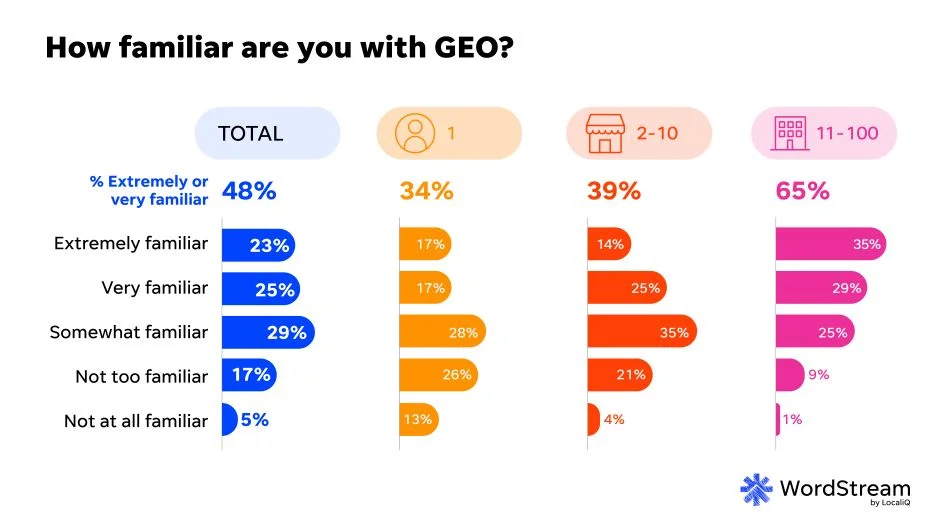
Overall, 48% of businesses are either extremely or very familiar with GEO. And only 5% are not at all familiar with it. That’s great news since generative search is relatively new.
That familiarity is much higher for larger businesses. 65% of them said they were either extremely or very familiar with GEO. 39% of mid-sized businesses said the same. And for single-employee organizations, it was 34%.
On the flip side, 39% of solopreneurs said they were either not too familiar with GEO or not familiar with it at all. That’s not an unexpected result since smaller businesses may be spread thinner, having less time to think about emerging channels and technology, and taking on more tasks with fewer people.
That said, generative search engines are gaining popularity. A recent poll revealed that 60% of US adults use AI to search at least some of the time. One way or the other, small businesses will need to keep up with these trends if they want to compete for traffic and understand where they’re losing out.
If SMBs monitor AI referrals and mentions
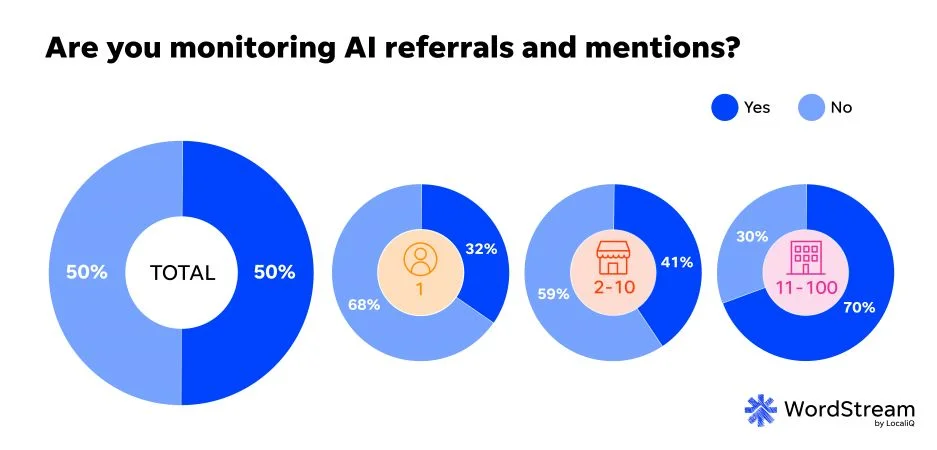
The number of businesses that track GEO referrals and mentions fell neatly in line with their familiarity. Half of all respondents reported monitoring AI referrals and mentions. 70% of the largest businesses, 41% of medium-sized businesses, and 32% of solopreneurs said they did.
GEO can level the playing field for smaller brands; most AI citations come from websites that aren’t in Google’s top 10 results. Small businesses could take advantage of this citation arbitrage to grab traffic from AI search engines.
Web pages with the most AI traffic
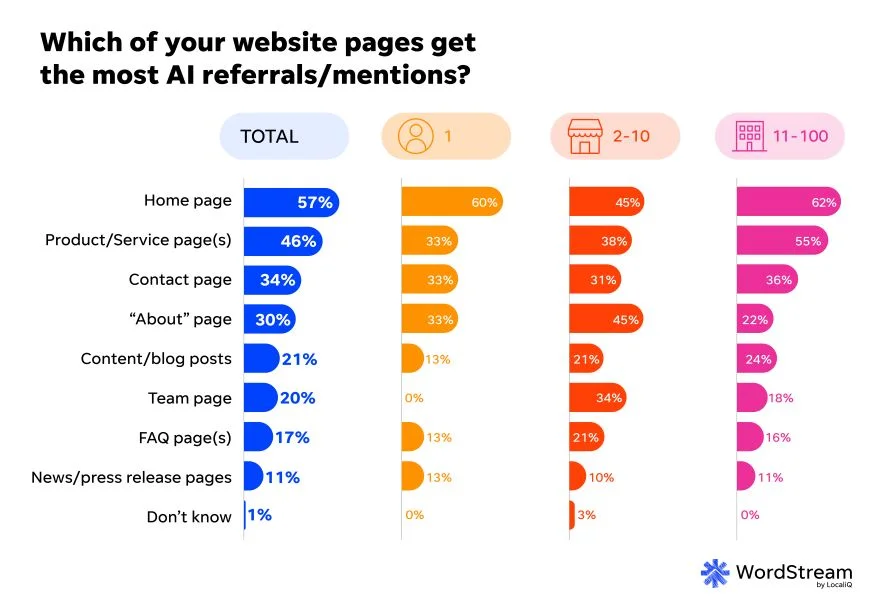
We asked the businesses that monitor AI referrals and mentions to identify which web pages are the most common targets. Home pages (57%) were most often cited as traffic drivers from AI referrals, with product/services pages (48%) coming in second and contact pages (34%) rounding out the top three.
45% of businesses with two to 10 employees also said their “About” page was a prime target for AI links, which exceeded both sole proprietors (33%) and the largest businesses in the study (22%). It’s possible that the size of the business is just big enough to invest in a strong About Us page, without being so large that it becomes impersonal.
FAQ (17%) and News/press release pages were the least likely to generate lots of AI referrals.
As GEO becomes a more important piece of the traffic mix, small businesses would do well to optimize their home, product, and about pages to get found there.
How SMBs improve visibility in AI search
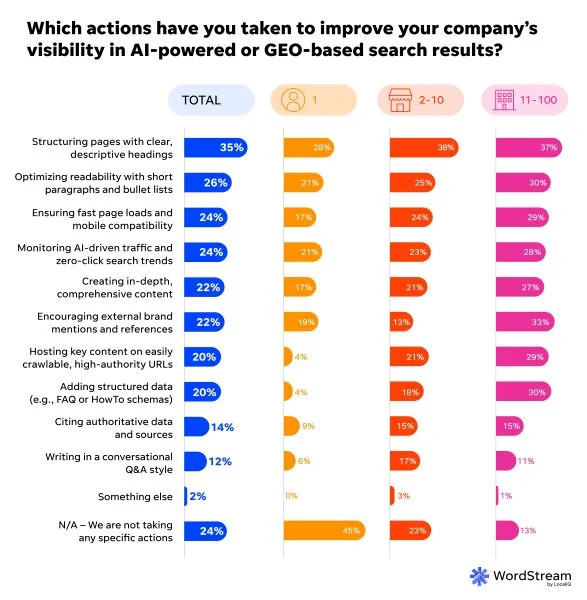
Across the board, structuring pages with clear, descriptive headlines was the most popular action taken to improve visibility in AI search—35% of all businesses did that.
Optimizing readability (26%) and addressing technical SEO tasks, such as improving site speed and mobile compatibility (24%), were also top tactics. The largest businesses in our survey also identified encouraging external brand mentions (33%) and structured data (30%) as their number two and three top options for increasing visibility in AI search engines, respectively.
Interestingly, just about every tactic mentioned also aligns with SEO best practices. So, while many small businesses feel the pinch of “learning” GEO, they may already have a game plan for getting AI’s attention.
SMBs’ main GEO challenges
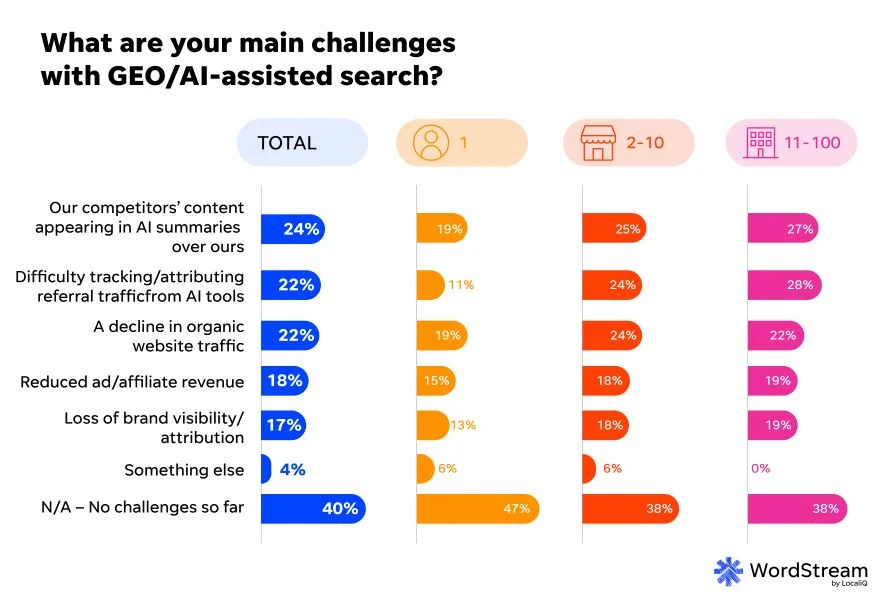
The biggest challenge with GEO, according to small businesses, is that their competitors’ content appears in AI summaries over their’s (24%). Difficulty tracking and attributing referral traffic from AI tools tied for second overall (22%) with declining organic website traffic.
For both sole proprietors (19%) and businesses with up to 11 employees (25%), the biggest GEO challenge is competitors appearing higher in rankings. Both groups also mentioned a decline in organic website traffic as a top hurdle in AI search.
Bigger businesses said traffic and attribution difficulties (28%) were their biggest GEO challenges, followed by competition (27%) and traffic decline (22%).
It’s interesting that the challenges were more evenly spread out both in aggregate and for each group of businesses. No one challenge garnered more than 30% of the vote, while the top four were within 10 percentage points of each other. Compare that to SEO, where the top challenge of driving traffic received nearly 20% more votes than the fourth highest. It appears that small businesses face many similar obstacles to success in AI search, regardless of their size.
How small businesses without a website are planning for the future
Roughly one-third of the businesses that participated in our survey don’t currently have a website. That was surprising, so we wanted to understand if they ever planned to launch one, what’s keeping them from doing so, and if new technologies like AI are changing their mind.
When site-less SMBs plan to launch a website
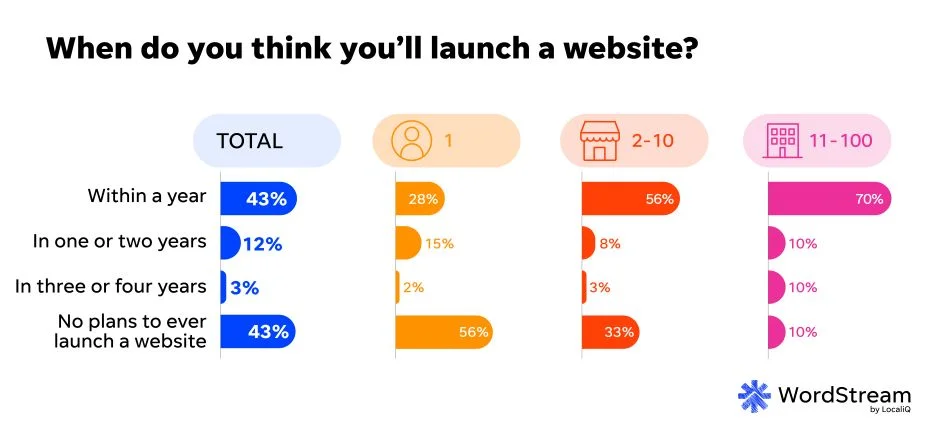
For those businesses without a website, launching one isn’t out of the question. 55% of those SMBs said a website was likely within the next year or two. That number jumps to 80% for the biggest businesses, but that was a pretty small sample size since most brands in that category already have a site.
43% of SMBs don’t ever plan to launch a website, and that number goes up to 56% for sole proprietorships. That’s surprising if you go back and see how many one-person shops rely on a website to find leads and sell—and that nearly half of them felt their businesses wouldn’t survive as is without one.
Why SMBs don’t have a website
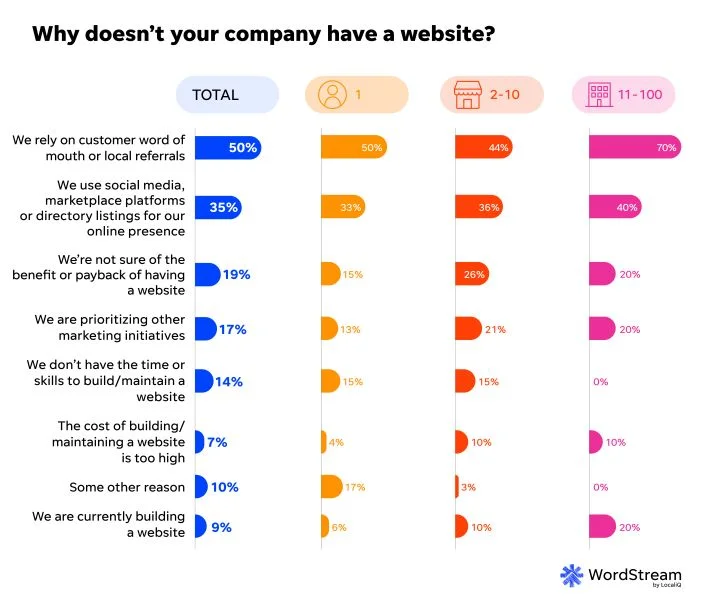
The primary reason businesses in every category lack a website is that they rely on word of mouth or local referrals—that’s the reason 50% of the SMBs gave. The second most common reason (35%) was that businesses use other digital platforms—such as social media, marketplaces, and directory listings—to find new customers.
Lack of clarity or resources rounded out the top reasons not to launch a site. 19% said they weren’t sure of the payback, 17% are focusing on other marketing initiatives, and many of the rest said it was too taxing on their time (14%) or finances (7%).
When you put these pieces together, it’s clear that not having a website does not equal not having an online presence. For businesses without a website, it’s even more crucial to claim your Google Business Profile, maintain accurate directory listings, and keep your social media profiles up to date. But it’s still possible that you’d miss out on a lot of leads and prospects without a website.
If website-less SMBs think a website would be beneficial
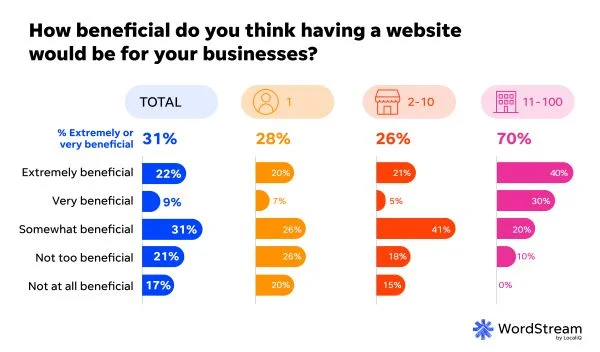
We asked the businesses that didn’t have a website if they thought having one would be beneficial. 31% of all respondents said it would be extremely or very beneficial. That result leaned more heavily toward the bigger brands, as 70% of them said that, while just 28% of the sole proprietorships and 26% of the mid-sized businesses agreed.
17% of all businesses without a site felt it wouldn’t be beneficial at all, which stood out. It would make sense if very small businesses said they don’t have the time to build or manage one, but to not think it would help at all is less expected.
AI’s influence on the decision to launch a site
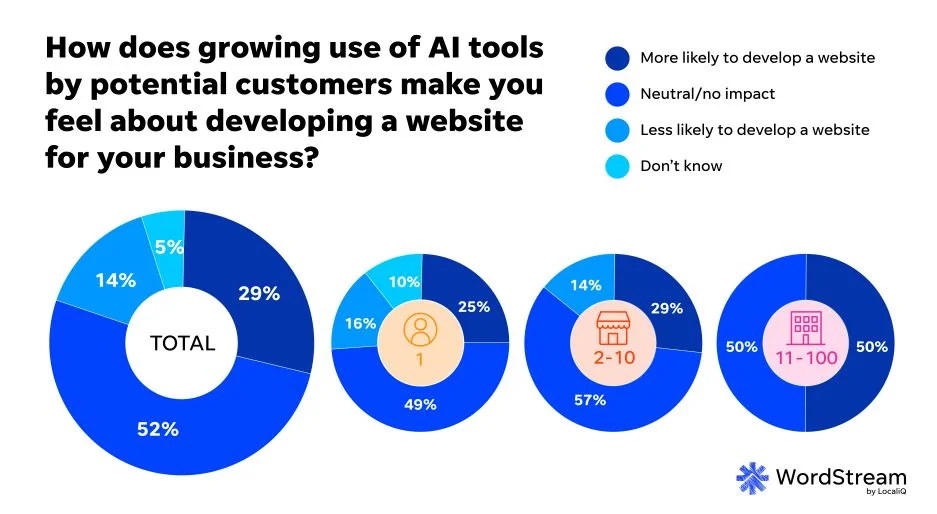
The growing adoption of AI tools won’t sway most businesses to build a website. 52% of SMBs said AI growth will have no impact on that decision; 14% said it would make them less likely to build one, and 5% weren’t sure. That leaves just 29% of these businesses more likely to have a site in the face of AI’s proliferation.
Those numbers stayed somewhat consistent for one-person and mid-sized businesses in our survey. However, 10% of sole proprietors were unsure, while none of the businesses with two to 10 employees said that. The small group of bigger businesses was split evenly between being neutral and being more likely to build a site.
AI’s impact on overall internet presence and performance
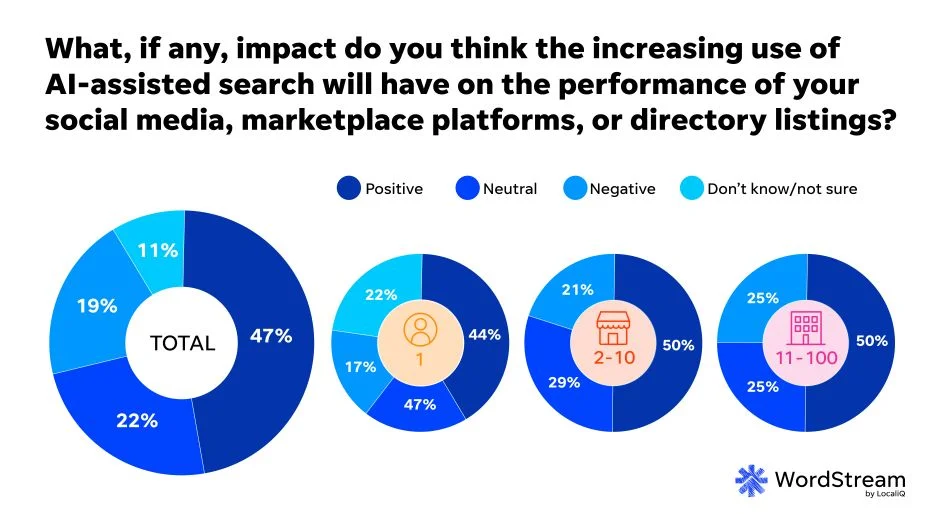
We learned how businesses with websites are affected by AI. What about those that don’t have a site? 47% of the businesses we surveyed said AI tools like ChatGPT and Gemini will be a net positive for the performance of their local channels (like social media and directory listings). That does make sense, since social media posts are now showing up in AI search results. Businesses without a site have more opportunities to get found by people searching. However, a website is still going to give SMBs a better chance of showing in both AI and organic search.
Digging in by company size, we see the positive sentiment is the same (50%) for both the medium and largest size businesses in the cohort, while sole proprietors (44%) were a little less likely to feel that way. Sole proprietors were also the only group to have members who didn’t know how AI could impact their online presence.
Note that a quarter of the businesses without a website had a negative outlook on AI’s impact, while just 17% of the one-person brands responded that way. If you’re a very small business and don’t have a website, you may have less to lose to AI in terms of traffic and attention share.
What it all means for the future of online search
How people search online is fracturing, and it’s clear that small businesses are feeling the pressure to adapt.
For more than a decade, Google was synonymous with online search. There were few competitors, and they held only a small portion of the search market. SMBs could put most of their digital marketing focus on finding customers through that one channel.
Social media has now become a significant alternative for product and brand discovery. We saw in our survey that small businesses consider it as or more important than search engines for finding new traffic and customers. SMBs need to put some of their limited resources into their social accounts or miss out on this shift in consumer behavior.

Social media is a bigger part of the marketing mix for SMBs
We also saw that small businesses are starting to think about optimizing for AI search engines. While a smaller piece of the search pie for now, more people are turning to platforms like ChatGPT and Gemini to find answers and solutions. Again, SMBs have another channel to figure out or fall behind their competitors.
Google is still the 800-pound search gorilla. But many of the SMBs we surveyed said they’re losing search traffic in part due to AI. The upcoming challenge for these small-but-mighty businesses will be balancing the time they spend optimizing for traditional search engines with growing their presence on social media and gaining traction in AI platforms. It’ll take some creative strategies and new tools—many of them AI-powered—to strike that balance.
Get more visibility, traffic, and leads for your business
What we learned from this survey can help inform your own marketing strategy. If you’d like to generate more attention, traffic, and leads through all your digital channels, we’re here to help. Reach out to talk about our digital marketing solutions, and we’ll show you how they can help you surpass your growth goals.