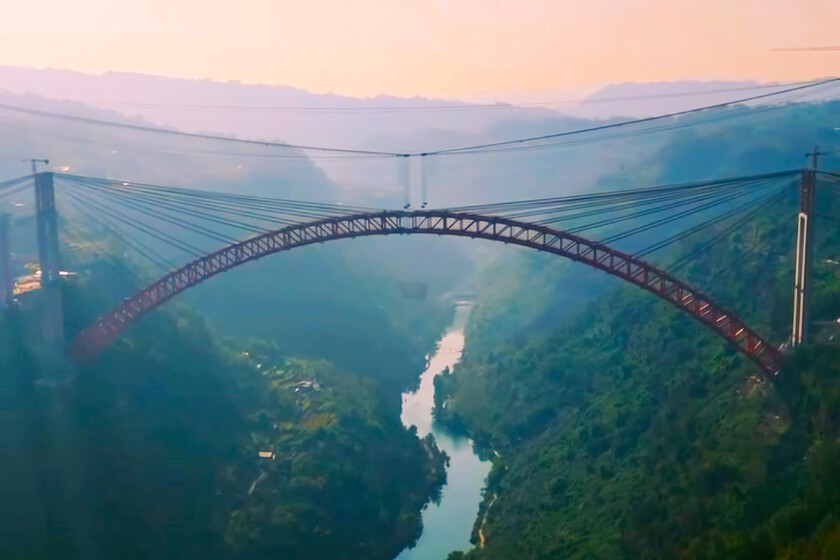
There is not a month when a mega-construction is not launched, and in that area, China leads with an iron fist. Whether due to the magnitude of its works, the technique used or the terrain saved with the structure, the Asian giant has become an example of perseverance when creating, above all, infrastructure that connects all its regions. After the highest bridge in the world, in the province of Chongqing, they are involved with another record-breaking bridge.
One with the largest steel span in the world.
Fenglai Daxi River Grand Bridge. As is often the case with these works, something that stands out as much as its magnitude is the construction time. In just three years, they have built a bridge in an extremely complex area. It clears two cliffs and the causeway will be 310 meters above the water surface. But more than because of the terrain, if it is news for something, it is because of the opening, that space between two columns.
The total length of the bridge will be 1,136 meters when it is finished and the span is almost half of it: 580 meters that are suspended leaning on an arch-shaped structure made of steel. The height of the arch in its central part is 116 meters and both the photos and videos show the complex lattice-type structure.
Precision. More than a whim, it is necessary if you want to bridge that distance while looking for a bridge that can withstand both the weight and the possible tremors that are frequent in the region. To build the structure, the engineers resorted to the BIM (or Building Information Modeling) methodology that simulates by computer all the processes of both the construction of the structure and its future maintenance.
This is common, but essential in this lattice structure where many embedded components require an accuracy of less than a millimeter of deviation. On November 28, the team completed the joining of each of the pieces weighing more than 300 tons that make up that great puzzle of the lattice span, and now it remains to create the road that will consolidate the union between regions.
Necessary. Because the Fenglai Daxi River Grand Bridge is not simply a feat of engineering: it is a catalyst for something China is aggressively pursuing. The country wants to carry out an economic and social transformation of the most challenging regions of its geography, and the Chongqing region falls into those plans as it has a large number of mountain ranges that have traditionally challenged communication with large centers.
When completed, the bridge will be part of the Wu-Liang Expressway that will connect the urban center of Chongqing with the Wulong district in approximately one hour, when the current detour takes approximately three hours, having to take a mountain route. And it is just one piece of a much more ambitious plan, which includes 52 construction projects, more than 1,200 kilometers of highways and a total investment of 155 billion yuan, about 19 billion euros.

Megathings = tourism. Thus, the bridge will seek to become an element that will facilitate the flow of goods between the regions, but also of people with the aim of promoting tourism. Currently, about 350,000 people live in Wulong and it has traditionally been a poor area due to the soil not being the best for farming and its natural isolation. However, since 1994, tourism has transformed it, especially since the Karst Geology National Park was included in the UNESCO World Heritage list in 2007.
Now, Wulong aspires to become a global tourist destination, and this improvement in infrastructure seems key to achieving that goal. Furthermore, it is no longer just that China’s mega-constructions facilitate mobility: the buildings themselves are designed with the aspiration that they become points of interest.
An example is the Huajiang Grand Canyon Bridge, an immense construction 625 meters above the river level that is used to cross from one side to the other, but has a cafeteria and some adventure activities. Another is the Three Gorges Dam, which can not only move the Earth’s axis of rotation, but has a museum that documents the construction, an example of how the dam itself works, and multiple observation points.
Images | Get Sci-Tech
In WorldOfSoftware | Young tourists from China have begun to visit random places en masse. There is an explanation: Xiaohongshu