Wilmington, Ohio, resident Quintin Koger Kidd was so concerned last June with his local public officials’ alleged misdoings – open meeting violations and other discrepancies – that he filed a complaint in court to have the mayor and city council members removed from their posts.
When Koger Kidd later heard that the city supported plans by Amazon Web Services to build a $4bn datacenter on 500 acres (200 hectares) south of town, he was aghast. Amazon has sought a tax abatement that would see its datacenter exempt from paying property taxes for 30 years in exchange for the funding of local schools and infrastructure projects.
“The people up on city council are, for the most part, good people. They care about the community, [but] they have been taken advantage of by these companies,” he says, referencing the multinational giant. “They’re in over their heads … It’s the digital colonization of flyover states.”
For decades, administering small towns and communities in the US largely centered on zoning amendments, fixing roads and ensuring that trash was collected. But today, the emerging presence of datacenter developments is creating a vicious new divide between local administrators, who play an essential role in rural America, and the residents they are elected to represent.
In small towns across the US, residents are accusing local representatives of a wave of issues that range from failing to listen to public concern and profiting from the presence of datacenters, resulting in a deepening distrust in local government.
In December, three people were arrested at a city council meeting in Port Washington, Wisconsin, after a brawl erupted around a proposed datacenter in the community of 12,000 people. A month earlier, police escorts were required at a council meeting discussing datacenters in DeKalb county, Georgia.
The boiling anger is prompting a crisis in local government circles.
Late last year, the mayor and a council member of Ashville, a small town south of Columbus, Ohio, resigned abruptly after residents recoiled at the prospect of a new facility being built locally by EdgeConneX, a Virginia-headquartered datacenter company. The resignations leave the village of fewer than 5,000 residents without much-needed administrative experience.
Similar stories are playing out in small towns in Minnesota, Michigan, Oregon and elsewhere, where officials and administrators with decades of experience and who are oftentimes paid very little, are walking off the job due to acrimony fueled by datacenters.
When the municipal leaders of Saline Township, a rural community of 2,270 people south of Ann Arbor in Michigan, voted last September against rezoning a tract of agricultural land sought by a developer representing the tech giants Oracle and OpenAI, residents thought that was the end of the threat of a massive datacenter dominating their community.
But they and their fellow residents were almost immediately proved wrong.
Within weeks, lawyers for Related Digital, the developer, and landowners who want to sell their land to the developer sued the township, alleging it was guilty of “exclusionary zoning”, a practice that is illegal in Michigan.
The township leaders quickly settled the lawsuit, essentially setting in motion a 1.4 gigawatt, $7bn datacenter that could place major demands on the local electricity grid, in return for relatively minor funding to local schools and promises around noise reduction and limited electricity use.
“In the 50 years I’ve spent practicing municipal law, this is one of the most divisive things I’ve seen,” says Fred Lucas, an attorney representing the Saline Township municipality, of the datacenter debate.
“It’s been a nightmare. Every [public] meeting is filled with people calling for everybody to resign. I wish I’d never heard of data storage facilities.”
Some locals are livid and have sued township leaders for allegedly violating Michigan’s open meetings act by making decisions in secret and failing to hold public votes.
Related Digital claims the project will create 2,500 union construction jobs and thousands more across the wider community but declined to comment directly on its role in the unrest caused by its presence in the community.
“We are developing on just 250 acres of the more than 1,000 acres we own – so 75% of the site is being preserved as open space, farmlands and wetlands,” says Natalie Ravitz, a spokesperson for Related Digital.
Experts say the communication gap between residents and datacenter companies is due to the multifaceted nature of bringing huge corporations to small communities.
“Both parties are talking past each other when it comes to the benefits and the costs that are associated with the datacenters,” says Nicol Turner Lee, director of the Center for Technology Innovation at the Brookings Institution.
“These are private corporations that, in many respects, have been given a lot of political deference to engage in this very accelerated behavior.”
For their part, landowners say they are free to do what they want with their own property. In Wilmington, Ohio, local media report that Amazon Web Services will create 100 permanent jobs with a payroll of $8m. The community was previously left stranded by a major multinational when in 2009 the closure of a DHL Express facility eliminated more than 8,000 jobs, devastating the local economy.
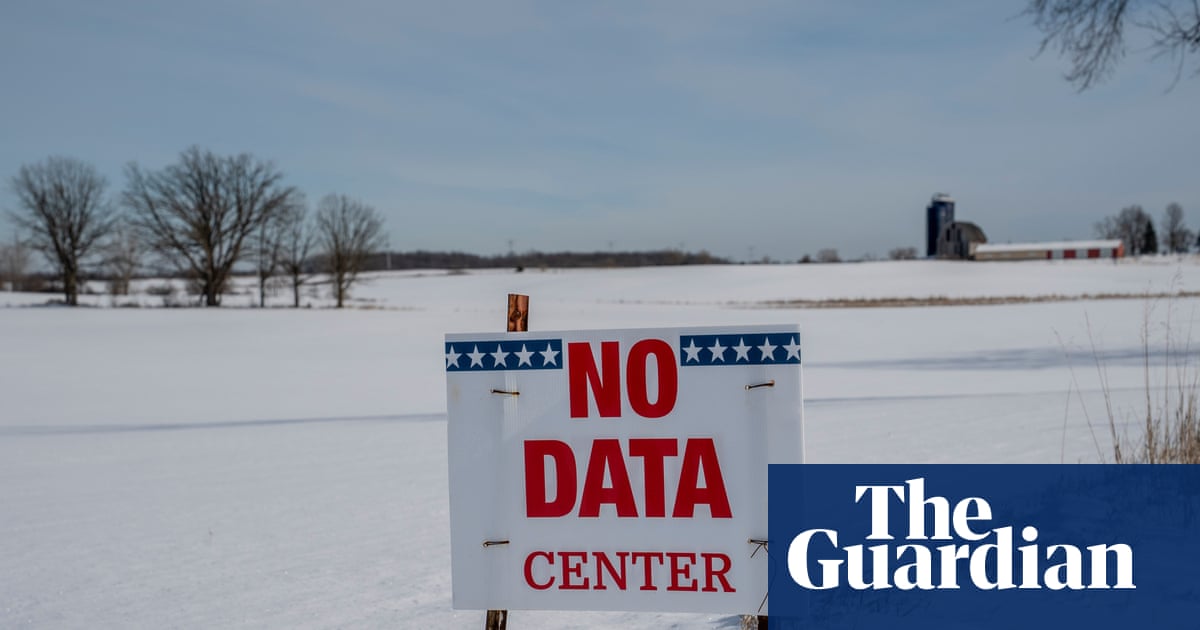
But skeptics say their voices are not being heard, and in neighborhoods across the city of 12,000 residents, lawn signs opposing the datacenter are growing in number.
Some say the first they heard of the datacenter project was during a school board meeting held at 7.15am last November that approved a compensation agreement with Amazon. Furthermore, Wilmington’s city council wants to rezone an additional 545 acres from “rural residential” to a category that allows for the construction of data storage facilities.
A tract of agricultural land for sale close to the planned location of the proposed datacenter increased from under $10m in 2021 to $21m last August. The Clinton county auditor’s office shows the property, which spans more than 280 acres, is part owned by a city council member, who didn’t respond to emails from the Guardian.
Standing in a new housing development that abuts the proposed datacenter site, Koger Kidd, who admits he’s a regular user of artificial intelligence apps, points out just how close the site is to residential homes.
“There will be backup generators here. It could get really loud,” he says.
Amazon Web Services and Wilmington’s city council didn’t respond to questions emailed from the Guardian.