Everyone has built a “Chat with your PDF” demo. But moving from a POC to an enterprise production system that handles millions of documents, strict compliance, and complex reasoning? That is where the real engineering begins.
We are currently seeing a massive bottleneck in the industry: “POC Purgatory.” Companies deploy a standard RAG (Retrieval Augmented Generation) pipeline using a Vector Database and OpenAI, only to hit three walls:
- The Context Wall: Massive datasets (e.g., 5 million+ word manuals) confuse the retriever, leading to lost context.
- The Accuracy Wall: General-purpose models hallucinate on domain-specific tasks.
- The Governance Wall: You cannot deploy a model that might violate internal compliance rules.
To solve this, we need to move beyond simple vector search. We need a composed architecture that combines Knowledge Graphs, Model Amalgamation (Routing), and Automated Auditing.
In this guide, based on cutting-edge research into enterprise AI frameworks, we will break down the three architectural pillars required to build a system that is accurate, scalable, and compliant.
Pillar 1: Knowledge Graph Extended RAG
The Problem: Standard RAG chunks documents and stores them as vectors. When you ask a complex question that requires “hopping” between different documents (e.g., linking a specific error code in Log A to a hardware manual in Document B), vector search fails. It finds keywords, not relationships.
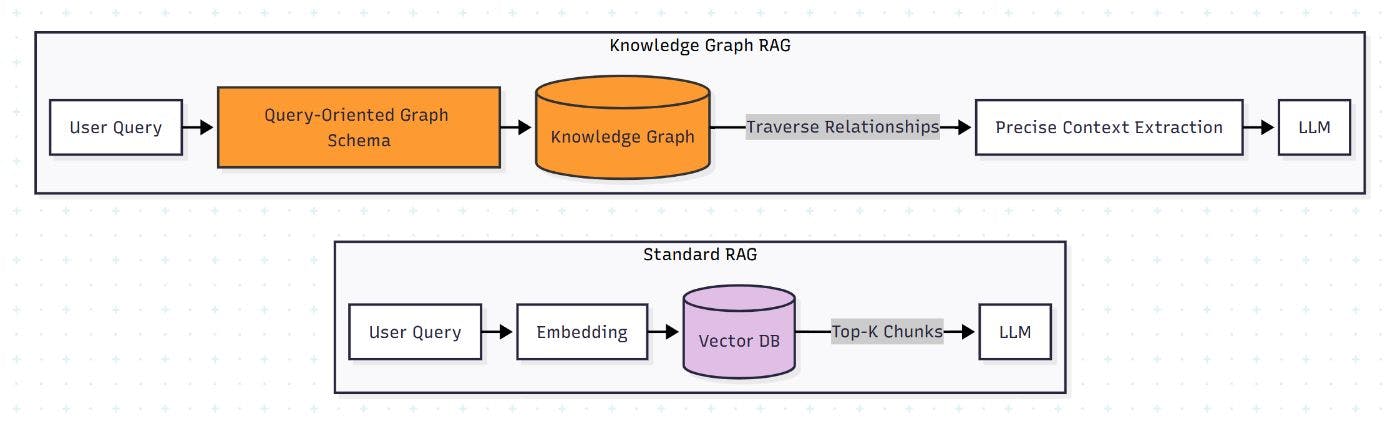
The Solution: Instead of just embedding text, we extract a Knowledge Graph (KG). This allows us to perform “Query-Oriented Knowledge Extraction.”
By mapping data into a graph structure, we can traverse relationships to find the exact context needed, reducing the tokens fed to the LLM to 1/4th of standard RAG while increasing accuracy.
The Architecture
Here is how the flow changes from Standard RAG to KG-RAG:
Why this matters
In benchmarks using datasets like HotpotQA, this approach significantly outperforms standard retrieval because it understands structure. If you are analyzing network logs, a vector DB sees “Error 505.” A Knowledge Graph sees “Error 505” -> linked to -> “Router Type X” -> linked to -> “Firmware Update Y.”
Pillar 2: Generative AI Amalgamation (The Router Pattern)
The Problem: There is no “One Model to Rule Them All.”
- GPT-4 is great but slow and expensive.
- Specialized models (like coding LLMs or math solvers) are faster but narrow.
- Legacy AI (like Random Forest or combinatorial optimization solvers) beats LLMs at specific numerical tasks.
The Solution: Model Amalgamation. n Instead of forcing one LLM to do everything, we use a Router Architecture. The system analyzes the user’s prompt, breaks it down into sub-tasks, and routes each task to the best possible model (The “Mixture of Experts” concept applied at the application level).
The “Model Lake” Concept
Imagine a repository of models:
- General LLM: For chat and summarization.
- Code LLM: For generating Python/SQL.
- Optimization Solver: For logistics/scheduling (e.g., annealing algorithms).
- RAG Agent: For document search.
Implementation Blueprint (Python Pseudo-code)
Here is how you might implement a simple amalgamation router:
class AmalgamationRouter:
    def __init__(self, models):
        self.models = models # Dictionary of available agents/models

    def route_request(self, user_query):
        # Step 1: Analyze Intent
        intent = self.analyze_intent(user_query)

        # Step 2: decompose task
        sub_tasks = self.decompose(intent)

        results = []
        for task in sub_tasks:
            # Step 3: Select best model for the specific sub-task
            if task.type == "optimization":
                # Route to combinatorial solver (non-LLM)
                agent = self.models['optimizer_agent']
            elif task.type == "coding":
                # Route to specialized Code LLM
                agent = self.models['code_llama']
            else:
                # Route to General LLM
                agent = self.models['gpt_4']

            results.append(agent.execute(task))

        # Step 4: Synthesize final answer
        return self.synthesize(results)

# Real World Example: "Optimize delivery routes and write a Python script to visualize it."
# The Router sends the routing math to an Optimization Engine and the visualization request to a Code LLM.
Pillar 3: The Audit Layer (Trust & Governance)
The Problem: Hallucinations. In an enterprise setting, if an AI says “This software license allows commercial use” when it doesn’t, you get sued.
The Solution: GenAI Audit Technology. n We cannot treat the LLM as a black box. We need an “Explainability Layer” that validates the output against the source data before showing it to the user.
How it works
- Fact Verification: The system checks if the generated response contradicts the retrieved knowledge graph chunks.
- Attention Mapping (Multimodal): If the input is an image (e.g., a surveillance camera feed), the audit layer visualizes where the model is looking.
Example Scenario: Traffic Law Compliance
- Input: Video of a cyclist on a sidewalk.
- LLM Output: “The cyclist is violating Article 17.”
- Audit Layer:
- Text Check: Extracts Article 17 from the legal database and verifies the definition matches the scenario.
- Visual Check: Highlights the pixels of the bicycle and the sidewalk in red to prove the model identified the objects correctly.
A Real-World Workflow
Let’s look at how these three technologies combine to solve a complex problem: Network Failure Recovery.
- The Trigger: A network alert comes in: “Switch 4B is unresponsive.”
- KG-RAG (Pillar 1): The system queries the Knowledge Graph. It traces “Switch 4B” to “Firmware v2.1” and retrieves the specific “Known Issues” for that firmware from a 10,000-page manual.
- Amalgamation (Pillar 2):
- The General LLM summarizes the issue.
- The Code LLM generates a Python script to reboot the switch safely.
- The Optimization Model calculates the best time to reboot to minimize traffic disruption.
- Audit (Pillar 3): The system cross-references the proposed Python script against company security policies (e.g., “No root access allowed”) before suggesting it to the engineer.
Conclusion
The future of Enterprise AI isn’t just bigger models. It is smarter architecture.
By moving from unstructured text to Knowledge Graphs, from single models to Amalgamated Agents, and from blind trust to Automated Auditing, developers can build systems that actually survive in production.
Your Next Step: Stop dumping everything into a vector store. Start mapping your data relationships and architecting your router.