As AI continues to reshape the technological landscape, one critical question remains: who controls the infrastructure?
While centralized AI platforms dominate the conversation, a quiet revolution is brewing at the intersection of blockchain and artificial intelligence.
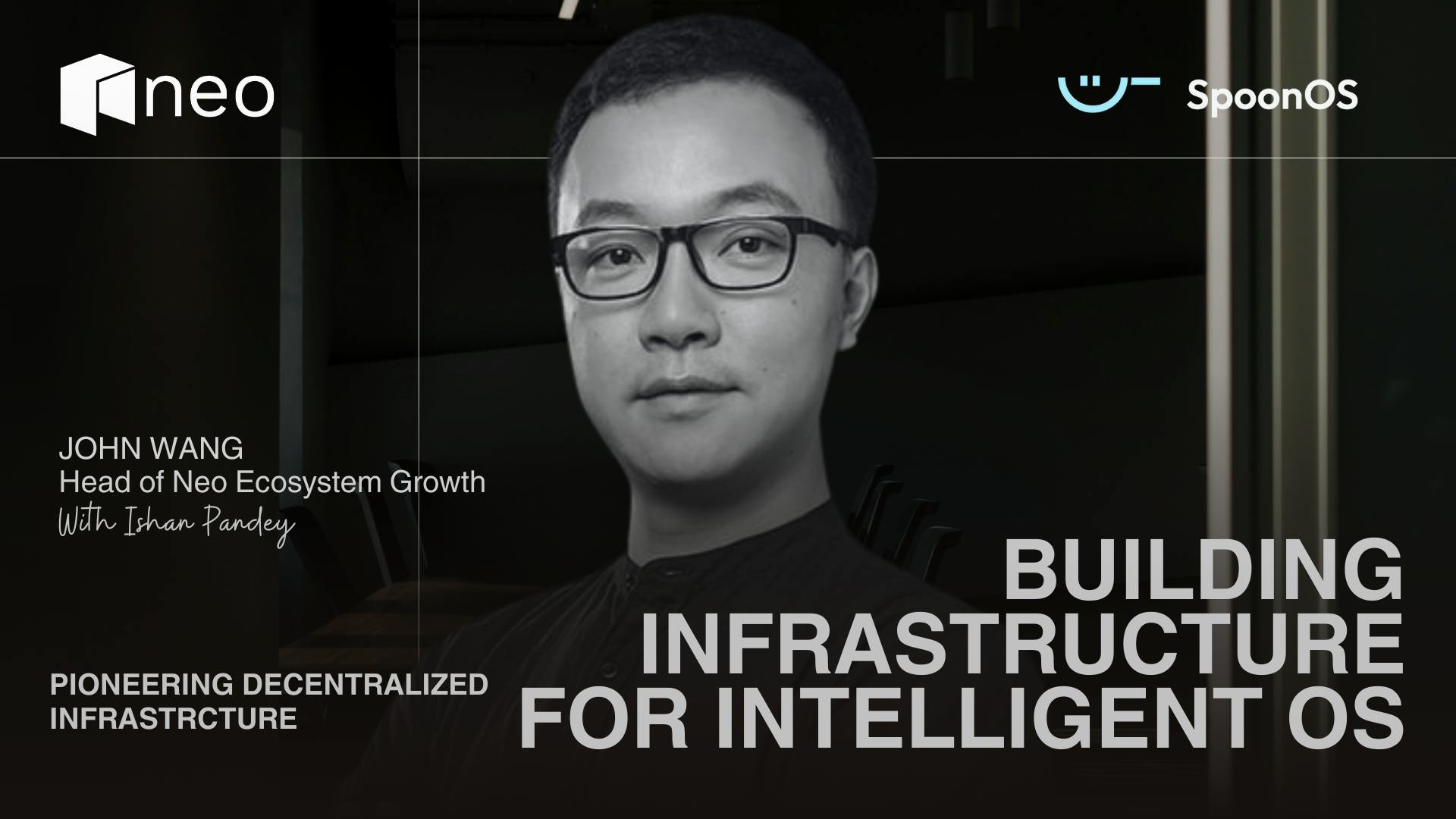
John Wang, Head of Neo Ecosystem Growth and Managing Director of Neo Ecofund, has been at the forefront of this movement, backing decentralized solutions that challenge the status quo. With over 100 ecosystem investments under his belt and a strategic vision spanning multiple continents, Wang’s latest focus on SpoonOS represents a bold bet on democratizing AI infrastructure.
In this exclusive interview, we explore the technical and business challenges of creating AI infrastructure that serves users rather than corporations, the $100K challenge Neo and SpoonOS launched to solve centralized AI’s biggest problems, and what the future holds for blockchain-powered AI ecosystems.
Ishan Pandey: Hi John, welcome to our “Behind the Startup” series. You’ve led ecosystem development for Neo since 2017, investing in over 100 projects globally. What drew you from strategic consulting at Accenture to the blockchain space, and how has your approach to ecosystem building evolved over these years?
John Wang: My transition happened around 2016, when blockchain was still very niche. At that time, Bitcoin and ICOs were generating unusually high returns, which initially caught my attention. But as I dug deeper, reading the Bitcoin whitepaper and understanding the philosophy behind it, I realized blockchain represented something fundamentally different from the traditional systems I was used to.
Working in consulting, especially at big firms, often felt like being part of a machine where individuals had little power to influence outcomes. We created plans and proposals, but whether they were used wasn’t up to us. Many weren’t even meant to improve anything, they were internal tools for corporate processes.
Blockchain, however, promised fairness, transparency, and genuine participation. It gave individuals more agency. Good or bad, anyone could use Bitcoin, and the system treated everyone equally. That idea motivated me to join the industry in 2017. I believed blockchain offered a real opportunity to build something meaningful and more equitable than the traditional corporate world.
Ishan Pandey: Neo and SpoonOS recently launched the $100K challenge focused on problems that centralized AI cannot fix. What are the specific technical and infrastructural limitations of centralized AI systems that decentralized solutions like SpoonOS can uniquely address?
John Wang: Our intention isn’t to compete directly with centralized AI companies, they have enormous resources. Instead, we see decentralization as a vertical segment of the larger AI industry.
AI itself is an infrastructure that enhances efficiency across all sectors, centralized or decentralized. However, in Web3, many AI projects focus primarily on tokens, not on building real tools for developers. There’s a big gap: Web3 developers lack proper AI tools.
Decentralized AI can help bridge that gap by enabling more people to participate, developers can contribute GPU power, co-build models, and collaborate globally without being controlled by large corporations.
Our goal isn’t “decentralized is better than centralized.” It’s that Web3 needs tools enabling developers to use AI in a fair, open, and community-driven environment.
Ishan Pandey: SpoonOS operates at the intersection of blockchain and AI infrastructure. How does SpoonOS’s architecture differ from traditional AI platforms, and what technical advantages does decentralized AI infrastructure offer to developers and end users?
John Wang: It’s hard to compare head-to-head with centralized AI companies, they have enormous capital and resources. For now, we’re still learning from them.
Our short-term goal is to build an operating system and tooling suite for Web3 developers that matches the quality and usability of centralized platforms. Current AI developer tools aren’t Web3-friendly—they don’t integrate blockchain data, payments, or components easily.
There’s also a skill-gap problem: AI developers want blockchain features, and blockchain developers want AI tools. But the two worlds are still disconnected.
SpoonOS aims to be the bridge, reducing the difficulty for both groups.
Long term, the decentralized advantage comes from co-building. Once the core system stabilizes, we will open-source it, enabling global developers to contribute. If the world’s developers build something together, it will surpass what any centralized company can create.
Ishan Pandey: You’ve invested in over 100 projects across the Neo ecosystem. What criteria do you use to identify projects worth backing, and what made SpoonOS stand out as a strategic priority? How do you balance risk and reward when investing in emerging tech at the intersection of AI and blockchain?
John Wang: For early-stage investments, where we focus, two things matter most:
- A logical, reasonable idea. n It can be bold, but it must make sense and solve a clear problem. n
- The founder’s character and motivation. n Many founders today simply want funding, not to build a real startup. A good founder must genuinely want to create something meaningful. Even if the initial idea is wrong, it can change—the founder, however, is the core. n
Why SpoonOS stood out:
SpoonOS is our own incubated project. It addresses a very specific gap: the disconnect between AI developers and Web3 developers. Lowering that barrier creates a logical growth model, developers use SpoonOS to build agents, those agents attract users, and the ecosystem becomes self-sustaining.
On balancing risk in AI × blockchain:
Blockchain investments have slowed for us; we rarely invest early-stage unless incubating internally. It’s safer for most people today to hold OG tokens.
AI, however, is different. AI projects usually solve concrete technological problems and provide real utility. Even though valuations may be high, the sector is early, similar to blockchain’s early days. Many industries still don’t use AI deeply, which means there’s room for meaningful innovation and early investment.
Ishan Pandey: Looking at the broader landscape, major tech companies are racing to control AI infrastructure while blockchain projects promise decentralization. Where do you see the AI infrastructure landscape in 3–5 years? What role will decentralized platforms play, and what needs to happen for projects like SpoonOS to achieve mainstream adoption?
John Wang: The trend in AI is consolidation. Last year, different AI companies were building very different LLMs. Now, leading models like ChatGPT, Gemini, and Grok all aim to solve most problems for users. Big companies will likely dominate general-purpose AI.
This means opportunities will emerge in vertical AI solutions—sector-specific products built using existing LLMs. These vertical products will solve problems in chemistry, finance, real estate, or any specialized domain. Startups should focus on serving specific industries rather than trying to compete with giants.
Role of decentralized platforms:
I see decentralization not as competition but as complementary to centralized AI. Decentralized systems offer:
- lower operational costs through token incentives n
- access to global data and GPU power n
- co-building models and infrastructure n
- AI-driven efficiency that enhances decentralized systems themselves n
The relationship is symbiotic.
What SpoonOS needs for mainstream adoption:
Right now, we aren’t where we want to be. We launched global hackathons to bring developers in, gather real feedback, and let them identify what’s broken or missing.
Our roadmap includes:
- expanding local developer evangelists worldwide n
- collecting feedback to refine the OS n
- releasing improved versions n
- building high-level, low-code tools on top of the OS so developers can create agents without heavy coding n
Eventually, we aim for SpoonOS to evolve from a technical GitHub-style toolkit into a more intuitive, visual development environment.
Don’t forget to like and share the story!
:::tip
This author is an independent contributor publishing via our business blogging program. HackerNoon has reviewed the report for quality, but the claims herein belong to the author. #DYO
:::
n n