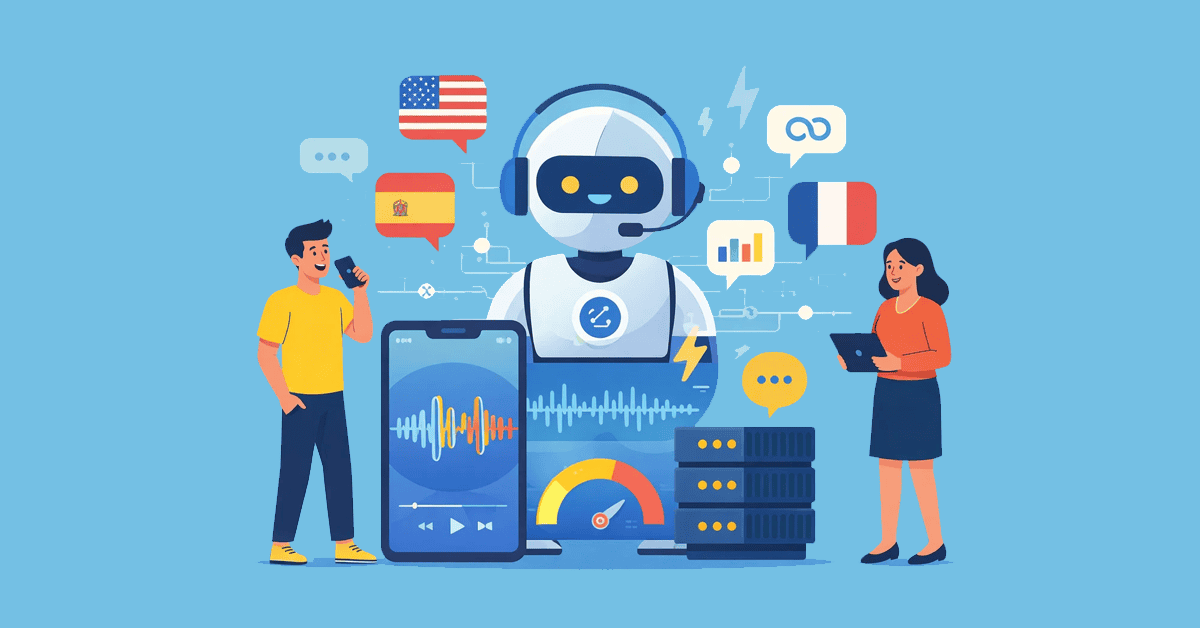
Voice interactions are advancing faster than most teams realize. Users now expect assistants that respond instantly, understand real accents, switch languages easily, and sound natural.
Legacy voice systems often can’t keep up. They slow down under heavy traffic, struggle with multilingual inputs, and become costly as usage grows.
Because of this gap, you now see a shift toward a new class of multilingual and ultra-efficient voice agents. These modern systems deliver fast responses, high accuracy, and smooth conversations at scale.
In this blog, you will see how these modern voice agents are reshaping conversational AI.
Understanding Conversational AI in Social Media
Conversational AI has now changed how users interact with businesses on apps, social platforms, and e-commerce sites. This transition is even more evident when we examine conversational AI on social media, where user-triggered engagements demand immediate and organic voice communications.
People now speak their questions, submit voice notes, and expect instant responses. However, many older voice AI systems cannot adapt to multilingual behavior, respond at the necessary speed, or scale during peak traffic. These trends demonstrate that voice-powered experiences are now a necessity.
Example: Retail Support Workflow
One large retail brand up-leveled its customer-support technology from an outdated voice tool to AI-powered multilingual voice agents. This reduced resolution speed by 40% and led to improved customer satisfaction across regions.
The Importance of Multilingual Voice in Social Media
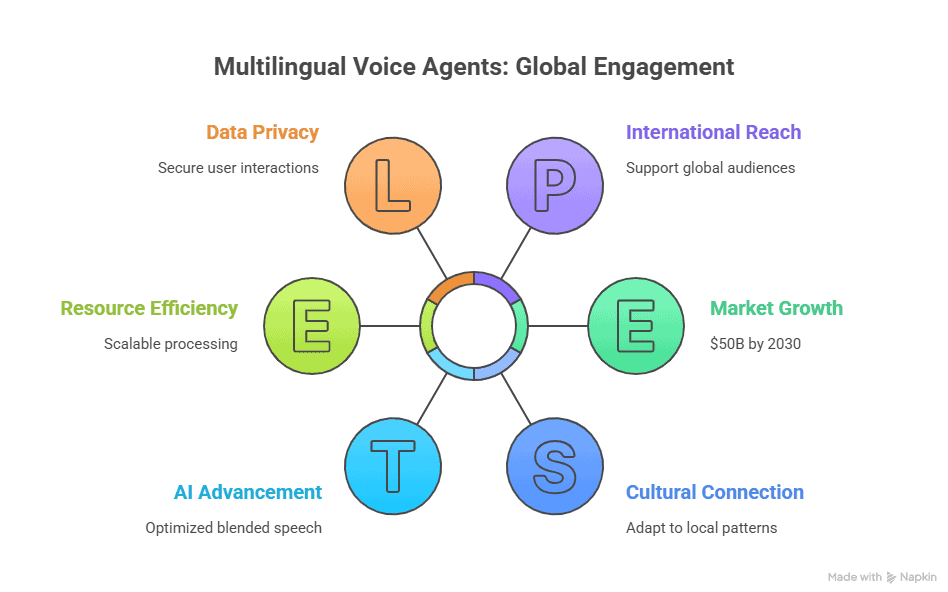
As you move toward multilingual conversations, you need voice systems that feel natural. You want tools that respond fast and keep the flow smooth. Yet many older voice tools slow you down. That is why real-time voice APIs now matter so much. They let you build conversations that feel warm and human.
Today, solutions like the Falcon multilingual TTS API show you what this next step looks like. Falcon gives you a low response time. So, the conversation feels instant and real. You speak, and the system replies without delays. This speed helps you keep users engaged.
It supports 35+ languages, and it can switch between them even mid-sentence. This helps you manage code-mixing without losing clarity. You keep conversations natural because the system responds quickly and catches every word. The API also maintains steady latency across 10+ global regions, so replies stay fast everywhere. It can even handle 10,000 concurrent calls, which helps you scale without stress.
How Social Media Trends Influence Conversational AI
- Now people ask questions, offer feedback and expect immediate responses on social platforms.
- Voice search is also rising on Instagram, YouTube, WhatsApp and short-video apps.
- Users often speak more casually on social media, mixing languages, slang, and regional expressions.
- Brands and creators depend on those quicker responses to keep the conversation flowing during livestreams, product launches, and Q&A streams.
- These real-time habits drive conversational AI to be quick, adaptive and more contextually aware.
- As a result, voice agents must understand multilingual speech, recognize intent quickly, and adapt to informal language.
This behaviour sets the stage for why multilingual voice intelligence matters across social platforms.
Case Example: Creator Engagement
A creator with followers across the US and the Middle East used multilingual voice agents to answer live questions. The system responded naturally in Arabic-English mixes. Viewer engagement increased because the conversation felt smoother and more personal.
How to Build Ultra-Efficient Multilingual Voice AI Agents
Building powerful AI voice agents requires a structured approach grounded in real user behavior and operational needs.
Step 1: Define your use case
Choose a clear purpose such as:
- Customer support
- Voice-led onboarding
- Influencer engagement
- Social commerce Q&A
- Product discovery
- Community moderation
This approach fits well with modern automation practices seen in AI-powered social media tools, which help teams deliver faster and more personalized conversations at scale.
Step 2: Build for real-time performance
Your voice agent must deliver continuous, low-latency responses. Aim for:
- Real-time audio streaming
- Sub-one-second responses
- High context retention
Step 3: Support mixed-language speech
Modern users switch languages fluidly. Falcon excels here by recognizing blended inputs and generating natural, code-switched replies.
Step 4: Scale efficiently
Traffic spikes in social events or live commerce demand elastic scaling without inflated costs. Monitor:
- Performance during peak load
- Cost per audio minute
- Accuracy across languages
Step 5: Train for natural social speech
Social speech includes slang, memes, emojis, and local idioms. Models trained only on formal speech lack contextual accuracy.
Example: Streaming Platform Moderation
A regional streaming service saw recognition accuracy jump from 68 percent to 92 percent after switching to a voice agent trained on informal and region-specific speech.
Real-World Use Cases for Voice AI Agents
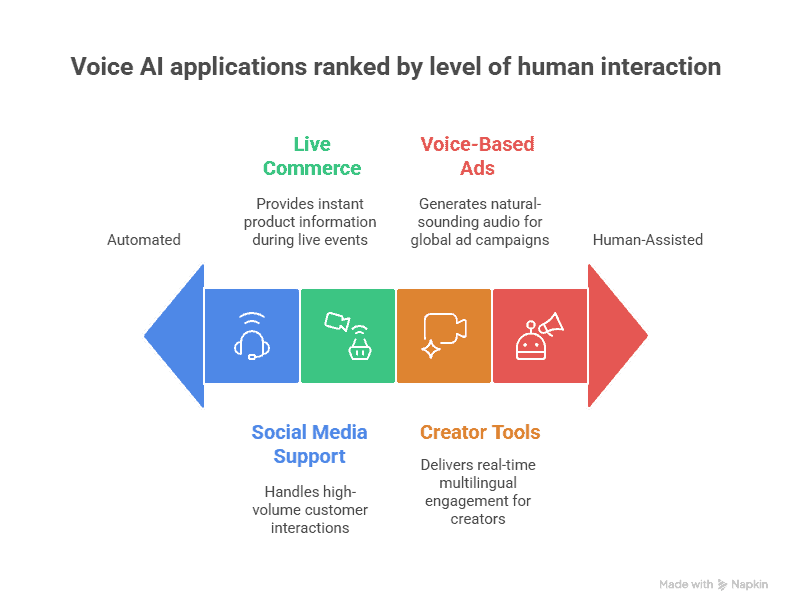
Voice AI is no longer experimental; it’s actively transforming how brands communicate, support customers, and scale content across global audiences. Below are some of the most impactful real-world applications, backed by measurable results.
Use Case 1: Social Media Support
As in-app voice notes and audio-based support requests become mainstream, brands are looking for multilingual voice AI agents to manage volume customer interactions. Such agents should instantly comprehend mixed-language input and process speech with appropriate social media automation strategies without the need for human intervention.
How it works: A customer sends a voice note, which is often a mix of English and regional language, to an AI agent, which processes, understands, and provides an answer in clear voice or suggests quick next steps. This minimizes the response time and increases customer satisfaction.
Example: A leading telecom company distributed voice AI agents that were able to process English, Arabic and mixed bilingual speech of the sort spoken by their customers. Automated rates of resolution succeeded 70% within weeks, ensuring a substantial decrease in support expenses and response times.
Use Case 2: Creator Tools
Content creators are increasingly recognizing voice AI as a part of their personal brand. AI voice agents make your work easier because you no longer need to record many takes or switch languages by hand. They let you speak to global audiences in real time. This helps you keep your message clear and your tone steady across every language. As a result, you deliver smoother multilingual engagement without extra effort.
Here’s how it works: You can apply AI voices to multilingual voiceovers, live Q&A replies, or interactive commentary. You still keep full control of tone and intent. You also avoid the heavy setup that older tools demand. So, you stay focused on creating better content.
For example, one creator used bilingual voice replies during livestreams. This simple change helped them speak to both English and Spanish viewers at the same time. It also sparked stronger audience interest. In fact, the creator saw engagement rise by 33%.
Use Case 3: Live Commerce
Live commerce is built on speed: Viewers are always asking questions, and if they don’t get an immediate answer, the conversion opportunity fades away. Voice AI agents fill this gap by delivering real-time product information in various languages in live shopping events.
How it works: As viewers ask questions in the chat or submit voice notes, a company’s AI agent provides real-time, voice-based responses to queries about sizing, product features, and availability or top offers.
Example: A fashion retailer integrated bilingual AI voice Q&A during a peak-season live sale. The result: faster query resolution and a measurable 18% increase in conversions, driven by real-time, multilingual support.
Use Case 4: Voice-Based Ads
In advertising, localization is no longer optional. Brands must sound native in every market. AI voice agents make large-scale voice ad production seamless by generating natural-sounding audio in dozens of languages.
How it works: Brands simply provide a script, tone guidelines, and target languages. The AI produces studio-quality voice ads that can be deployed instantly across global markets.
Example: A leading gaming brand used AI voice agents to produce localized ads in five different languages. The team reduced production time in a big way because the process became fast and simple. As a result, you get a clear example of how AI can speed up creative work. You also see how natural and personal voice delivery can boost your click-through rates.
Challenges in Voice-First Design and How to Overcome Them
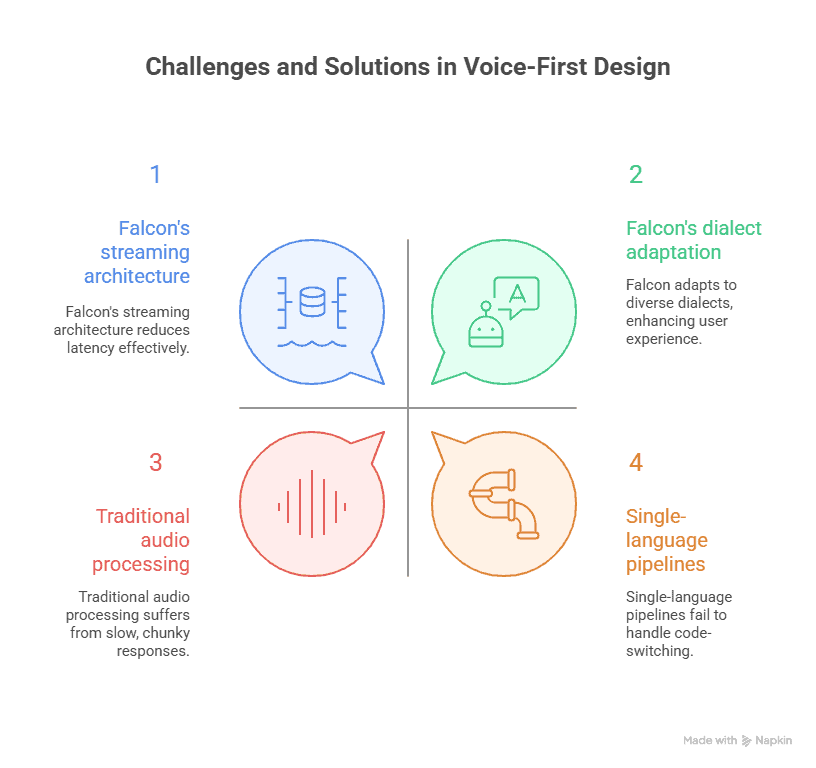
As brands develop voice-first interfaces, they face a number of technical and behavioral problems. Here’s a look at some of them and how robust systems can counter them.
1. Latency
In voice interactions, timing is everything. Even a slight delay can break the conversational commerce flow. Research shows that if a voice response takes longer than two seconds, users lose attention or assume the system has malfunctioned.
The challenge
Traditional models process audio in slow chunks, which causes frustrating pauses before every response.
Solution
Modern voice systems use an advanced streaming architecture that processes and generates speech simultaneously. Instead of waiting for full audio input, it begins responding as a user speaks. This keeps interactions instant, natural, and interruption-free, even during high traffic.
2. Dialect Variation
Accents and regional dialects vary country to country, sometimes even block to block. But older speech models all too frequently don’t get it and prompt in error or over and over again.
The challenge
Speech systems trained on narrow datasets struggle with pronunciation differences, slang, or locally influenced rhythms of speech.
Solution
Advanced voice models learn from a wide mix of real-world speech. They use data from many regions, so you get support for many accents and dialects. As a result, you can speak in mixed Gulf-Arabic, African-accented English, or rural Spanish with ease. Moreover, the system still understands you and gives you steady performance in many settings. This approach helps you trust the voice experience every time you use it.
3. Code-Switching
The practice of code-switching, or moving between languages in the same sentence, is especially common in markets like the Middle East and Southeast Asia, as well as Latin America. But most legacy models treat this as an error.
The challenge
Older architectures attempt to force input into a single-language pipeline. It causes them to break when users mix languages.
Solution
Many voice models are crafted for language-shift detection in real-time. So, they can parse a sentence that switches from one language to another or from one to two others, if the moves are between three languages without hopping out of context.
4. High Cost
Scaling voice agents, especially those requiring multilingual, real-time processing has historically been expensive. Legacy systems need heavy compute and complex pipelines that increase cost per interaction.
The challenge
Brands face rising operational expenses as usage grows, making voice automation difficult to scale sustainably.
Solution
Newer architectures are designed with optimized compute efficiency, streamlining audio processing and reducing model overhead. By streamlining audio processing and reducing model overhead, it delivers enterprise-level performance without the corresponding price spikes.
5. Informal Speech
Social platforms aren’t official lines of communication. By and large, users converse casually, break grammar rules, speak in slang, shorten words, and talk a little like they do throughout the day.
The challenge
Casual speech, especially platform-specific slang or abbreviated phrases, is common in DMs, voice notes, and live stream comments, and is particularly challenging for traditional NLP models, which are trained on formal datasets.
Solution
Contemporary voice systems are trained on platform-specific conversation data, so they can keep up with the latest sentence styles, slang, emotional cues, and realistic conversation tones. The result is more human-like and relatable responses that are easy for anyone to comprehend.
Future Trends in Social Media Marketing With Voice AI
Voice-first experiences will soon shape how users interact with every digital product. People will expect assistants that respond instantly, understand accents, and adapt to different languages without hesitation. These systems will also carry context across conversations, detect emotion, and adjust tone in real time.
As brands scale across regions, voice-first assistants will need to maintain accuracy even under heavy traffic. They must deliver human-level fluency while handling millions of simultaneous interactions. This requires advanced speech models, efficient streaming, and strong multilingual intelligence.
Platforms like the Falcon multilingual voice API will power this future. They offer real-time speed, native language fluency, and global-scale performance. Similarly, they reduce computational cost, which makes large deployments sustainable. With these capabilities, developers can build voice-first AI assistants that feel natural, adapt to users everywhere, and operate reliably at any scale.
Shape the Future of Voice-Driven Engagement
The future of conversational AI depends on systems that understand every user, respond instantly, and scale without friction. Multilingual and ultra-efficient voice agents will shape this next wave of global engagement. A multilingual voice API gives you the speed, accuracy, and flexibility needed to build these future-ready voice experiences.
Visit to explore how automated voice experiences can elevate your digital interactions and support your long-term content strategy.