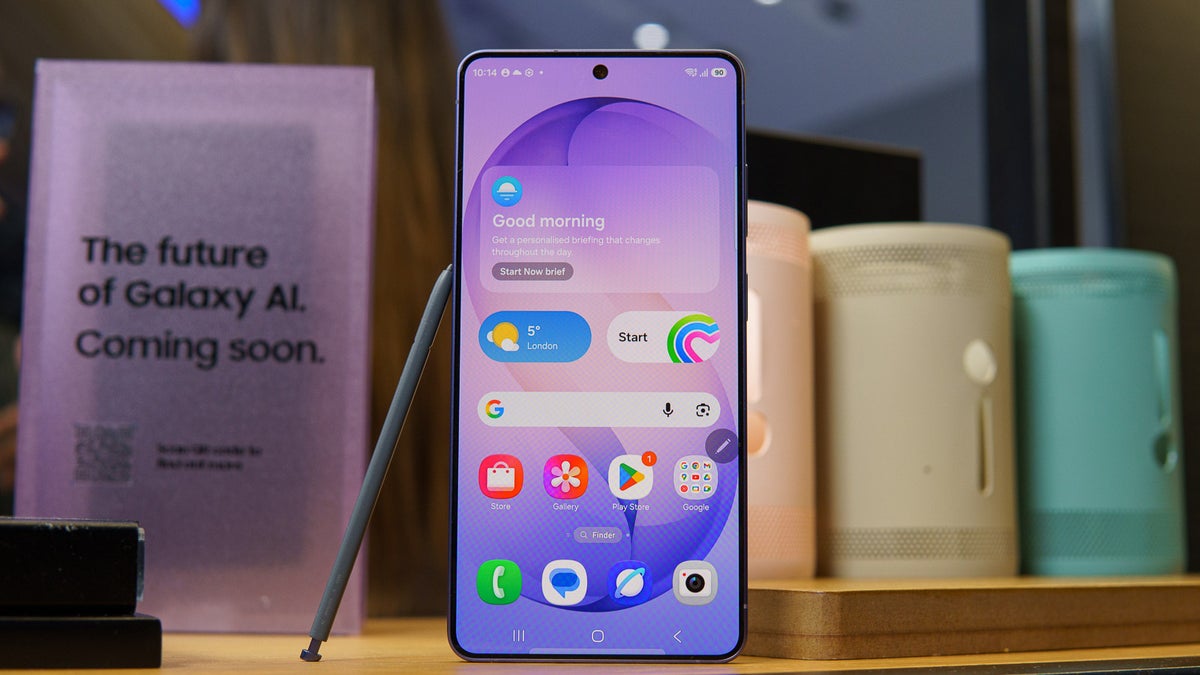
There are also a number of customization options that make the privacy display a lot better than just something that can be turned on or off. For example, you can tell the Galaxy S26 Ultra to only hide the screen when certain apps are open or when you’re doing something sensitive like entering a PIN number.
The display can also be customized to hide only part of the screen, like when a notification pops up. Only the notification will be hidden while the rest of the display works as normal, which is only possible because of the pixel-level privacy.
So all of this sounds pretty good, doesn’t it? Finally, innovation from Samsung again! Well…unfortunately, there are some problems with Samsung’s privacy display.
The display has taken a hit
According to initial reports coming in from some users, the Galaxy S26 Ultra’s display is straining their eyes after only a short period of use. This is without the privacy mode turned on. Close-up images of the Galaxy S26 Ultra show that the display appears to be a lot less refined than the one on the Galaxy S25 Ultra.
Short periods of use, especially if you’re reading text, appear to be tiring out users’ eyes. It’s worth noting that our initial Galaxy S26 Ultra hands-on look at the phone did not lead to these problems. However, the hands-on did not nearly go into as much depth as our upcoming review will, so we might see this issue for ourselves.
The clarity and image quality sacrifice
A bigger problem of the privacy display, one that will be noticed by everyone, is the hit that its image quality takes when you turn on privacy mode. The maximum privacy option in particular makes the display a lot less attractive to look at.
Resolution — or in simpler terms, the clarity and sharpness of everything — takes a nosedive. As does the image contrast, as colors look a lot more muted. This clearly makes the maximum privacy option something that you would only really use when there is something that you really want to hide from the rest of the bus. Unfortunately, this isn’t a feature worth keeping on all the time, in my opinion.In addition, the privacy display isn’t as useful as it first seemed. Don’t get me wrong, it’s a very interesting concept, but for now the angles at which the screen appears completely dark are too few. Most people will still be able to make out most of what’s happening on the screen of the phone.
The anti-glare properties have been downgraded
One of the nicest features that Samsung has ever introduced to its flagship phones is the anti-reflective coating on their displays. It completely changes how the phone looks under artificial or natural lighting. The effect is so good, in fact, that Apple improved its own coatings to mimic it with the iPhone 17 series.
This anti-glare display coating has also been downgraded slightly on the Galaxy S26 Ultra. While still good, the coating on the Galaxy S25 Ultra is noticeably better at reducing unwanted glare and reflections. Though we can’t confirm just yet whether this is because of the new privacy display, I think that is the most reasonable conclusion. Why else would Samsung downgrade an excellent feature on its newest flagship?
I’d rather have this than nothing
Despite all of these problems, I’m glad that Samsung introduced the privacy display on the Galaxy S26 Ultra.
For starters, this is the first time that something like this has been done. It is all but guaranteed that future iterations of this technology will be improved upon greatly. Some Chinese phone makers are already experimenting with their own take on the privacy display according to reports.
Secondly, I would rather have Samsung try something new and run into some problems than fall back to mediocre annual upgrades that barely changed anything. The Galaxy flagships remained very stagnant for quite a long time, but the privacy display and the new apertures show that Samsung is finally dipping its toes into newer technologies again.
I’m all for that, as you can see over on my X and Threads. But if Samsung could bring back Bluetooth on the S Pen, that’d be great.