Growth in a white-label model often looks like more clients, more sites, more revenue. But growth alone does not mean the system is scaling. The real shift happens almost unnoticed: from website delivery to a website operations platform.
At first, agencies focus on delivering websites. Over time, they begin operating dozens of them simultaneously. This transition introduces complexity that most systems are not designed to handle. Scale is not about volume. It is about stability under volume.
What scaling actually means in a white-label model
Growth measures how much you produce. Scale measures how reliably your system performs as production increases. Growth and scale must not be confused. A white-label partnership is scaling when:
- Delivery time per account stays stable or improves
- Margins remain predictable as client count grows
- Output quality is consistent across accounts
- The system relies on processes rather than individuals
When these metrics hold steady, the system is absorbing growth. When they begin to drift, the system is accumulating operational friction. Most scaling problems do not appear as failures. They appear as a gradual degradation across these metrics.
Why most white-label systems break after 15–30 accounts
White-label systems rarely collapse suddenly. Instead, they degrade as complexity increases. At low volume, inefficiencies are manageable. Teams compensate through effort. Manual fixes, inconsistent builds, and provider delays are absorbed because the system is not yet under pressure.
As account volume increases, those inefficiencies begin to compound. Delivery slows down, updates take longer, and issue frequency increases. Teams start depending on specific individuals, and workflows become harder to maintain consistently.
This is the point where the operating model changes from delivering websites to managing a continuous system of websites. Without the right structure, this transition leads to instability.
The KPI framework for clean scaling
Scaling cannot be evaluated with a single metric. It requires a set of indicators that reflect how the system behaves under increasing load.
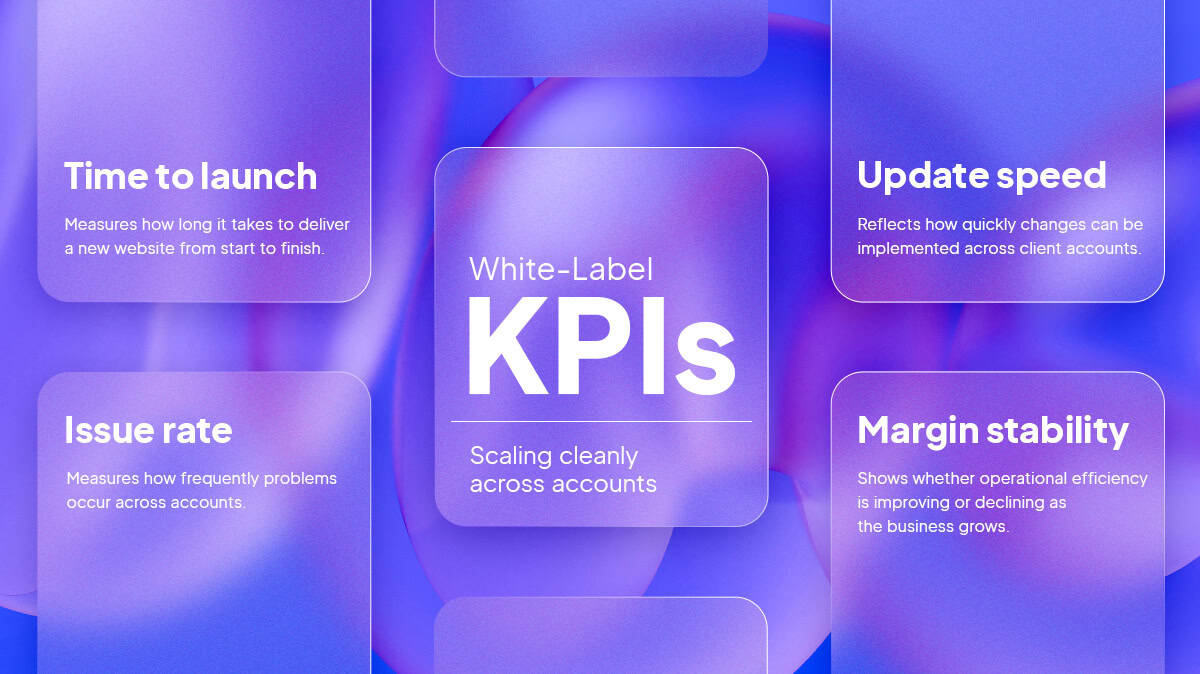
The four KPIs that define clean scaling are time to launch, update speed, issue rate, and margin stability. Each of them reveals a different type of pressure inside your system.
To understand whether your white-label partnership is truly scaling, these metrics need to be examined individually.
Time to launch
Time to launch measures how long it takes to deliver a new website from start to finish. In a system that scales cleanly, this metric remains stable or improves as more accounts are added. The 30th site should not take longer to launch than the 10th.
When the time to launch increases, it usually indicates a lack of standardization. Teams are rebuilding processes instead of repeating them. Dependencies increase, coordination slows down, and delivery becomes less predictable.
This is one of the earliest signals that growth is introducing friction rather than efficiency in white-label web services.
How to measure TTL
Track the average time from onboarding to launch and compare it across cohorts (e.g., first 10 sites vs next 20). If it increases with volume, the system is not scaling cleanly.
Update speed
Update speed reflects how quickly changes can be implemented across client accounts. This includes content edits, feature updates, fixes, and ongoing optimizations.
At scale, this metric becomes more important than initial delivery. Websites are not static assets. They require continuous iteration. In a fragmented system, updates become increasingly difficult. Each site behaves differently, requiring custom handling. What should be a simple change turns into repeated manual work.
In a standardized system, updates are applied consistently across environments. Speed increases because the system is predictable. Slow update speed is a direct indicator that the website layer is not unified.
How to measure update speed
Track the time required for common updates and how that time changes as account volume grows. If effort increases with scale, the system is not standardized.
Issue rate
Issue rate measures how frequently problems occur across accounts. This includes bugs, website performance issues, downtime, and support tickets. A rising issue rate signals instability in the system. It often reflects inconsistencies in how websites are built or maintained.
At low volume, issues may appear manageable. At scale, they compound. More accounts mean more points of failure, and small inconsistencies become recurring problems. A stable system keeps issue rates predictable because environments are consistent. When every site operates on the same infrastructure, problems are easier to prevent and resolve.
How to measure issue rate
Track the number of issues or support tickets per account over time. Focus on consistency—if issue frequency increases as more accounts are added, the system is not stable.
Margin stability
Margin stability shows whether operational efficiency is improving or declining as the business grows. In many white-label models, revenue increases while margins quietly shrink. Additional accounts introduce hidden costs, including support time, rework, and coordination overhead.
If the cost per account increases with scale, the system is not compounding efficiency. It is accumulating effort. A scalable system reduces the effort required per account over time. This leads to stable or improving margins, even as client volume increases.
Margin stability is the most important KPI because it reflects the combined effect of all other metrics.
How to measure margin stability
Track cost per account and gross margin per client as your account volume grows. If costs increase or margins decline with scale, the system is not operating efficiently.
Website layer infrastructure: where these KPIs are determined
These KPIs do not exist independently. They are shaped by the system that sits underneath your operations. This layer defines how websites are built, updated, and managed across all accounts.
When this infrastructure is fragmented, every KPI begins to drift. Time to launch increases because builds are inconsistent. Updates slow down because environments differ. Issue rates rise because systems are not standardized. Margins shrink because more effort is required per account.
When this infrastructure is standardized, the opposite happens. Processes become repeatable, updates become faster, issues decrease, and margins stabilize. This is the point where growth turns into scale.
Own the website layer under your brand
In a white-label model, infrastructure is shared between the agency and the provider. This creates a critical dependency. Owning the website layer means controlling how websites are created, managed, and operated within a consistent system.
When agencies lack this control, their performance depends on external limitations. Delays, inefficiencies, and inconsistencies introduced by the provider directly affect internal KPIs.
When agencies operate on a controlled and standardized layer, scaling becomes predictable. The system behaves the same way across all accounts, reducing variability and improving reliability.
How infrastructure stabilizes scaling KPIs
At a certain point, KPI performance becomes an infrastructure problem rather than an operational one. 10Web’s white-label website builder stabilizes the key scaling metrics in the following ways:
- Time to launch becomes consistent through standardized, AI-driven site generation
- Update speed improves through centralized multi-site management
- Issue rates decrease because all sites operate within the same environment
- Margins stabilize as the effort required per account is reduced
These improvements are not isolated optimizations. They result from removing variability at the system level. When the underlying infrastructure is consistent, the metrics built on top of it become predictable.
Conclusion
Scale is not what you produce. It is what your system can sustain. Scaling in a white-label model is defined by how stable the system remains as the numbers increase. Once you shift from website delivery to a website operations platform, success depends on controlling the system rather than increasing output.
Tracking the right KPIs makes this visible. Stabilizing those KPIs requires infrastructure.
When the time to launch, update speed, issue rate, and margins remain consistent under growth, the system is scaling cleanly. When they begin to drift, it is a signal that the underlying structure needs to change.
In many cases, improving these metrics is less about optimizing workflows and more about the system your agency runs on. Platforms like 10Web approach this by standardizing the website layer, making it easier to maintain consistent performance as you grow.
FAQ
What does scaling mean in a white-label business?
Scaling means your system can handle more clients without losing efficiency, quality, or profitability. It’s about maintaining stable performance as volume increases, not just growing output.
What are the key KPIs for measuring white-label scalability?
The main KPIs are time to launch, update speed, issue rate, and margin stability. Platforms like 10Web focus on stabilizing these metrics through standardized infrastructure and automation.
Why do white-label systems break after a certain number of clients?
Most systems start to break around 15–30 accounts because inefficiencies begin to compound. Without a standardized platform, manual workflows and inconsistencies become harder to manage at scale.
How can agencies scale white-label website services more efficiently?
Agencies can scale more efficiently by standardizing processes, reducing manual work, and using centralized systems. Platforms like 10Web are designed to support this by unifying website creation and management.