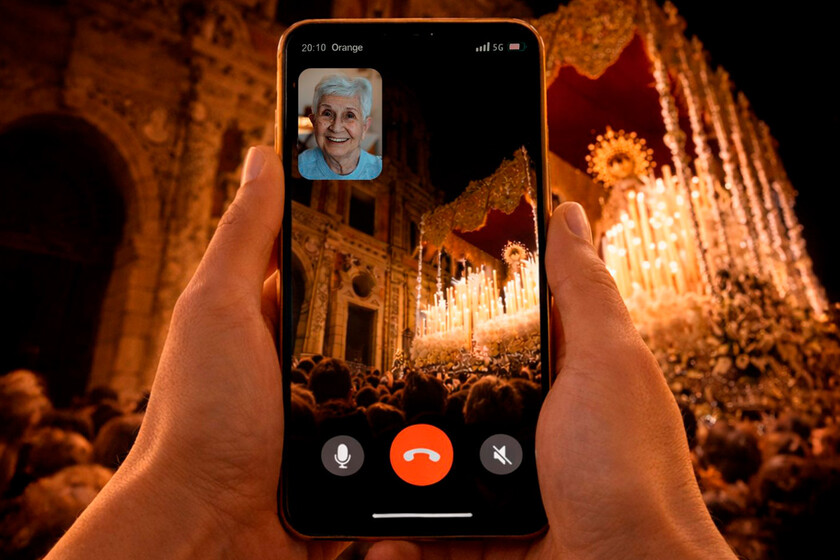
At large events there is a moment that we all recognize: we are at a concert, at a fair or at a massive celebration and just when we need the cell phone, the connection does not respond as it should. We want to send a location or publish something on networks and everything takes longer than normal or does not load at all. There is no mystery behind it, but a known problem: the network has to serve too many devices at the same time. And when that happens, the experience suffers.
An extra connection. Based on that experience that we all know, Orange has launched “5G Fast Track”, a service that seeks to improve the connection in very specific situations. The company proposes it as a solution for events with a high concentration of people, where the demand for data skyrockets in a matter of minutes. What it introduces is an interesting nuance: the user can activate a connectivity boost to try to maintain a more stable experience in the midst of that saturation.
“This service is complementary to the usual network: it is an optional extra, activated for a limited time, which optimizes the use of the network in extraordinary situations of high traffic and that are important for the customer.”
Timely activation and different formats. One of the keys to “5G Fast Track” is that it does not require you to change the rate or maintain the service permanently. As our colleagues at WorldOfSoftware Móvil explain, the user can activate it only when they need it, for example, before entering a busy event. Orange sells it in three formats: 24 hours for 3 euros, 7 days for 7 euros and 1 month for 10 euros with automatic renewal. In this first phase, the service is available to residential, self-employed and small business customers. The company has announced that it will soon launch a modality for companies and public administrations.
What about net neutrality. The idea of paying for a better connection quality in these contexts can raise questions, and the main one has to do with whether this conflicts with the principle of net neutrality. The European regulation, in force since 2016, requires that traffic be treated equitably and without discrimination, something that is also included in Spanish legislation. With the information available, there are no clear reasons to conclude that this service violates current regulations, among other things because it does not discriminate between specific applications or content, but rather acts on the quality of the user’s connection in a general way.
Amazon has decided that it is a good time to launch one” width=”375″ height=”142″ src=”https://i.blogs.es/884635/firephone2014/375_142.jpeg”/>
The question. However, regardless of how it fits within the current framework, the proposal leaves an open question that is not minor. If paying for a better experience at specific times becomes established as an option, it is worth considering how far this type of services can evolve within the market. For now we are talking about a specific extra linked to very specific situations, but the idea of introducing differentiated levels of quality in connectivity could generate debate if it is extended.
Images | Orange
In WorldOfSoftware | MásMóvil has said goodbye to triple coverage. Although it may seem like it, it is not bad news.