The Nvidia ecosystem is quickly becoming the control plane for AI infrastructure.
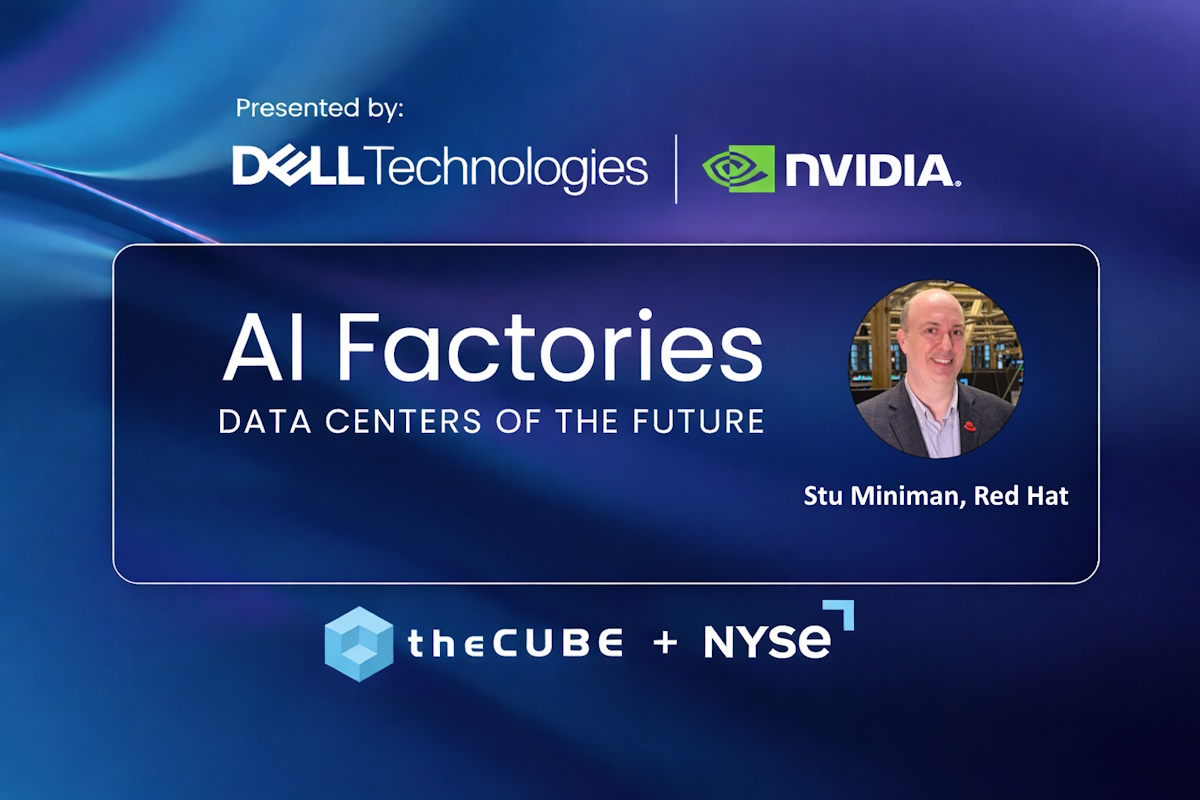
The shift isn’t just about GPUs anymore. As enterprises move from experimentation to scaled deployment, the market is consolidating around a standardized stack where Linux and Kubernetes integrate tightly with Nvidia hardware, and the Red Hat–Nvidia partnership reflects customers’ push for repeatable AI factories over bespoke builds, according to Stu Miniman (pictured), senior director market insights, hybrid platforms, at Red Hat.
“We’ve got a big partnership with Nvidia … we’ve got day-zero support for the Vera Rubin,” Miniman said. “We’ve got all the Blackwell support and working closely with Nvidia to make sure that the software stack underneath can support all of the hardware. Our history with the Linux, all of the vendors that you see that are putting out the full stacks for an AI factory, they’re all ones that we’ve been working with for decades.”
Miniman spoke with theCUBE’s John Furrier for theCUBE + NYSE Wired: AI Factories – Data Centers of the Future interview series, during an exclusive broadcast on theCUBE, News Media’s livestreaming studio. They discussed how the Nvidia ecosystem is reshaping AI infrastructure through Linux, Kubernetes and AI factory standardization.
The Nvidia ecosystem scales AI factories through standardization
What’s emerging is a familiar pattern with higher stakes. Just as Linux underpinned the rise of the cloud, Kubernetes now underpins AI workloads. Nvidia’s role inside that stack is expanding from silicon supplier to ecosystem anchor, pulling together hardware, software and integration partners into a coherent AI factory model, Miniman explained.
“Even back when we called it hyperconverged, it was really about distributed architectures. That’s what we’re seeing,” he said. “If I look at an AI factory, I want repeatability. I want standardization. Many of the echoes that we heard from the cloud is, I want to get rid of the undifferentiated heavy lifting and make it easier to adopt technologies. I want to get utilization out of my GPUs. I want to be able to scale it. That’s where Kubernetes plays an important piece of it.”
That emphasis on repeatability is critical, Miniman emphasized. Enterprises aren’t looking to reinvent orchestration every time they deploy a model. They want a stable base that can span data centers, edge environments and cloud providers. Red Hat’s footprint across Fortune 1000 companies gives Nvidia a direct path into those environments.
“If we look at the Linux itself, Nvidia’s had a Linux option … that they’ve been shipping for a long time,” Miniman said. “It’s a popular Linux that many people use. But when we talk about scalability, when we talk about security, Red Hat is really unparalleled in that space. We have the majority of the paid Linux market share out there. As Nvidia’s customers went from ‘I’m playing with things’ to ‘I’m scaling them out,’ Nvidia saw that they had a lot of overlap.”
From experimentation to standardized AI deployment
The result is less fragmentation and more alignment around a shared foundation. As AI workloads mature, the plumbing matters more than the novelty. Kubernetes is being tuned for AI, GPU utilization is being optimized and upstream projects are smoothing adoption for data scientists who don’t want to manage clusters, Miniman noted.
“A project that we helped launch in partnership with Google and Nvidia and others was llm-d,” he said. “That really is how do we take advantage of all of that underpinning that Kubernetes brings and let AI take advantage of it. The knock on Kubernetes for years has been like, ‘Oh, I don’t have that skillset.’ What we’re trying to get to is that late majority, how do we make it simpler to be able to take advantage of that?”
As AI moves from pilot to production, the Nvidia ecosystem is less about chips and more about control. It increasingly shapes the stack, the standards and the operational model that determine how AI runs at scale, according to Miniman.
“If we’re building an AI factory, it’s a stack and no one vendor has all the pieces,” he said. “The hardware, the software, we’re working really closely, not just with the hardware vendors themselves but some of the key systems integrators that are helping the customers with that last mile of deployment and really getting productivity of production workloads … that’s our history at Red Hat.”
Here’s the complete video interview, part of News’s and theCUBE’s coverage of theCUBE + NYSE Wired: AI Factories – Data Centers of the Future interview series:
Image: News
Support our mission to keep content open and free by engaging with theCUBE community. Join theCUBE’s Alumni Trust Network, where technology leaders connect, share intelligence and create opportunities.
- 15M+ viewers of theCUBE videos, powering conversations across AI, cloud, cybersecurity and more
- 11.4k+ theCUBE alumni — Connect with more than 11,400 tech and business leaders shaping the future through a unique trusted-based network.
About News Media
Founded by tech visionaries John Furrier and Dave Vellante, News Media has built a dynamic ecosystem of industry-leading digital media brands that reach 15+ million elite tech professionals. Our new proprietary theCUBE AI Video Cloud is breaking ground in audience interaction, leveraging theCUBEai.com neural network to help technology companies make data-driven decisions and stay at the forefront of industry conversations.