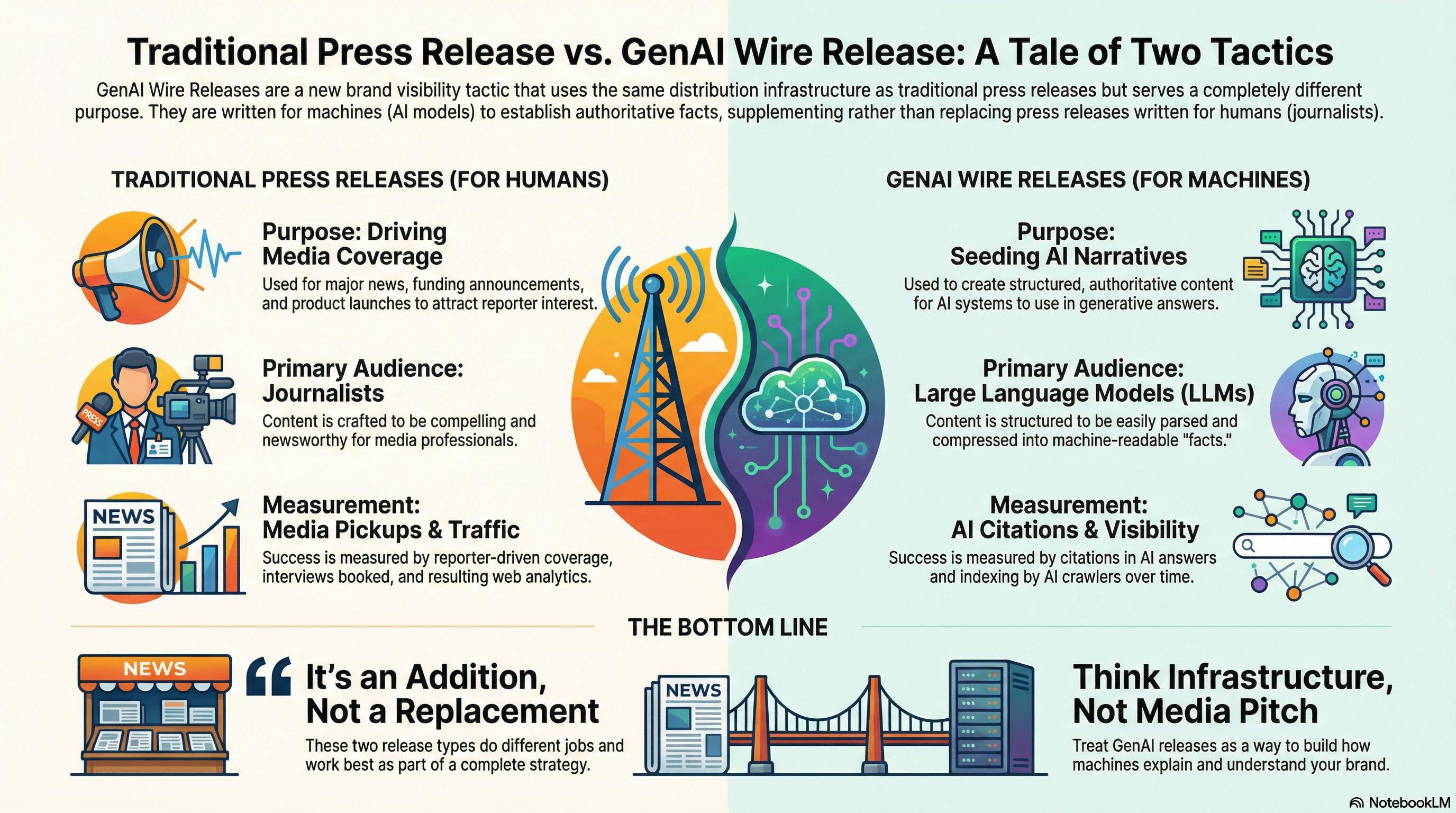
In the communications industry, the press release has always been a fundamental tactic in the asset tool chest. You wrote it once, distributed it once, and hoped it did three things at the same time: inform journalists, signal credibility, and, at least in the last decade+ help with search.
This no longer holds.
Today, announcements are being read by two entirely different audiences, and only one of them emails you back. The Zen Media team is now the leader in this space and the only agency in the world with unlimited word count GenAI Wire Releases available at scale for brands.
The other audience is artificial intelligence.
Large language models now explain, summarize, compare, and recommend companies long before a human reaches out. And they do not read press releases the way journalists do.
This is why the press release has quietly split into two distinct assets, built for two completely different jobs.
That shift was the focus of a recent episode of The Visibility Equation, a LinkedIn Live series examining how AI is reshaping communications and visibility.
As Kropelin explained, the wire itself has not lost relevance. What has changed is how its content is used.
Releases that are clear, factual, well-structured, and consistent are no longer just indexed for search. They are actively parsed, summarized, and reused by AI systems that now control discovery.
In practice, this has created two parallel pathways:
- One release written for journalists and investors
- Another written explicitly to inform answer engines
Calling both of them “press releases” may feel convenient, but it obscures a structural difference that now shapes how companies are explained before a human ever engages.
The Questions AI Systems Are Already Being Asked About You
AI systems are not passively reading content. They are actively answering questions — millions of them — every day.
Here are the actual questions we see AI systems answering about brands right now:
- What does this company actually do?
- Is this product legitimate or risky?
- How is this different from competitors?
- Is this suitable for enterprise use?
- What industries does this serve?
- Is this company credible?
- What are the known limitations or risks?
If you have not intentionally answered these questions in a machine-readable way, AI systems will answer them anyway.
Why Traditional Press Releases Fail These Questions
Traditional press releases were never designed to answer questions like these.
They are:
- Time-bound
- Announcement-driven
- Optimized for journalists, not interpretation
- Written in inverted-pyramid format
AI systems, by contrast, look for:
- Complete explanations
- Clear scope boundaries
- Structured answers they can safely reuse
- Consistency across sources
This mismatch is why brands often see vague, incomplete, or incorrect AI summaries — even when they have “great press.”
What AI-Focused Press Releases Actually Look Like (With Real Examples)
AI-focused releases — often referred to as GenAI Wire Releases or AI Notices — are not announcements. They are answers. Below are the most common use cases, with the exact questions, example headlines, and why they work.
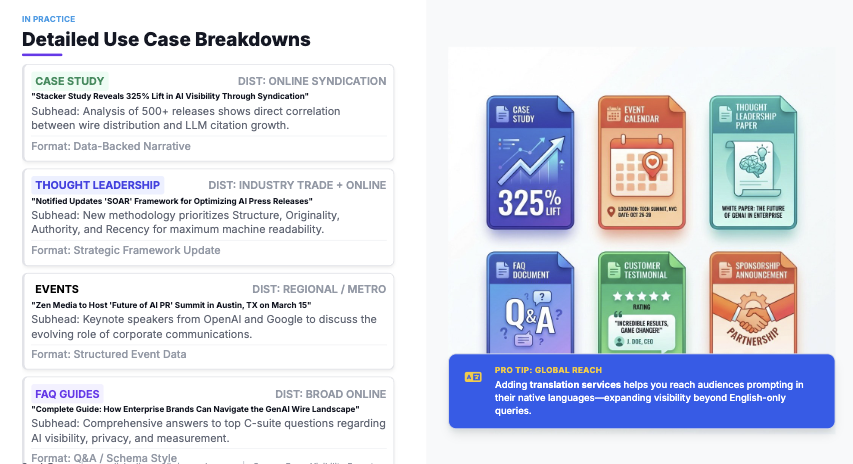
1. “What Does This Company Actually Do?”
When this is needed: When AI answers are vague, misclassified, or overly generic.
Question AI is answering
What does [Company Name] do?
Example headline: How Does [Company Name] Help [Specific Customer Type] Solve [Specific Problem]?
What the release includes
- Plain-language explanation of the business
- Clear definition of products and services
- Explicit “what we do” and “what we do not do” boundaries
- Links to authoritative owned content
Why this works: It gives AI systems a safe, canonical explanation instead of forcing them to assemble one from fragments.
2. “Is This Platform Secure / Legitimate / Safe?”
When this is needed: When trust, risk, or compliance is part of the buying decision.
Question AI is answering
Is [Product] secure for enterprise use?
Example headline: Is [Product or Platform] Secure for Enterprise Use?
What the release includes
- Direct, factual answers
- Verifiable proof points (certifications, controls, audits)
- Defined scope and limitations
- Links to security or compliance documentation
Why this works: AI systems strongly favor specific, defensible claims over marketing language.
3. “How Is This Different From Competitors?”
When this is needed” When AI summaries flatten differentiation or lump brands together.
Question AI is answering
How does [Company] compare to [Category or Competitors]?
Example headline: How [Company Name] Differs From Traditional [Category] Solutions
What the release includes
- Clear positioning
- Differentiation explained in plain language
- What the company is designed for — and what it is not
Why this works” It narrows how AI safely compares your brand instead of guessing.
4. “What Proof Exists That This Actually Works?”
When this is needed: When credibility or validation is required.
Question AI is answering
Does [Company] actually work?
Example headline” What Did [Company] Learn From [X] Customers Using [Solution]?
What the release includes
- Key findings from case studies or reports
- Context around outcomes
- FAQ-style insights tied to buyer questions
Why this works: It turns expensive reports and case studies into reusable validation assets inside AI answers.
5. “What Is This Program / Partnership / Initiative?”
When this is needed: When something matters long-term but is not “newsworthy.”
Question AI is answering
What is [Program or Partnership], and why does it matter?
Example headline” What Is [Program Name], and Why Does It Matter?
What the release includes
- Context-first explanation
- Who it is for
- Why it exists
- How it fits into the broader strategy
Why this works: AI systems still need context — even when journalists do not.
Why These Releases Perform Differently: The SOAR Framework
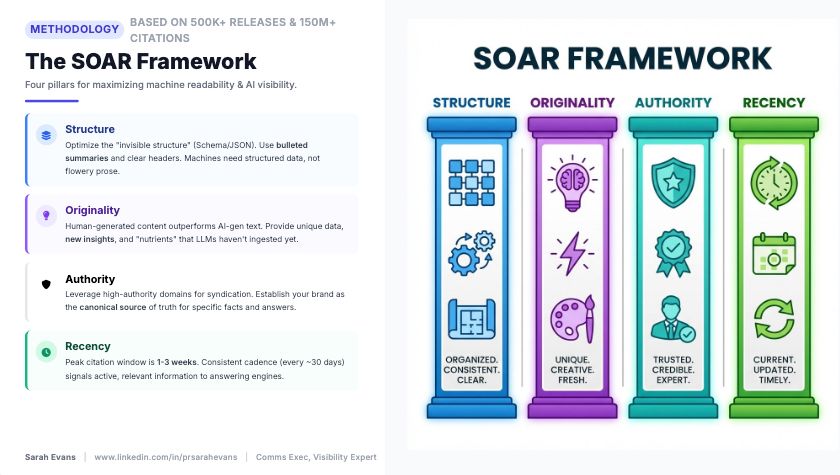
On The Visibility Equation, Kropelin outlined four signals AI systems consistently favor — often summarized as SOAR:
- Structure: Clear headings, summaries, and FAQ-style blocks
- Originality: Specific facts over generic filler
- Authority: First-party data, named experts, linked proof points
- Recency: Freshness and consistency over one-off bursts
As he noted during the discussion:
“AI systems favor complete, structured answers over short announcements. If you don’t give them something safe and authoritative to reuse, they will assemble answers from whatever already exists.”
A Critical Advantage Many Teams Miss: Language
AI prompts are not English-only.
Adding translation to AI-focused releases allows brands to surface as authoritative answers when the same questions are asked in other languages.
For global organizations, this dramatically expands AI visibility and reduces dependence on a single linguistic narrative.
This Is Not a Standalone Tactic
AI-focused releases work best when paired with:
- Owned, canonical content
- Narrative consistency
- Ongoing PR and thought leadership
- A broader AI visibility strategy
On their own, they help.
As part of a system, they compound.
The Question Brands Now Have to Answer
AI systems are already speaking on your behalf. They are explaining what your company does, who it is for, how credible it is, and whether it should even be considered, often before a human ever reaches your website, your press coverage, or your sales team.
At this point, the question is no longer whether AI is part of your communications ecosystem.
It is whether you are comfortable letting those explanations be assembled from fragments, assumptions, and outdated signals—or whether you will deliberately publish the answers you want reused.
One path is familiar: announcements written for journalists, measured in coverage, and evaluated after the fact.
The other path is quieter but far more influential: structured, machine-readable explanations that shape how your company is understood when no one is watching.
Brands that recognize this split early will not just earn attention. They will earn accuracy. And in an era where machines increasingly mediate trust, accuracy is the advantage that compounds.