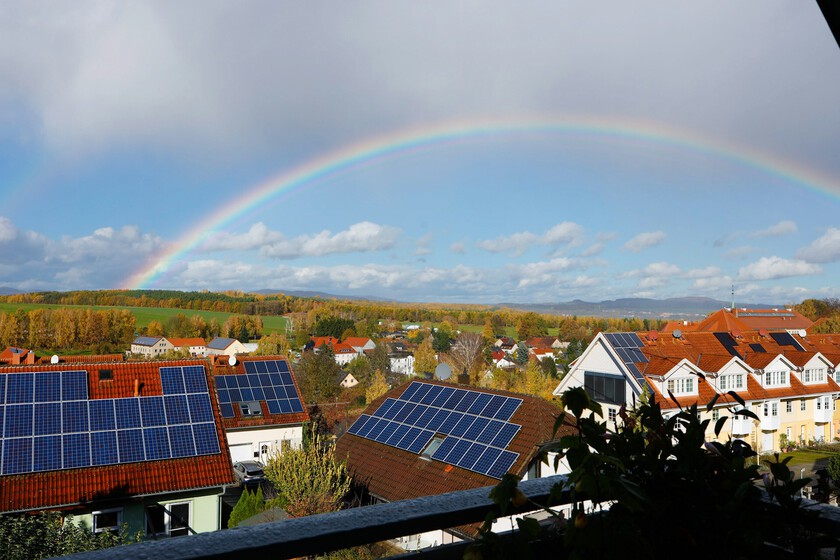
If there is a renewable energy that has emerged in recent years, it is solar, as can be seen in this graph from the International Energy Agency. However, solar energy still has its limitations: it requires space (hence there are projects on lakes and in the open sea) and of course, it depends on the sun. Yes, installing batteries can cushion this irregular supply (here Spain is a powerhouse), but a research team from the University of Seville with the CSIC has given a twist to classic photovoltaic panels and can now generate electricity with rain.
Context. Solar panels lose effectiveness when full sun does not fall on them, either because there are clouds or it is raining. Therefore, the ideal scenario is midday on a sunny day, but spoiler: this happens less times than you need to plug something in.
Not to mention devices that need continuous and autonomous energy supply, no matter what happens in the electrical grid. The battery option allows us to satisfy the supply on demand and although they are now at their minimum Price, it still implies purchasing another component, considering its useful life and its management as waste.
The invention. As the CSIC explains, they have developed a hybrid device that allows capturing energy from both the sun and rain, and also doing so at the same time. As? With a sheet thinner than a human hair (100 nanometers) superimposed on the solar cells.
It works on two fronts at the same time: on the one hand as a protective encapsulant for perovskite solar cells, improving their durability in adverse conditions. On the other hand, as a triboelectric nanogenerator: it converts the impact of raindrops into electricity due to friction. Thus, it is capable of producing up to 110 volts, enough to light LEDs or power sensors.
Why is it important. Because if this technology is commercialized, it will open the doors for completely autonomous electronic devices to function without batteries or plugs. This is the case of the implementation of IoT outdoors or in remote areas without access to the electrical grid. It serves as an example of use in applications in rural infrastructure or agriculture, such as environmental sensors, weather stations, urban signage or auxiliary lighting.
The innovation is not only generating energy from rain, but integrating it all into a single thin layer that solves the main Achilles heel of perovskite: its environmental degradation. In fact, science had already tried taurine from octopuses.
How have they done it. To carry out this device, they used plasma technology to deposit plasma technology in a similar way to that implemented in mobile screens.
For the base, perovskite cells, a material with better efficiency and lower cost than traditional silicon, but fragile under conditions such as humidity. The use of triboelectric materials is not new: a few years ago a research team from the University of Hong Kong came up with something similar: the generation of electricity by the simple friction of droplets upon impact, like the static electricity generated by rubbing a balloon.
Yes, but. Although technically speaking they have generated electricity, the reality is that it is high voltage but low intensity, which in practice is not even useful for charging a mobile phone. And although the perovskite is reinforced with this sheet, in the long term it is still less durable than silicon, so it still has pending issues.
Likewise, there remains the great challenge of leaving the laboratory and validating these experiments in real environments. If production can be scaled to an industrial level, another challenge would arise: keeping costs low.
In WorldOfSoftware | Europe produces more clean electricity than fossil electricity for the first time. The hard part starts now
In WorldOfSoftware | Solar panels have an invisible and very brief moment in which they do not work. And solving it is key to your future
Cover | Lara John