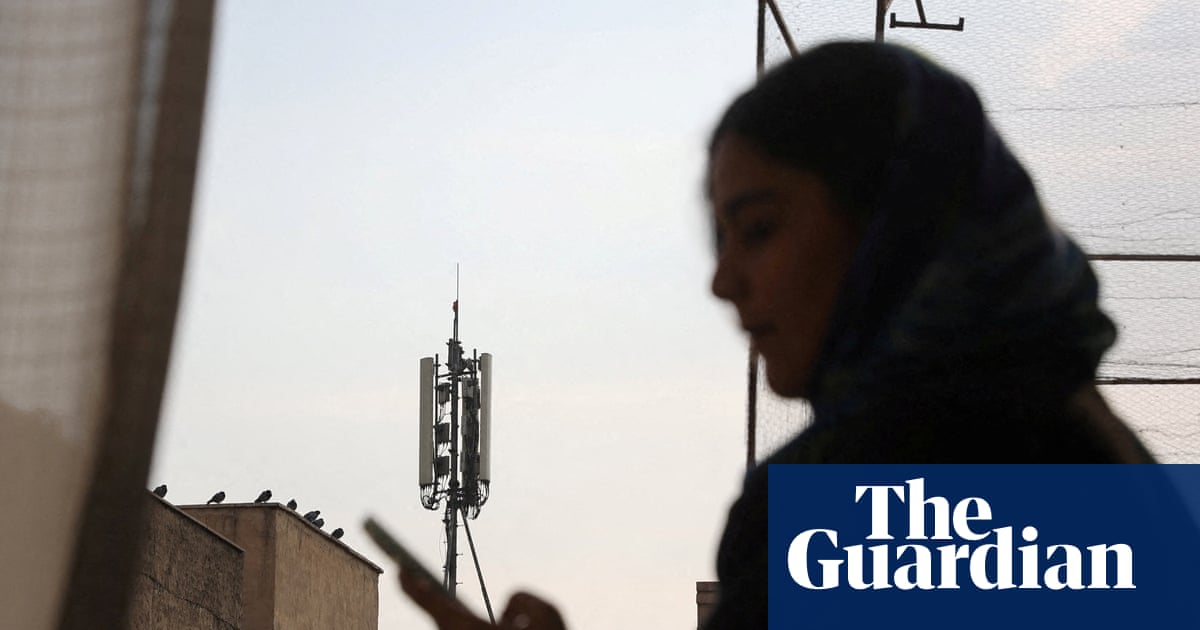
During the height of Iran’s blackout in January, people could still access a platform that, in some senses, was like the internet.
Iranians could message family members on a government-monitored app and watch clips of Manchester United on a Farsi-language video-sharing site. They could read state news and use a local navigation service.
What they couldn’t do was check international headlines about thousands of people being killed by government forces during one of the bloodiest weeks in recent Iranian history. Nor, for the most part, could they get evidence out of Iran to the outside world – no pictures, no videos, no testimony of military vehicles being driven into protesters or family members being dragged from their homes and shot.
What Iran has, a splinternet, is becoming reality for many millions of people. It is likely to get far worse.
More than half of Russia’s regions are able to access only a limited, government-approved version of the internet through their mobile phones. The “great firewall of China” blocks most of the global internet, including sites such as Google and the Guardian. The Myanmar junta has experimented with targeted internet shutdowns and so recently have authorities in Afghanistan and Pakistan.
For nearly two decades, the US backed a global effort to make it extremely difficult for governments to divide up the internet in this way. It hinged on funding tools built by groups worldwide to circumvent censorship. These made it very costly and very hard to shut down the internet entirely, and they ensured that governments that did seek to cut off their people often had to isolate themselves and their financial institutions as well.
Like many US soft-power initiatives, the programme was imperfect, morally complex and at times at odds with the policies of other governments. Yet it is one foundation of what the internet is: a global commons. Today’s online world is dominated by large tech platforms and awash with illegal content and misinformation. But it is still a structure in which facts, ideas and information accessible from London are largely accessible from Delhi, Johannesburg and São Paulo as well.
That could change rapidly. On the one hand is the matter of US funding, now cut or apparently redirected towards a Trumpian, politicised effort to undermine global attempts to regulate US big-tech platforms.
On the other is the mounting export of censorship technologies, which are constantly improving and increasingly marketed overseas. These include devices sold by companies in China that give their customers – governments in Pakistan, Myanmar and Ethiopia among others – extremely fine-tuned control over what comes in and out of a country. It is believed that similar technologies are the foundation of Iran’s current shutdown.
Censorship technologies are growing more powerful at the same time as programmes designed to stymie them have been decimated.
To those who work on the problem, the stakes are high. “When governments want to not be scrutinised for how many people they’re killing in their streets, they’ll shut the internet down,” said a former US official.
It is not easy to build a splinternet. The internet is, by design, a decentralised and deeply inter-dependent network. But Iran’s recent example indicates that it is becoming far more plausible. Russia has been attempting to create a similar cut-off internet for some years, and other authoritarian regimes appear to share the ambition. It will become cheaper and easier to achieve.
Governments worldwide, including in Europe, are promoting notions of sovereign data, sovereign AI and, in some cases, sovereign internet. Accompanying this is an ambition to nationalise infrastructure, for example to keep UK citizens’ health records stored in UK data centres. This is an understandable goal, given the increasingly authoritarian bent of US tech platforms that are the custodians of much of the world’s data.
But if fascist or authoritarian regimes ascend, such an approach risks replacing one set of despots with another. Iran’s ability to cut off its internet was prefigured by a years-long push to nationalise its underlying infrastructure. Shutdowns such as Iran’s become far easier when a country’s data is entirely accessible to its domestic authorities.
Those fighting for digital freedoms in harsh environments – in Iran and beyond – are approaching Europe, hoping the EU might pick up some of what the US has dropped and fund anticensorship technologies.
It is doubtful that Europe has the money or the willpower to do much, given the other responsibilities it must shoulder. Next to defence, it seems a marginal concern. But the information environment as we know it – the ground of shared fact that allowed this piece to be written and you to read it – is at stake.