Looking for a website builder with API integration? Modern SaaS platforms, agencies, and digital service providers now expect users to launch fully branded websites directly within their own products, with no need to switch to external apps.
Website builder APIs empower platforms to automatically generate, customize, and manage sites using user data, onboarding forms, or AI prompts, all from a single interface. This seamless integration reduces friction, boosts user activation, and unlocks new revenue streams like Website-as-a-Service (WaaS) offerings.
In this guide, we’ll break down the must-have features for comparing website builder APIs and show you how API-driven site creation can deliver fast, scalable web experiences for any business model.
Understanding modern website builder APIs
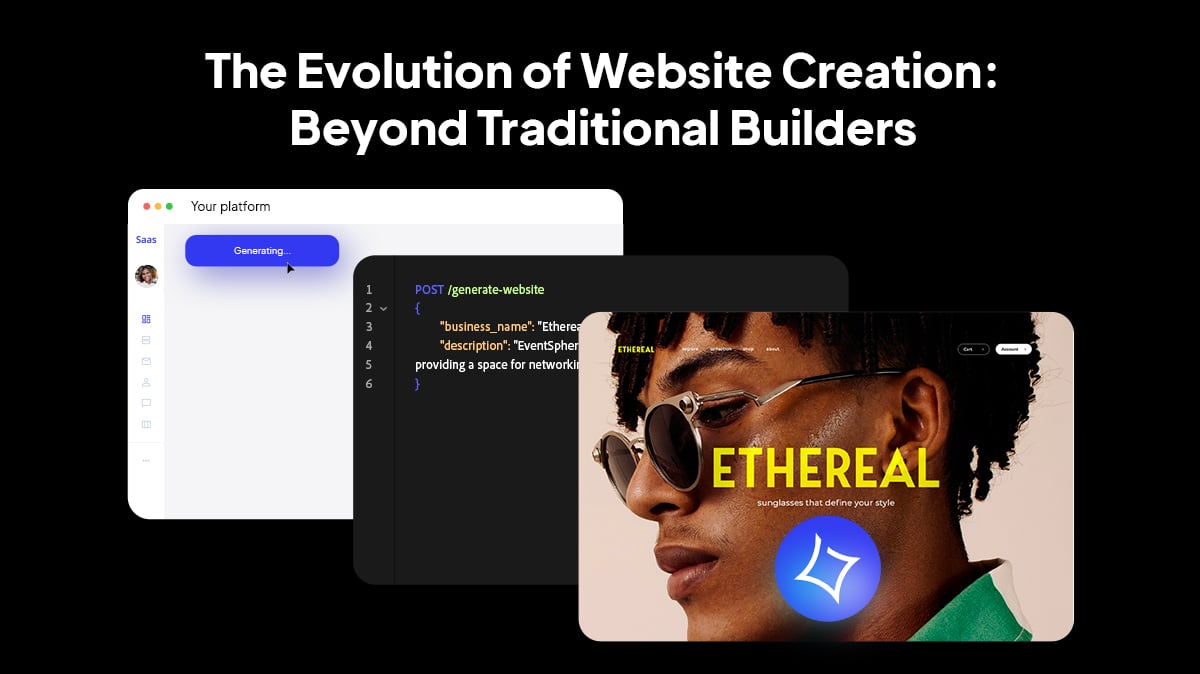
Website builder APIs have evolved from simple site generators into tools that help platforms deliver full digital presence experiences inside their own products. Instead of expecting users to switch to an external builder, these APIs let SaaS platforms, agencies, hosts, registrars, and enterprise tools create and manage sites programmatically, often from a single prompt or a few fields of business data.
What matters most is how the API fits into a larger workflow. A strong website builder API can:
- Collect user information and generate a structured site.
- Power a visual, no-code editor for your team and end-users.
- Integrate your system with hosting infrastructure for long-term management.
Leveraging an API keeps the entire experience branded and contained within your ecosystem, which is especially valuable when onboarding new users or offering website creation as an added service.
For SaaS platforms, this means turning website creation into a native feature that boosts activation and retention. Agencies can scale client sites without repetitive manual work. Hosts, registrars, and telcos can transform basic services into more complete digital bundles. Enterprise platforms gain a way to provide unified, on-brand websites across distributed teams or customers.
Plugging into a website builder API opens the door to new growth channels and services that keep clients coming back for more.
Key features to compare in website builder APIs
Choosing the right website builder API ultimately comes down to how well it supports the website lifecycle inside your product. Some APIs focus on generating simple sites, while others provide deeper control over design, hosting, and long-term management. These are the elements that have the most significant impact when comparing solutions.
AI-powered site generation and editing
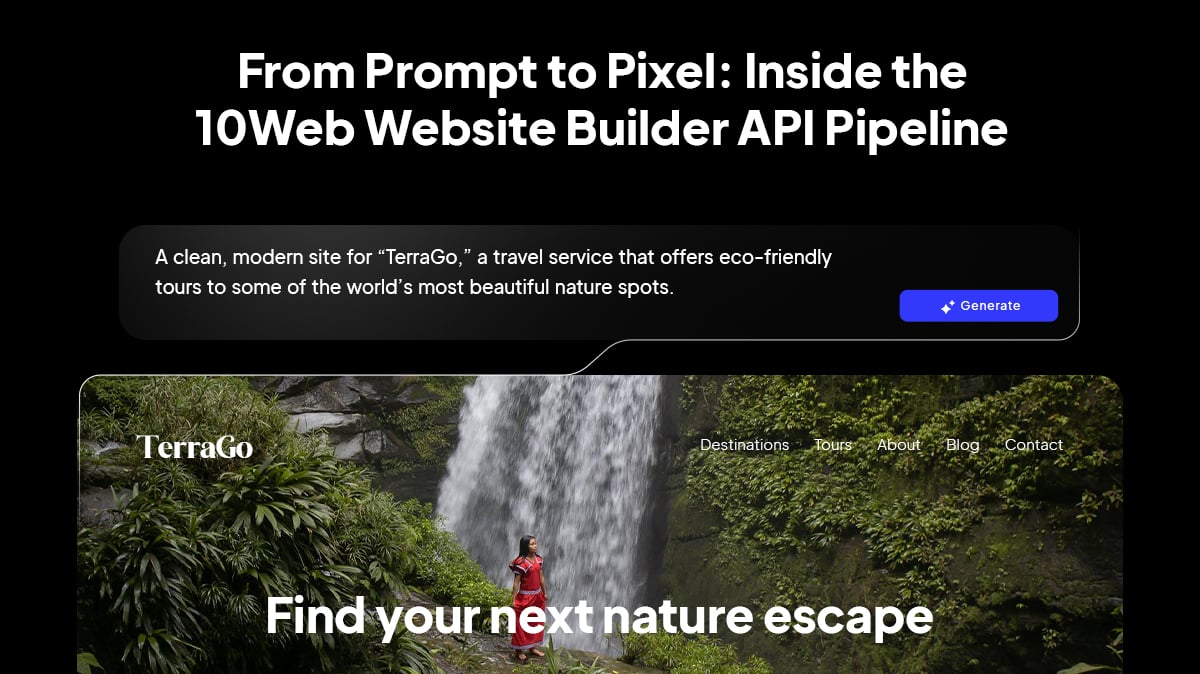
AI has become the fastest way for users to create a website. For example, the 10Web Website Builder API can take a short prompt or structured data and produce a complete website, including pages, layouts, copy, and visual elements.
For platforms, this dramatically reduces onboarding friction. Customers start with a website that already looks tailored to their business, making the editing process lighter and more approachable.
What separates top providers is the ability to refine that site after generation. Advanced builders offer AI-assisted editing to change layouts, rewrite text, or add new sections through natural language.
Customization, design flexibility, and theming
After the initial site creation, design control becomes the next priority. Some providers rely entirely on drag-and-drop editing, while others use a component-driven approach that maintains brand consistency.
The strongest solutions offer a balance: a user-friendly editor for minor adjustments and structured design systems that partners can manage at scale.
Hosting, performance, and security infrastructure
A website builder API is only as strong as the hosting it runs on. Once a website goes live, performance and reliability reflect directly on your platform. Look for solutions that offer containerized hosting, global CDNs, automated SSL, caching, daily backups, and protection from common security threats.
With these capabilities baked into the API, your team avoids managing DevOps overhead, and every site benefits from enterprise-level performance out of the box.
Ecommerce and plugin ecosystem integration
If your customers sell online, or might in the future, ecommerce support is essential. Some APIs provide simple product modules, while others offer full store capabilities with inventory, checkout, and payment integration.
Another key differentiator is plugin ecosystems. Platforms built on extensible systems like WordPress can tap into thousands of plugins for ecommerce, SEO, forms, analytics, membership sites, and more. This gives partners room to grow without having to build features from scratch.
Building a Website as a Service (WaaS) or SaaS platform with APIs
While website builder APIs do make it possible for platforms to offer website creation as a built-in capability rather than an external step, for teams moving toward WaaS models or embedding website creation within SaaS products, the principal value is scale. Hundreds or thousands of sites can be created, branded, and managed automatically, all within the platform users already trust.
Where traditional builders focus on a single user editing a single site, WaaS and embedded models focus on orchestration. The API handles the technical overhead, like provisioning, design presets, content population, publishing, and updates, while your product owns the experience. Customers remain inside your platform, with reduced setup friction, and website creation becomes a part of your core offering.
Multi-tenant architecture and white-label solutions
For WaaS platforms, multi-tenancy and white-labeling are essential. A strong API needs to provision websites instantly, associate them with the correct user accounts, and manage them throughout their lifecycle, all under your brand.
White-labeling extends beyond logos. It means the dashboard, editor, domain, onboarding flow, and support paths all reflect your product, not the underlying provider. The behind-the-scenes nature of website builders with API integration lets SaaS companies, agencies, hosts, registrars, and telcos deliver a clean, unified experience without redirecting users or revealing third-party systems.
Recent findings show that this kind of high-volume automation is a major reason platforms turn to API-first or white-label builders. They can expand digital services without increasing internal development or infrastructure overhead.
User management and billing integration
When websites become part of your offering, they need to fit your user logic and billing model. Look for APIs that support role-based access, client accounts, team permissions, and multi-site dashboards. Billing integration should work with your existing subscription or usage-based plans so upgrades, limits, and renewals remain consistent with your product.
This alignment is what makes WaaS sustainable. Each site becomes tied to your recurring revenue model rather than a separate system.
Developer experience and support
Developer experience can make or break the integration process. Mature APIs offer clear documentation, sandbox environments, sample requests, and embeddable components that partners can quickly plug into onboarding flows. Predictable lifecycle operations, create, update, publish, assign users, make it easier for teams to automate workflows confidently.
When the developer experience is strong, integration time shrinks, reliability improves, and your team can maintain more websites without increasing operational overhead.
Comparing 10Web’s AI Website Builder API
Among the emerging website builder API solutions, 10Web stands out for offering a tightly integrated combination of AI site generation, WordPress extensibility, and white-label delivery. Rather than focusing on a single part of the workflow, the Website Builder API is designed as a complete turnkey solution, keeping everything branded and contained within the product experience.
Where many APIs rely on templates and DIY backend infrastructure, the Website Builder API’s strength lies in its full-stack pipeline. With WordPress for extensibility, an AI Website Builder, and optimized hosting infrastructure, this flexible solution:
- Generates a complete site, including pages, layouts, copy, and imagery, from a single prompt.
- Allows API partners and end users to refine generated pages individually through an AI-native editor or programmatically at scale.
- Supports generated sites with optimized, managed WordPress hosting.
- Integrates as a cohesive, branded part of your UI and customer experience, not a bolted-on afterthought.
Looking at the Website Builder API as a whole, it’s an end-to-end option that can serve SaaS platforms, agencies, registrars, hosts, and other providers looking to integrate WaaS-style site creation without the ongoing burden of building the underlying infrastructure themselves.
Request your API demo now
See how easy it is to integrate AI website generation into your platform!
Checklist: Key criteria for evaluating website builder APIs
Selecting the best website builder API starts with understanding what your platform actually needs. Every solution promises speed and automation, but not every API fits the same product model. SaaS platforms may need fast onboarding, agencies may want design flexibility, and registrars or hosts often care most about scale and white-label control. A good evaluation blends all three angles: user experience, business fit, and technical feasibility.
- AI generation quality: Does it create usable layouts and copy, or does it rely on rigid templates?
- White-label depth: Can you fully brand the dashboard, editor, domain, and user flows?
- Multi-tenant provisioning: Does it support bulk creation and lifecycle control for fleets of sites?
- Design flexibility: Are there theme APIs, component systems, or editor options you can tailor?
- Hosting & performance: What guarantees are in place for uptime, CDN coverage, SSL, and security? Will you need to piece together hosting infrastructure?
- Ecommerce & extensibility: Does it support advanced use cases or plugin ecosystems? What are the long-term implications of a closed vs. open system like WordPress?
- Developer experience: Are docs, SDKs, and sandboxes resilient and flexible enough for a smooth integration?
- Pricing scalability: How do per-site or per-usage costs align with your revenue model?
- Audience fit: Does it support your target users, SaaS, agencies, hosts, registrars, telcos, and enterprise?
Finally, prioritize APIs that shorten integration time and reduce long-term maintenance. A great API makes the right website builder integration profitable and practical for your team to support at scale.
Unlocking platform growth with website builder APIs
Website builder APIs are quickly becoming a must-have for platforms that want to offer more than data dashboards or marketing tools. They let you deliver complete, branded websites directly inside your product, fast, automatically, and at scale. With AI generation, white-label editing, and managed hosting available through a single integration, the barrier to offering a “website included” experience has never been lower.
For SaaS platforms, agencies, registrars, hosts, telcos, and enterprise ecosystems, the opportunity is clear: embed website creation where your customers already work and turn it into a long-term value driver. The right API strengthens your platform by extending what your platform already does best, giving users one more reason to stay.

Request your API demo now
See how easy it is to integrate AI website generation into your platform!
FAQ
What can a website builder API help my platform do?
A website builder API can automatically generate, host, and manage complete websites inside your own platform. With 10Web’s API, this includes AI-generated WordPress sites, ongoing editing, publishing, and white-label delivery under your brand.
Will my users know I’m using a third-party API?
With the 10Web Website Builder API, your users interact with your branded dashboard, domain, and editor. End users stay within your UI, and they never see 10Web branding.
What are the key features to look for in a website builder API?
Look for AI-powered site generation, white-label control, multi-tenant provisioning, design flexibility, integrated hosting, and strong developer tools. These influence how fast you can launch sites and how easily the API fits your product.
How does AI-powered website generation actually work using an API?
The API uses AI models to turn prompts or business data into pages, layouts, text, and images. The result is a ready-to-edit website that significantly reduces onboarding time and manual setup.
How long does it take to integrate a website builder API?
Teams can often prototype within days and complete an integration in several weeks, depending on feature depth and complexity. APIs with clear docs and development sandboxes significantly accelerate the process.
How do website builder APIs handle hosting, performance, and uptime?
Some website builders with API integration include managed hosting, CDNs, caching, SSL, and uptime guarantees. This offloads DevOps work and ensures every site performs consistently.