For most of human history, writing was slow, scarce, and authoritative. To write was to fix meaning in place, and to read was to accept that fixation as a serious act. Digital networks loosened that authority by making text cheap and abundant. Generative AI finishes the job by removing human effort as the primary constraint on producing words. Once that happens, writing can no longer derive its value from the act of production itself. Its value must come from something else.
That “something else” is judgment. In a world where words are effectively free, writing shifts from creation to selection. The central skill is no longer the ability to generate prose but the ability to decide what should exist, what should be emphasized, and what should be excluded. Good writing increasingly looks like good editing: framing the right question, setting the appropriate constraints, and knowing when additional language clarifies thought versus when it merely adds noise. The writer’s role becomes closer to that of an architect than a craftsman, shaping space rather than filling it.
When words were hard to produce, writing meant creating text.
When words are cheap, writing means choosing, shaping, and constraining text.
The value migrates from:
- Can you write this? → Can you decide what should exist?
- Can you express an idea? → Can you frame the right question?
- Can you fill the page? → Can you remove what doesn’t belong?
Future literacy is editorial literacy:
- Knowing what not to say
- Knowing when language clarifies vs. obscures
- Knowing which words bind commitments and which merely decorate thought
This is why prompt design, specification writing, and constraint-setting matter more than prose flourish.
More honest where it matters—and more performative where it doesn’t
Some text becomes more permanent and more carefully constructed, not less. Laws, contracts, technical specifications, scientific claims, and governance documents grow in importance as fixed reference points in a fluid world. These texts carry real consequences and must withstand scrutiny by both humans and machines. Around them, a much larger volume of writing becomes provisional and disposable: emails, internal documents, summaries, marketing copy, and routine explanations that are constantly rewritten, personalized, and recontextualized. Paradoxically, the more ephemeral everyday writing becomes, the more valuable and demanding durable writing is.
Hard Text (Durable)
- Laws, contracts, protocols, standards
- Scientific claims
- Technical specs and interfaces
- Governance documents
These become more carefully written, not less.
They are the load-bearing walls of society.
Soft Text (Ephemeral)
- Emails, memos, summaries
- Marketing copy
- Internal documentation
- Everyday explanation
These become more provisional, continuously rewritten, personalized, and re-contextualized.
AI makes casual writing disposable, which increases the relative value of writing that must endure scrutiny.
Audience also changes the nature of the written word. Writing used to be broadcast, assuming a relatively uniform reader. Increasingly, it is compiled. The same underlying idea may appear as a short executive summary, a technical deep dive, a conversational explanation, or a visual or spoken rendering, each optimized for a specific context. None of these versions is the “real” one. They are different views over a shared semantic core. Writing begins to resemble software, with a single source of meaning and many builds for different users.
This abundance of competent text has another consequence: it sharpens readers’ instincts. When everyone can produce fluent prose, fluency itself stops signaling insight. Readers become more sensitive to whether writing reflects lived experience, real responsibility, and genuine tradeoffs, or whether it is merely well-formed noise. As a result, writing polarizes. Where stakes are low, text becomes performative, optimized for attention and quickly forgotten. Where stakes are high, writing becomes more direct, more precise, and more honest, because it is tied to accountability. The written word survives where it carries consequences.
The deepest shift might be internal
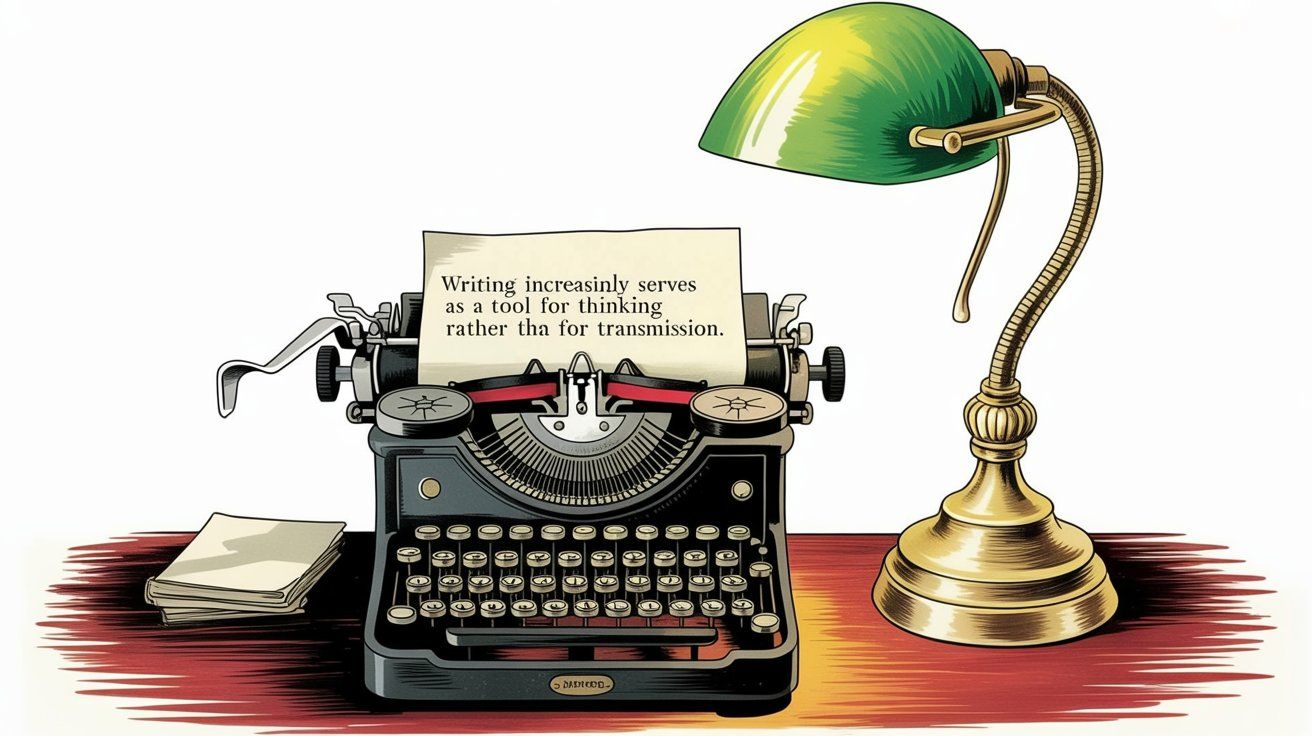
The deepest shift, however, is internal rather than public. Writing increasingly serves as a tool for thinking rather than for transmission. People write to clarify what they believe, to surface assumptions, to explore uncertainty, and to make commitments explicit. Much of this writing is iterative, private, and never meant to be read as a finished product. In this sense, writing returns to one of its oldest roles: a cognitive technology for shaping thought, now often used in dialogue with machines.
The future of the written word, then, is not one of decline but of concentration. Words matter less as a display of intelligence and more as a mechanism of decision and commitment. Writing becomes less about expression and more about structure. It fades into the background in many contexts, yet it becomes more intense and consequential where precision is required. The crucial question is no longer whether something is well written, but what that writing makes possible and what it forecloses.
The future of the written word is not fewer words.
It is fewer moments where words matter—and greater intensity when they do.