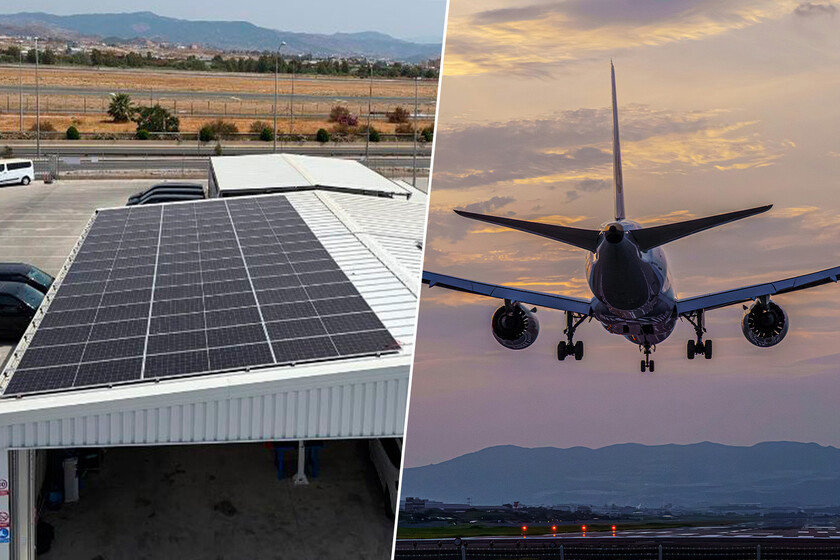
In our daily lives we are increasingly accustomed to seeing solar panels on balconies or roofs. Even when we travel by car, it is common to find land covered in plates or large wind turbines. However, there is one place where until now solar energy seemed out of place: airports.
For years, sun reflection was an unsolved problem in the airport environment. The fear that a flash could affect a pilot on approach stopped any attempt to install solar panels. In Malaga, that fear is no longer an obstacle.
In short. For the first time, Málaga-Costa del Sol Airport adds self-consumption photovoltaic installations promoted by private companies. Europcar and Goldcar have been the first to take the step, with a project developed by the Malaga engineering company Ubora Solar.
As La Opinión de Málaga highlights, this is not a project promoted by Aena, but rather a direct commitment by private companies to generate their own clean energy in one of the most regulated and monitored spaces in the country.
The big obstacle: glare. The main challenge of the project was not technical or economic, but rather air safety. The possibility that the solar panels generated annoying reflections or glare on pilots and controllers was a critical concern, also regulated by Aena regulations.
The answer involved an exhaustive analysis of visual risk. Ubora Solar developed aeronautical glare studies following the standards of the Federal Aviation Administration (FAA) and the European Aviation Safety Agency (EASA), taking into account everything from real flight trajectories to visibility from the control tower. All of this served to precisely define the orientation and inclination of the panels within the airport complex.
The results were conclusive. Luminance values were well below the European threshold of 20,000 cd/m², and any possible reflection coincided with the position of the sun, being “masked by its own brightness”, a phenomenon known as sun masking. In other words: the reflection exists, but it is imperceptible and does not pose an operational risk.
In other countries it was already a reality. Although solar installations already exist in airports in other countries, the case of Malaga is especially relevant due to its private nature. In the United States and in different parts of Europe, airport photovoltaics has been a reality for years, always subject to strict glare and air safety studies.
The difference, as various media emphasize, is that in Spain this step had not yet been taken without a direct impulse from the airport manager. Málaga thus acts as a laboratory and precedent for a model that could be replicated in other airports in the country.
A success that does not blind. For years, the sun was seen as a risk at airports. In Malaga, he has become an ally. The project demonstrates that the greatest fear—glare—is not combated with prohibitions, but with rigorous studies, planning and technology.
Málaga-Costa del Sol Airport not only manages takeoffs and landings. It has also opened a new path for the energy transition in one of the most complex environments that exists. And it has done so without losing sight of the most important thing: safety.
Image | Solar Ubora and Unsplash
WorldOfSoftware | When the December sun surpasses that of April: the luminous paradox of a vertical panel on the balcony