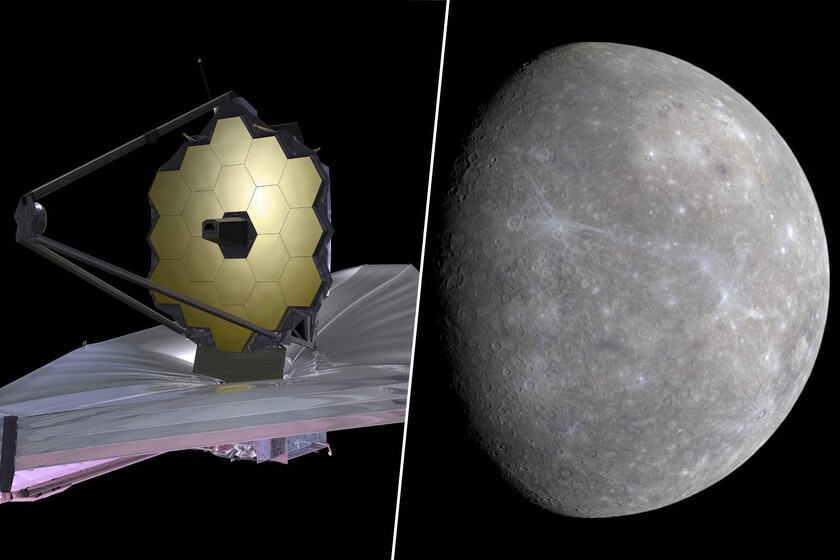
Most telescopes specialized in the analysis of exoplanets are capable of studying their atmosphere. However, James Webb has just gone further, directly analyzing the heat emitted by the surface of a planet located outside the solar system. This is very informative data, which until now had never been detected and marks a new study method for the future.
LHS 3844b. The exoplanet that James Webb has analyzed is LHS 3844b. Its size is 30% larger than that of our planet and it is located at a distance of 50 light years. According to the analysis of this space telescope, it is a dark, hot, arid rocky world without an atmosphere, quite similar to Mercury.
Ideal for James Webb. This exoplanet is also characterized by being tidally locked. That is, it takes exactly the same time to orbit its star as it does to rotate around itself. As a consequence, he always shows the same side to his star. Like the Moon to the Earth. Planets that always have the same side facing their star have one side where it is always day and another where it is always night. The first, in addition, usually has very high temperatures.
But the best thing is that they are cannon fodder for MIRI, one of James Webb’s star instruments. This has a great capacity to detect infrared emissions, such as those emitted by a hot object. In other words, the analysis of a body’s infrared emissions can give us an idea of the heat it emits.
eclipse chasers. On planets like this, with one side always exposed to its star, there is a problem. When analyzing the heat emitted by its surface, it can be confused with that of its star. Therefore, eclipses are ideal for MIRI to do its work. When this happens, the planet hides behind the star, so the only light that reaches the Space Telescope is from it. Thus, the data is obtained that must then be subtracted from the set that is normally measured to know exactly what the infrared contribution generated by the planet alone is.
Geology enters the chat. In reality, the radiation measured by MIRI does not only provide us with information about heat. The different elements that can be present on a planet have a different emission spectrum. They reflect more or less radiation. Therefore, it is possible to know approximately what the composition of the atmosphere and surface of the planet is. This exoplanet does not have an atmosphere, so we can basically know data about its surface and even its geology.

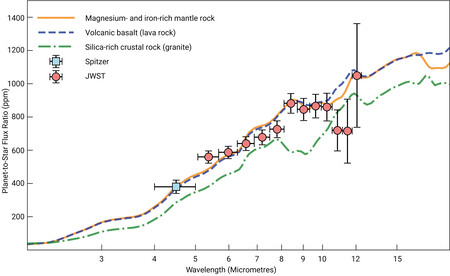

The infrared spectrum of the hot dayside of LHS 3844 b is derived from the brightness contrast with its host star in ppm (parts per million = 0.0001%) at different wavelengths. Observational data obtained from the James Webb and Spitzer space telescopes (circles and squares) are consistent with mantle (solid orange line) or volcanic rock (dashed blue line), while ruling out an Earth-like crust (green dashed dotted line). Credit: Sebastian Zieba et al./MPIA
two eclipses. In 2023 and 2024, two eclipses were detected on this exoplanet that allowed James Webb to analyze its infrared emissions. The signal obtained was compared with that of planets and well-known objects, such as Earth, Mars and the Moon. It had nothing to do with Earth, so it is assumed that the surface of both planets must be very different. Possibly with very little water in the case of the exoplanet. On the other hand, there were quite a few similarities with the Moon. That would lead one to think that the planet could be covered in basalt, a very common volcanic rock on our satellite.
Something doesn’t add up. The initial hypothesis given these signals is that the planet could be young and covered in fresh lava. However, with this volcanic activity, gases such as carbon dioxide or sulfur dioxide are released, which were not detected by the James Webb.
Therefore, another hypothesis has been proposed. The planet is likely covered in a thick layer of dark, fine-grained material formed over long periods by radiation and meteorite impacts. It is something similar to what happens on Mercury or the Moon. Planets without an atmosphere are especially susceptible to this phenomenon, known as space weathering, so it would be plausible.
We will have to check it. It is hoped that James Webb will be able to obtain even more data to confirm whether this last hypothesis is correct. Be that as it may, only with what he has already been able to measure he has overcome many barriers. The achievements of this telescope seem to have no end.
Images | NASA | Sebastian Zieba et al./MPIA
In | The James Webb has broken another historical record: a supermassive black hole older than expected