We are witnessing live a technological race that is no longer measured only in announcements or demonstrations, but in tangible investments that grow at a speed that is difficult to ignore. In the United States, and also in other regions, large companies are allocating increasing amounts of money to build and expand the infrastructure that supports the current deployment of artificial intelligence services and the expansion of computing capacity that these companies pursue. Some speak of excessive enthusiasm and even a possible bubble, but the money already invested is part of the economic reality of the sector, while the projected figures point to an even larger scale. The question, therefore, is not whether the bet exists, but how big it really is.
The numbers. If the first step is to assume that the investment exists, the second is to quantify it precisely. Data collected by The Wall Street Journal suggests that Meta, Amazon, Microsoft and Alphabet (Google) could concentrate a joint expenditure of up to $670 billion in 2026 aimed at artificial intelligence infrastructure. We are talking about capital outlays associated with data centers, hardware and capacity expansion, not just “brick”. When a single annuity reaches that order of magnitude, the conversation shifts from expectations to measurable economic consequences.
Dollars are not compared. What the analysis proposes is not a direct equivalence between amounts spent in different times, but rather a way of measuring the economic weight of each effort in its own historical context. Instead of adjusting old figures to current prices taking into account inflation, the article uses the percentage of gross domestic product (GDP) as a common reference for separate projects over time. That shift in focus shifts the conversation from absolute money to relative magnitude within the U.S. economy. And it is precisely there where the investment associated with artificial intelligence acquires a historical dimension that is difficult to ignore.
The investments. Among the great economic milestones that are often used as historical references in the United States, there are episodes as different as the Louisiana Purchase, the railroad expansion of the 19th century or the construction of the interstate highway system, all of them with different relative weights within the economy of their time. Using that same metric, this effort has been estimated around the following magnitudes:
- Louisiana Purchase: 3% of GDP
- Railway expansion: 2% of GDP
- Interstate highways: 0.4% of GDP
- Apollo Program: 0.2% of GDP
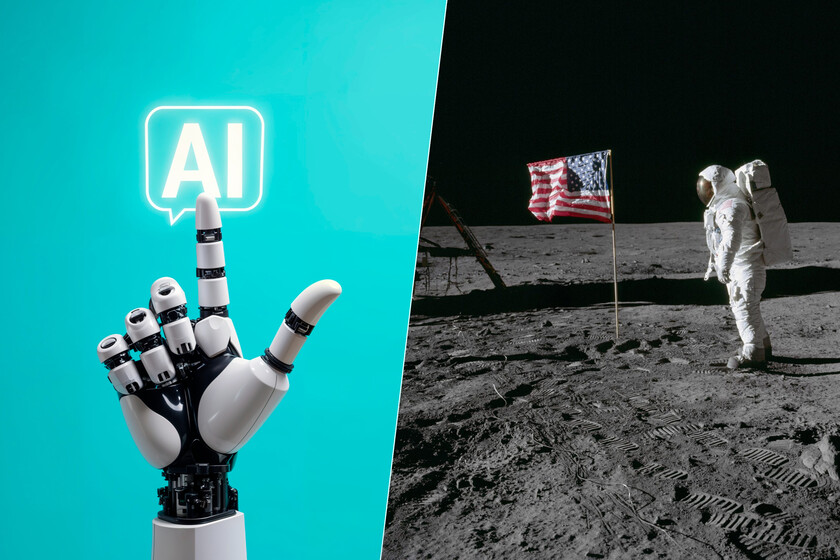
As we can see, the planned investment in artificial intelligence infrastructure is around 2.1% of GDP compared to 0.2% of GDP for the Apollo Program.
It’s not the same, but. Historical parallelism functions as a scaling tool, not as institutional equivalence. The large projects with which the current moment is compared were, in many cases, public initiatives financed directly or indirectly by the federal State, while investment in AI infrastructure corresponds mainly to corporate spending. That distinction is important, however, from a strictly economic perspective, the relative size of the effort remains comparable.
The State does not pay the main bill. That the bulk of investment is private does not mean that the public sector remains on the sidelines. It’s no secret that the U.S. government influences the pace and shape of deployment through regulatory decisions, permitting, energy planning, and federal land use for new data center infrastructure. This set of levers is not a substitute for corporate capital, and at the same time it fits with a broader strategy aimed at preserving American leadership in the global race for AI.
Historical comparison. This ends up pointing out something deeper than a simple number: it indicates the type of priority that a society decides to give to certain technologies at a specific time. When investment in AI infrastructure reaches a relative weight comparable to that of major American economic milestones, reading transcends the technology sector and enters the strategic field.
Imagenes | NASA freepik
In WorldOfSoftware | Daniela Amodei, co-founder of Anthropic: “studying humanities will be more important than ever”