Threads and X play, essentially, the same game. Short messages, public conversations and the ambition to become the place where the things that matter are discussed. On mobile, Threads is already moving very close to X in daily active users on a global scale, to the point that, on specific days, it was ahead. But when you look beyond the numbers, the feeling is different. The conversation that jumps to the media and public debate continues to be born, almost always, in the same place.
The most cited photo comes from Similarweb data and focuses exclusively on mobile use. That’s where Threads has closed the gap significantly. According to this analysis firm, both platforms converge in very close figures of daily active users on a global scale, around 130 million. In the week with data until September 20, 2025, Threads was ahead of X on three of the days analyzed. Even so, the series as a whole does not allow us to speak of consolidated leadership, but rather of a very tight and localized equality in time.
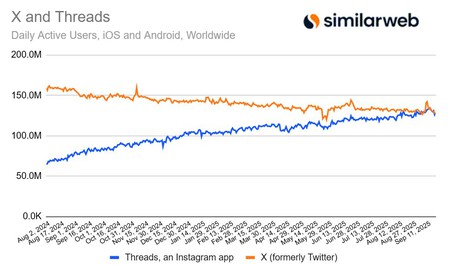
Daily active users on iOS and Android. Threads approaches X on mobile phones globally | Source: Similarweb
What does this data measure and what is left out. When talking about daily active mobile users, it is advisable to sharpen the focus. Similarweb counts daily usage on iOS and Android, counting each person only once a day, even if they open the app multiple times. Additionally, any user who performs a minimal action, such as opening the app or logging in, is considered “active.” This metric reflects access habits, but does not distinguish between reading, interacting or publishing, nor does it measure what type of accounts concentrate the activity or what content is amplified outside the platform.
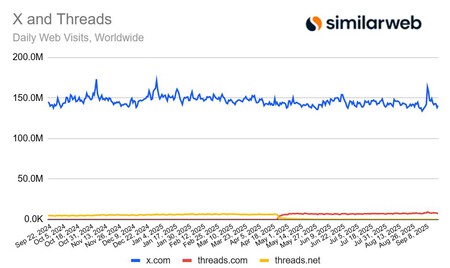
Daily web traffic on a global scale. X maintains a very large advantage over Threads in browser visits | Source: Similarweb
That balance that appears in mobile use is broken as soon as the focus is expanded. When looking at web traffic, the distance between both platforms is once again very marked. Similarweb data shows that It is not a minor detail, because web access is usually more present in professional contexts, newsrooms and news monitoring. Changing metrics also changes the story the data tells.
Information consumption follows another map. When the question is not how many people enter each day, but rather where users get information, the scenario changes. The conclusions of the Reuters Institute’s Digital News Report 2025 suggest that The difference is not so much size but function within the media ecosystem.
Part of that difference has to do with the type of use. An academic study published in 2024 describes X as a “passive sensor” especially useful for detecting opinion leaders, combining public visibility, active community and clear temporal traceability of messages. This architecture makes it easier for statements, reactions or controversies to be followed in real time and reused in other contexts. For media and analysts, X not only works as a social network, but also as a tool for observing public conversation.
A growth pushed from within the ecosystem. The progress of Threads is largely explained by its integration with Instagram and, in general, with the Meta ecosystem. Direct access from an already massive application reduces barriers to entry and makes it easier for many users to try out the platform without additional effort. That push helps explain why mobile usage numbers have grown rapidly. However, this dynamic does not guarantee that users adopt Threads as a central space for public or informative debate, nor that they transfer there the practices that they currently maintain in X.

Not even the recurring controversies surrounding Elon Musk have been enough to displace X from its role as an informational reference point. Threads advances in usage and visibility, but the center of gravity of the conversation remains where it was. For that to change, it will not be enough to add users or rely on the Meta ecosystem. It would require a deeper transformation of professional, media and political habits that, for now, is not appreciated.
Images | Mohamed Nohassi | Kelly Sikkema
In WorldOfSoftware | Neither board games nor karaoke: ‘Word on Beat’ is the new king of the living room and proof that we prefer rhythmic chaos