Space is a critical domain for US national security, and African nations will play a pivotal role in defining space competition between the United States and China. The United States is sorely underinvested in this area; China is not. But the United States can secure its interests in space through creative, modest investment across multiple sectors of African economies.
US space access and cooperation in Africa was once comprehensive. Now it’s virtually nil. From 1980 to 1991, Somaliland was an alternate landing site for the NASA space shuttle. NASA and the US Air Force maintained telemetry, tracking, Earth station, and data networks across Eritrea, Kenya, Nigeria, Morocco, Gabon, and South Africa through the 1990s. However, through a series of state-backed investments and following a concerted, yearslong strategy, Beijing is gaining control over the entire value chain for critical minerals that are essential for space technologies. This places China in the driver’s seat on prices, timelines, and deployments of its space systems—and US and allied space systems—in the coming years. China’s space-economic diplomacy in Africa is doubly threatening to the United States: It provides China with sharper and nearer offensive capabilities, and it gives Beijing unmatched leverage over US and allied advanced defense and space supply chains.
There is still hope for the United States to regain some of its strategic advantage in space, but it will require rewriting the rules of the game in ways that benefit African states. The US commercial space sector might offer a hidden advantage that could start to reroute critical minerals supply chains from China’s dominance. US companies—with government financing—could start to restructure critical technology supply chains in Africa by growing talent, building equity, and providing end-use of that technology. This would help generate significant political buy-in and start to slowly tilt the space diplomacy playing field back in Washington’s favor.
China’s Africa space strategy is mature and comprehensive. Since China built a telemetry, tracking and command (TT&C) station in Swakopmund, Namibia in 2001, Beijing has been expanding its space diplomacy footprint across the continent. It now accesses a ground station in Windhoek, Namibia’s capital, as well as another TT&C station in Malindi, Kenya. Agreements with Nigeria, Ethiopia, and South Africa provide China up/down-link capability for space data. Algeria, Ethiopia, Egypt, and Sudan use Chinese satellite buses and launch to reach orbit. In 2024, Senegal joined Egypt and South Africa in cooperating on China’s International Lunar Research Station. China is also eying a spaceport in Djibouti just a few miles from a People’s Liberation Army Navy base—and Camp Lemonnier, a US naval expeditionary base.
These sites enable global tracking and safe operation of China’s satellites and manned space operations. But China’s view into space from Africa’s soil is just a small part of the problem. Africa is not only crucial to China’s civilian space program and diplomacy, it’s also part of a global space/military puzzle. China’s space investments in Africa are integral to its advanced missile program and deterrence against the United States. Its space ventures in Africa, combined with infrastructure in South America and Beijing’s efforts in the Arctic, China has almost global coverage on approaches to and from the United States.
China’s dual-use access in Africa restricts US space and defense supply chains
China has been systematically acquiring and building assets that expand its global military readiness and economic advantage. Africa is at the center of this dual-use strategy. Ports, bases, and naval visits in places such as Nigeria, Gabon, and Angola provide China both maritime domain awareness and access to minerals critical to its domes tech and defense industries. Coupled with billion-dollar Chinese investments in rail corridors, roads, and mines, China controls a massive proportion of the upstream critical minerals supply chain.
China has also cornered the downstream market. China’s near-90 percent control of global rare-earth processing allows it to score broader economic wins and advance its domestic technological sovereignty goals. The United States relies on China for 70 percent of its rare earths, according to a 2024 US Geological Survey report. China’s export controls over germanium and gallium refining caused prices for the minerals—vital for space solar cells and advanced radars—to more than double in 2024. The samarium cobalt and neodymium magnets for which China currently dominates production are vital to advanced air systems such as the F-35, as well as ship propulsion and air/space actuators.
According to China’s 11th Five-Year Plan for High-Tech Industrialization, control over these supply chains is both an explicit goal and a means toward pursuing technological sovereignty through indigenous innovation. China uses these supply chains to close gaps for its own advanced systems. Hypersonic missiles such as the Dong Feng 17, advanced fighters such as the J-20, cutting-edge aircraft carriers, and BeiDou satellites rely on minerals sourced primarily from Africa, such as bauxite, tantalum, and niobium.
Put another way, China can mine raw minerals in Zambia, transport them on Chinese trucks and rail, load them in Chinese berths onto Chinese state-owned vessels, and ship them to Chinese ports. On the mainland, China refines these minerals. US companies then source these materials or components made by Chinese technology companies, providing China potential backdoor access on top of market controls.
China benefits from and perpetuates this system, including by engaging with corrupt officials who are willing to reward Chinese businesses with access in exchange for bribes. While this is not a new phenomenon, it poses greater national security risks when tied to mineral access. China has also taken advantage of lacking US engagement in the Sahel to expand its commercial relationships. These include not only security assistance and cooperation, but also data access agreements in places such as Gabon. Although Guinea has canceled a series of Chinese mining concessions due to contract compliance challenges, Guinea alone accounts for around 70 percent of China’s bauxite imports, a mineral needed to produce alumina essential for advanced propulsion systems. Guinea’s stability is therefore critical to China’s supply chains.
Space matters to African countries
African states are acting in their own self-interest in partnering with willing space powers, including China. With rapidly growing populations, African countries have immense internet, telecommunications, and data needs. However, with limited budgets and at times large, ungoverned territories, many African governments struggle to meet these needs. Overhead satellite capabilities could provide African states with the overwatch they need and their mineral wealth provides the means to pay for them.
As Space in Africa founder Temidayo Oniosun wrote in September 2025, African states have viable sovereign uses of their own for space data. In addition to tracking security threats afflicting states such as Burkina Faso, Mozambique, and the Democratic Republic of Congo (DRC), many other states seek to use space assets to tackle issues such as deforestation, water management and hydrology, climate forecasting, migration, and poaching.
The US commercial space sector needs Africa and can offer a new kind of diplomacy
Experts have long proposed expanding space cooperation with African countries as a win-win for the United States, and the continent’s rapidly growing, tech-savvy population has a burgeoning interest in working with space-based capabilities. A long-standing bipartisan consensus holds that the United States needs more options for sourcing critical minerals for the national industrial base. Yet, there are fewer diplomatic and development tools available after last year’s cuts in the US federal service, tools that once positioned the United States to support Africa’s space economy ambitions.
China still trails the United States in commercial space launch and coverage. Despite feverish investment by state-backed venture capital, Chinese companies such as Galactic Energy and LandSpace are still getting off the ground. While Galactic’s reusable Pallas rocket has not yet successfully launched, SpaceX has completed more than five hundred reusable rocket missions, and Blue Origin has recorded dozens of reusable launches.
The US commercial satellite sector is also dominant, often paired with commercial lift providers. Companies such as Maxar, Umbra, Hawkeye360, CapellaSpace, and PlanetLabs are leading the way in advanced overhead imagery. US companies are also exploring in-space manufacturing, autonomy, and communications, as well as expanding opportunities for the cislunar economy—commercial activities between Earth and the moon. SpaceX has already expanded access to its StarLink network across two dozen African states. Chinese commercial satellite companies still rely on China’s state research apparatus, funding, and launch to reach orbit, though that gap is closing.
A playbook for US government-backed commercial space diplomacy in Africa
US space companies should structure deals with mineral extractors and value chain providers directly with African states to address both US and African needs. US and allied consortia can negotiate provisions with African governments and companies that guarantee access to and/or use of finished technology that African minerals produce. They can also create equity arrangements, such as education and training for African students, a pipeline to advanced technological employment, and agreements for regionally based refining and beneficiation. Such arrangements would give African nations greater control of and access to the benefits of their resources, while US companies would gain an advantage over Chinese competitors to expand markets with secure supply chains.
While it’s unrealistic to expect a strategic realignment of US priorities toward Africa, slowly increasing commercial engagement would give both US and African policymakers more options. Both of the past two US administrations have expanded legislative, diplomatic, and economic frameworks to provide access to friendly overseas mineral sources, while investing in longer-term US mining and refining operations. The Trump administration is working on implementing policies that would help US companies enter African markets and enter into agreements that play to Washington’s strengths. The administration’s willingness to back Department of Defense, Department of Energy, or other agency offtake agreements and leverage the Defense Production Act in support of critical minerals supply chains are key tools that space companies could wield to enhance their access.
The US government can further ease commercial space entry into Africa with a few targeted actions, all achievable in the current government budget climate. The United States should:
- Expand International Development Finance Corporation and Export-Import Bank guarantees to include projects that focus on African nations’ beneficiation, transparency, and data sovereignty needs.
- Conduct targeted engagement via the African Space Agency, US Department of State, and an expanded pool of US Foreign Commercial Service representatives in countries such as the DRC, Angola, Djibouti, Kenya, and Namibia that demonstrate commitment to expanding their space capacity.
- Refocus US State Department training and exchange programs toward space cooperation in Africa, and build on the best practices of programs previously funded by the US Agency for International Development.
- Transform defunct State Department environmental, science, technology, and health positions into science and technology roles that include a focus on space.
- Expand the role of the Office of Space Commerce at the National Oceanic and Atmospheric Administration in diplomatic exchanges to work alongside an empowered Foreign Commercial Service.
- Leverage the Pentagon’s Office of Strategic Capital to invest more in US and partner ground and space infrastructure to ease access to these markets.
- Sponsor exchanges that build local space talent via US Africa Command’s Space Force Component, SPACEFOREUR-AF, in key partner states to cultivate space expertise in military channels that can help support the commercial space industry and vice versa.
US space companies also don’t need to wait. To secure greater access to essential upstream minerals, they can also help finance in-kind agreements with African countries—either ahead of or instead of US financing. Space companies can also serve as commercial diplomats, both increasing access and expanding their talent pool among Africa’s rising scientific community.
China is already running this playbook. On November 20, China signed over its use of the ground monitoring station outside Windhoek to the Namibian government. African media heralded the transfer as a milestone in China-Africa space cooperation; Namibian officials praised the deal, noting that it would enable the country to better track agricultural growth, climate impacts, and population movements.
China’s dominance in space and over critical mineral supply chains in Africa is a direct threat to US national defense and commercial interests globally. There’s still time to secure US leadership in space with the help of African partners. But not much.
Maureen Farrell is a nonresident senior fellow with the GeoStrategy Initiative at the ’s Scowcroft Center for Strategy and Security. She is also vice president for Valar, a US company based in Nairobi, where she drives global partner engagement on security, counterterrorism, critical minerals, and a range of related issues.
Matt Petit is a mission lead for economic security at Vannevar. He joined the company after seventeen years as a foreign service officer with the US Department of State, working primarily on Africa and strategic competition issues.
Farell and Petit served together as directors for Africa at the US National Security Council.

The GeoTech Center champions positive paths forward that societies can pursue to ensure new technologies and data empower people, prosperity, and peace.
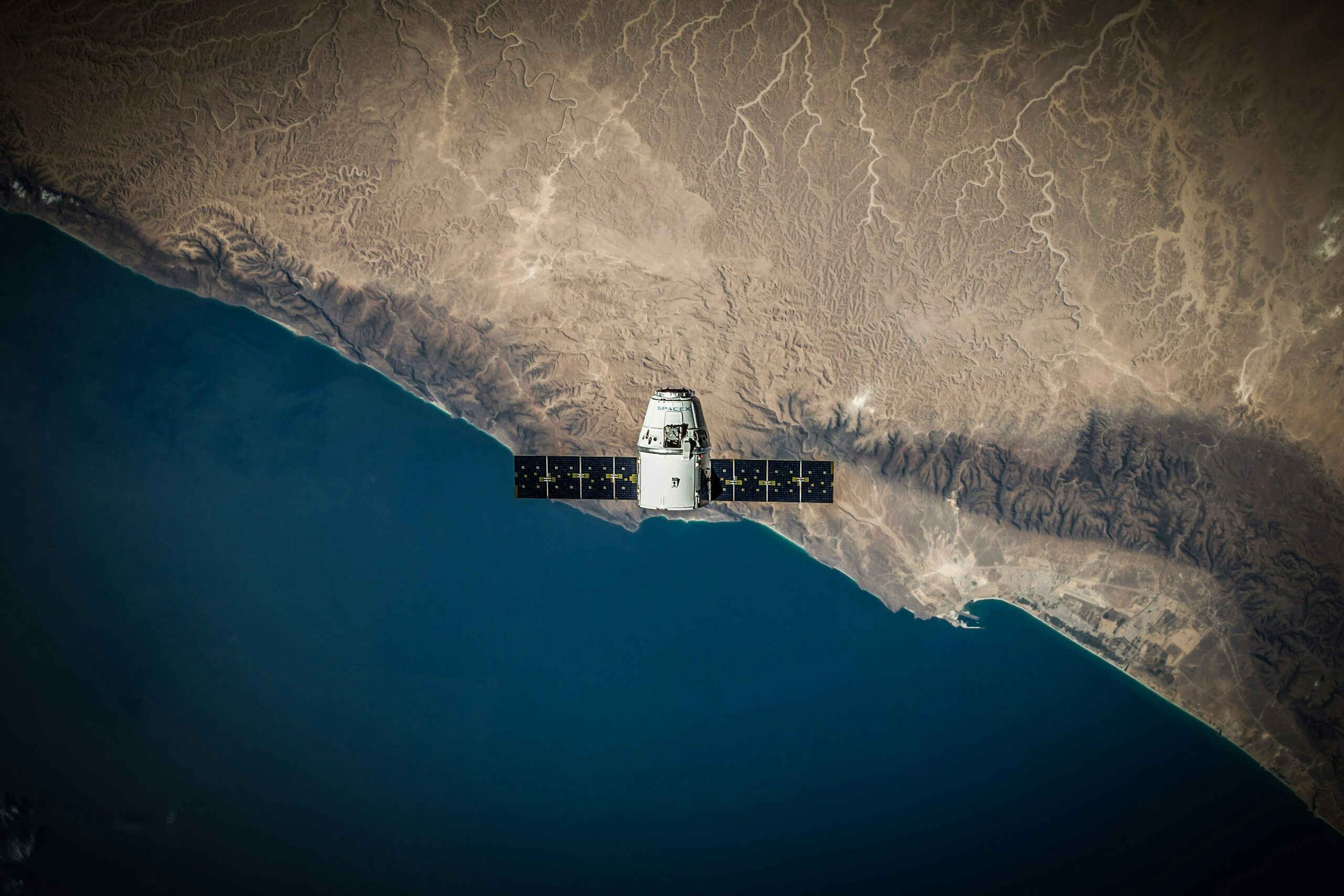
Image: Satellite over the coast, April 9, 2016.(SpaceX/Unsplash)