U.S. President Donald Trump said today on social media that he will allow Nvidia Corp. to sell its H200 graphics processing units to “approved customers in China,” reversing a policy that had previously prohibited the product from being shipped to the country.
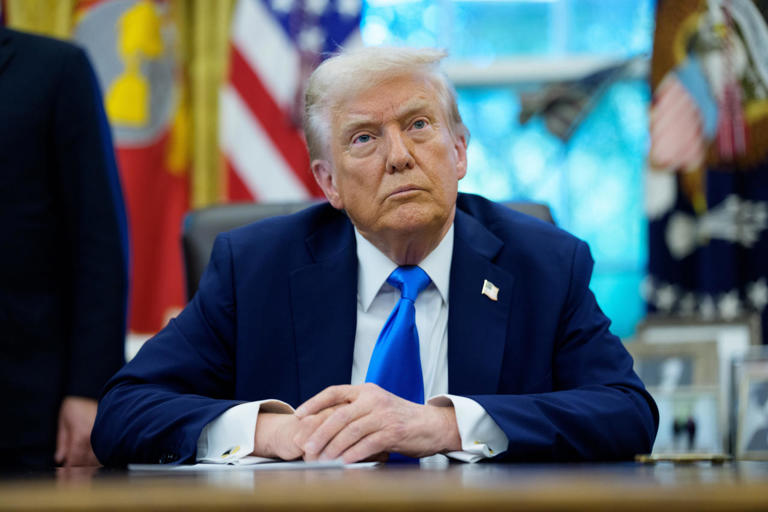
In a post on Truth Social, Trump (pictured) said that Chinese President Xi Jinping had “responded positively” to his proposal. He added that the policy will “support American jobs, strengthen U.S. manufacturing and benefit American taxpayers.” The Nvidia H200 GPU is an older chip that’s one generation behind the company’s latest “Blackwell” chip, which is widely considered to be one of the most powerful artificial intelligence processors money can buy.
Trump specifically pointed out that Blackwell would not be part of the deal. But nonetheless, the move could generate billions of dollars in revenue for Nvidia, which is already the world’s most valuable company. Last month, the chipmaker said it currently has a backlog of more than $500 billion worth of orders for its current-generation AI chips, up until the end of next year, and that’s not including any buyers from China.
According to Trump, Nvidia rivals such as Advanced Micro Devices Inc., Intel Corp. and “other great American companies” will also be allowed to sell similar chips to some customers in China. He added that the Department of Commerce is currently “finalizing the details” of the agreement, which will likely still restrict some Chinese entities from doing business with the chipmakers.
The decision by Trump partially brings to an end a long-running ban on the shipment of higher-end processors to China, and it’s very likely that money played a big role in it. Trump said on Truth Social that the U.S. government will receive a 25% cut of any sales, up from a previously announced 15% slice of the pie.
Still, it’s not entirely clear how many chips Chinese companies will want to buy. Earlier this year, the U.S. approved the sale of a less powerful chip known as the H20 to China. The H20 chip is a scaled-down version of the H200 that has less throughput, meaning it processes computations more slowly. It was designed to get around earlier rules on the export of chips to China.
Although it was initially approved under previous President Joe Biden’s administration, Trump banned its export shortly after he returned to the White House. He later reversed that stance, in return for a 15% cut of any sales, only to be snubbed by Xi, who said he wasn’t interested in buying them.
The H200 is a different kettle of fish, however, so Chinese firms might be interested in getting their hands on it. Nvidia seems to think so. In a statement, the company said it “applauds President Trump’s decision to allow America’s chip industry to compete to support high paying jobs and manufacturing in America. Offering H200 to approved commercial customers, vetted by the Department of Commerce, strikes a thoughtful balance that is great for America.”
Nvidia Chief Executive Jensen Huang has been lobbying the White House for months to try to gain permission to sell more advanced chips to China. He has established close personal relations with Trump over the last year, which may have helped to swing the president’s thinking in his favor.
Not everyone is so happy about the deal. Earlier this month, a bipartisan group of lawmakers in Congress expressed major reservations about any deal that would allow Chinese firms to buy advanced American AI chips. One of the lawmakers, Sen. John Kennedy, R-Louisiana, said he refused to attend a recent meeting with Huang on Capitol Hill because he believes the CEO is only interested in financial gain. He added that he doesn’t consider him to be “an objective, credible source about whether we should be selling chips to China.”
Last week, Republican Sen. Pete Ricketts of Nebraska insisted that “denying Beijing access to these AI chips is essential to our national security.” Ricketts, along with Democrat Sen. Chris Coons of Delaware, introduced a proposal known as the SAFE Chips Act, which is aimed at restricting the export of advanced AI chips to China, Russia, Iran and North Korea for at least 30 months.
Despite the opposition, it seems likely that Trump will have his way. Semiconductors are one of the biggest issues at the heart of the rocky trade relationship between the U.S. and China. The U.S. has sought to restrict China’s access to both the best chips and also the technology necessary to manufacture them, and Beijing responded recently by imposing export controls on so-called rare-earth materials, which are essential ingredients of processors. Trump hit back by threatening massive tariff increases on U.S. imports from China, but later struck a tentative truce after meeting with Xi in South Korea in October.
Photo: White House
Support our mission to keep content open and free by engaging with theCUBE community. Join theCUBE’s Alumni Trust Network, where technology leaders connect, share intelligence and create opportunities.
- 15M+ viewers of theCUBE videos, powering conversations across AI, cloud, cybersecurity and more
- 11.4k+ theCUBE alumni — Connect with more than 11,400 tech and business leaders shaping the future through a unique trusted-based network.
About News Media
Founded by tech visionaries John Furrier and Dave Vellante, News Media has built a dynamic ecosystem of industry-leading digital media brands that reach 15+ million elite tech professionals. Our new proprietary theCUBE AI Video Cloud is breaking ground in audience interaction, leveraging theCUBEai.com neural network to help technology companies make data-driven decisions and stay at the forefront of industry conversations.