A pioneering investigation into the impact of restricting social media access for children in the UK has been announced as politicians around the world consider action on the issue.
In December, Australia became the first country to ban under-16s from social media, with governments in other countries, including the, coming under pressure to do the same.
However, while experts say there is evidence that aspects of social media are harmful to most children, there has been no large-scale experimental study exploring the effect of limiting time spent on social media in healthy children as a population.
“This study is a world first to try to look at that question,” said Prof Amy Orben, of the University of Cambridge, who is co-lead of the study.
Orben and colleagues plan to study about 4,000 children across 30 secondary schools in Bradford, West Yorkshire, focusing on students in years 8, 9 and 10.
All participants would be asked to complete an initial questionnaire on areas including their mental health, sleep and friendships, and to download the research app on their main device.
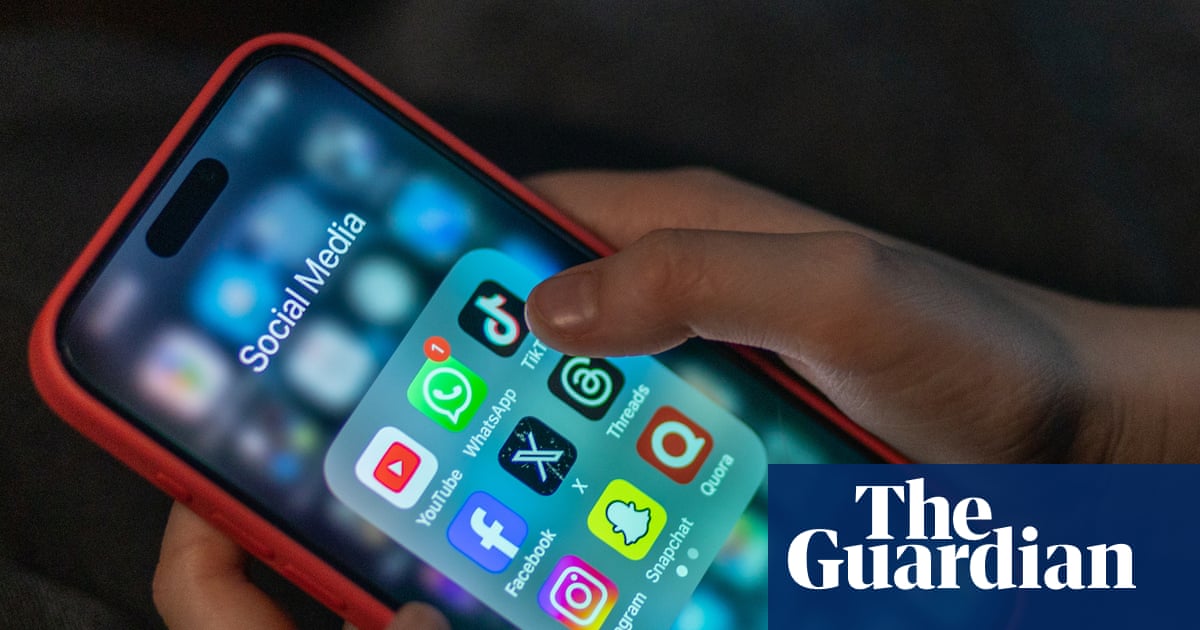
Each year group in each school would be randomly assigned to one of two conditions: the app would simply record the pupils’ social media use, or it would curtail their social media use by limiting access to the apps for TikTok, Instagram, Facebook, X, LinkedIn, Reddit, YouTube and Snapchat to one hour a day, as well as imposing a curfew from 9pm to 7am.
Crucially, the team said, all pupils within a particular year group in a school would experience the same intervention.
“We know that if we take away social media for one adolescent, that might have a very different impact than if we take it away for their whole friendship group for a certain period of time,” Orben said.
Access to messaging apps including WhatsApp would not be restricted, the team said, as they were important for family communication.
After six weeks students would complete another questionnaire. After an initial pilot period beginning in April, the team planned to start the study itself in October, with the first results expected in summer 2027.
Members of the House of Lords are preparing to vote on an amendment brought by John Nash to the children’s wellbeing and schools bill which would introduce an outright ban on children using social media.
The amendment has the support of some Labour peers, and if it passes in the Lords it will then be debated in the Commons, where 61 Labour MPs recently wrote a letter to the prime minister urging him to bring in a ban.
Liz Kendall, the technology secretary, reassured MPs on Tuesday that the government’s consultation on the issue would only take a few months and that it would have a firm position by the summer.
However, Nash insisted he would press ahead with his attempt to legislate immediately for a ban, saying on Tuesday: “The time for delay and procrastination is over. Without swift action to raise the age limit for social media to 16, we are at risk of a societal catastrophe.
“That is why I am urging all fellow peers to vote for my amendment, which has the backing of peers from every major party, to end the disastrous harm being done to our young people by social media and to give them their childhood back.”
While the researchers have noted that the study, called the IRL trial, has limitations – for example students may use devices that belong to other people or may choose not to participate – they said they hoped the results would shed light on the effect of restricting teens’ social media use.
“The participants’ levels of anxiety is our key outcome, and we’re also interested in depression,” said Dr Dan Lewer, who leads the Bradford Centre for Health Data Science and is co-lead of the study. The researchers would also explore the impact by looking at which apps were used and when, as well as participants’ sleep patterns, experiences of bullying, time spent with friends and family, and how they compared themselves to other young people, he said.
The trial was independent from the UK government’s announcement of a consultation on whether to ban under-16s from social media, Orben said, adding that the results may be valuable for other countries debating the issue.
“The decision that policymakers need to make is up to them,” she said. “We’re really just delivering the best quality evidence we can in the timeframes that are available.”