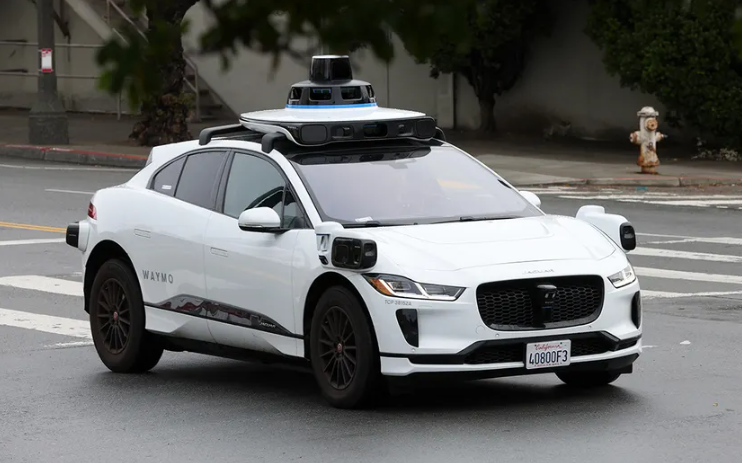
Robotaxis operated by Google’s Waymo LLC came to an abrupt halt across San Francisco on Saturday evening after a power outage uncovered a major flaw in the way the autonomous vehicles navigate.
The outage was first reported by CNBC and left more than 130,000 homes without power while knocking out traffic lights at major intersections across large parts of the city, causing confusion for Waymo’s driverless taxis. Seemingly unsure what to do when faced with an inoperable traffic light, the vehicles simply shut down when they approached them, adding to the congestion that resulted from the traffic lights’ failure.
Waymo said in a statement it was suspending its robotaxi service while waiting for the traffic lights to come back online. “We have temporarily suspended our ride-hailing services in the San Francisco Bay Area due to the widespread power outage,” the company said. “Our teams are working diligently and in close coordination with city officials, and we are hopeful to bring our services back online soon.”
The power outage began on Saturday afternoon local time and may have been sparked by a fire at a substation operated by Pacific Gas & Electric Co. By Sunday morning, power had been restored for about three-quarters of affected residents, but some parts of the city were still in blackout. Waymo has not yet confirmed to what extent its robotax operations have resumed.
🚖 Traffic in San Francisco was a mess as scores of autonomous #Waymos simply froze on roads as a massive #poweroutage hit the city.
Video clips of dozens of #driverless Waymos #robotaxis were seen sitting in intersections with no clue what to do.
With no traffic signals… pic.twitter.com/g9b9binRr2
— Shafek Koreshe (@shafeKoreshe) December 21, 2025
The incident appears to have exposed a significant weakness in Waymo’s autonomous driving technology, revealing that they’re unable to deal with blank traffic lights, and that could well cause concern about their rollout in other cities and countries.
Always eager to take a swipe at his rivals, Tesla Inc. Chief Executive Elon Musk cheekily posted on X that “Tesla robotaxis were unaffected by the SF power outage.”
That Tesla’s robotaxi service is operating normally is not really a surprise, because unlike Waymo, it still has human drivers in its vehicles. Tesla’s ride-hailing cars rely on a “driver assistance system” and are not truly autonomous, because they have a real driver sitting behind the wheel at all times, ready to take over and slam on the brakes in the event the system fails. Unlike Waymo, Tesla has not yet secured the necessary permits to operate fully autonomous cars in California.
Still, Tesla ultimately hopes to do so. It sees itself at the forefront of the nascent robotaxi industry and plans to launch fully autonomous vehicles at some point in future. But it seems to be going about things more cautiously, because it still has human drivers in the seat even in states where it has obtained clearance for driverless operations.
Tesla’s cars may also be better equipped to handle power outages, because they use different technologies. Notably, they’re equipped with high-resolution cameras that feed real-time video of the car’s surroundings into a powerful chip that runs neural networks, enabling it to mimic human-like decision-making in unusual situations, such as if a traffic light breaks goes out. Waymo, on the other hand, deploys LiDAR and radar and uses high-definition maps updated in real-time to navigate the roads. However, Saturday’s incident suggests that its cars struggle with unmapped changes.
The disruption to Waymo’s service comes as robotaxis have become an increasingly common sight in the U.S. They can currently be hailed in Atlanta, Austin, Dallas, Houston, Los Angeles, Miami, Phoenix and San Antonio, in addition to San Francisco. The company has said it plans to bring its driverless cars to even more cities, but Saturday’s incident may put a dent in those ambitions.
A significant majority of Americans appear to be somewhat cautious and concerned about the growing prevalence of robotaxis. A survey by the American Automobile Association earlier this year revealed that two-thirds of U.S. drivers say they are “fearful” of sharing the road with autonomous vehicles.
Photo: Waymo
Support our mission to keep content open and free by engaging with theCUBE community. Join theCUBE’s Alumni Trust Network, where technology leaders connect, share intelligence and create opportunities.
- 15M+ viewers of theCUBE videos, powering conversations across AI, cloud, cybersecurity and more
- 11.4k+ theCUBE alumni — Connect with more than 11,400 tech and business leaders shaping the future through a unique trusted-based network.
About News Media
Founded by tech visionaries John Furrier and Dave Vellante, News Media has built a dynamic ecosystem of industry-leading digital media brands that reach 15+ million elite tech professionals. Our new proprietary theCUBE AI Video Cloud is breaking ground in audience interaction, leveraging theCUBEai.com neural network to help technology companies make data-driven decisions and stay at the forefront of industry conversations.