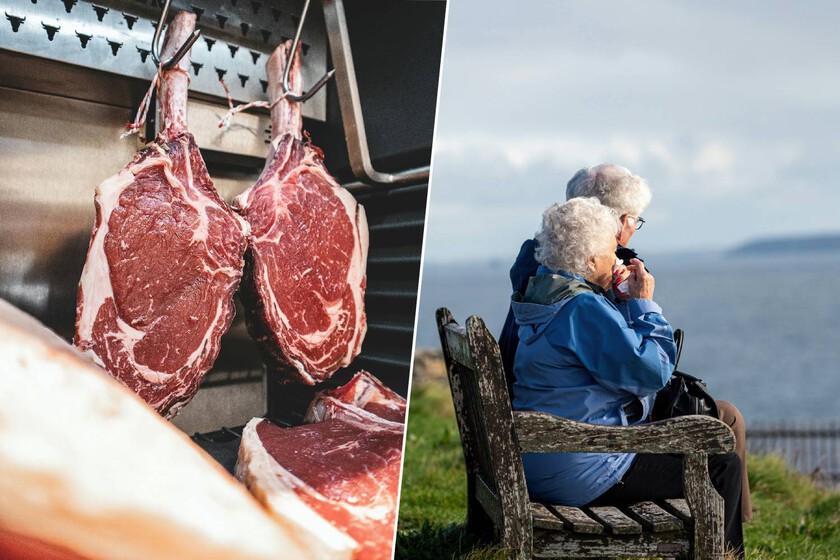
There are many positions in nutrition about which food will give us a better old age. One of the positions that you have surely heard is the need to reduce meat consumption to prioritize vegetables for all the benefits they provide. But now science is pointing out that what works at age 40 may not be ideal at age 90.
The change of course. A study published this year in The American Journal of Clinical Nutrition has shaken the hornet’s nest of gerontology after analyzing thousands of elderly people. The conclusion they have drawn is that among those over 80, those who consume meat are more likely to become centenarians than strict vegetarians.
But before you rush to cancel your salad order, read the fine print: the key is not the meat per sebut weight, fragility and the fight against muscle loss.
The data. In order to reach this conclusion, the study analyzed data from a longevity survey in the Chinese population carried out between 1998 and 2018. In total, the researchers followed 5,203 participants who were over 80 years old, classifying them based on omnivores or vegetarians, including vegans and lacto-ovo vegetarians.
The results. Adjusting for age, gender, and baseline health, the study yielded a surprising finding: vegetarian diets were associated with a 25% lower chance of reaching age 100 compared to omnivorous diets. A correlation that was statistically significant mainly in the elderly who were already thin.
Thinness. This is a really important point to present one of the nuances of this research. And the advantage of carnivores disappears in people who have a weight within the established normality. Thus, the negative association between being vegetarian and extreme longevity was observed almost exclusively in participants with a BMI lower than 18.5. That is, extreme thinness.
This reinforces what is sometimes known in medicine as the “old-age obesity paradox.” While in youth being overweight is a risk factor for almost everything, in extreme old age, having reserves of energy and muscle mass is life insurance. This is why the authors of the study emphasize that the consumption of foods of animal origin seems to act as a protective factor against malnutrition and frailty in these vulnerable individuals.
Because. The biological explanation that suggests that meat is good in old age is based on the constant fight against degradation. One of these events is the dreaded sarcopenia, which occurs when the natural loss of muscle mass accelerates over time. One of the objectives here, as we have repeated many times, is to maintain muscle with highly bioavailable proteins that are in meat, eggs and milk.
In addition to this, the study suggests that strict vegetarians, especially thin ones, may not be ingesting enough total calories to maintain their physiology in stressful situations. And it is not crazy now, but previous studies have already pointed out that, although restricting meat reduces mortality in young people and middle adults, this effect was reversed in old age.

They don’t cast a shadow. Logically, this study does not negate the many benefits of a plant-based diet for the general population. In fact, there are studies that suggest that for the vast majority of the population the priority continues to be preventing serious chronic diseases such as diabetes.
However, this work suggests that nutrition must be dynamic, since the requirement in middle age is not the same as in the last years of life.
Images | Simon Godfrey Kile Mickey
In WorldOfSoftware | Being bored is psychologically positive but it has an undesirable consequence on your body: it makes you gain weight.