For years we have heard that the future of air combat is called F-35, a program associated with stealth, advanced sensors and a very specific idea of Western technological superiority. It is the plane that makes headlines, budgets and strategic debates. But while that conversation progresses, there is a much quieter reality that dislodges the story: a fighter designed in the seventies Not only is it still in service, it’s still being built in South Carolina, and it’s still finding buyers in 2025.
The interesting thing about the F-16 is not only that it continues to fly, but to understand why so many countries continue to bet on it when there are newer alternatives. To answer that question you have to go back to its origin, follow its evolution and look at the present with data, contracts and calendars. It is also advisable to separate promises from real capabilities, because not all air forces Buy the “best”, they buy what they can operate on a sustained basis.
The secret of a fighter that does not retire
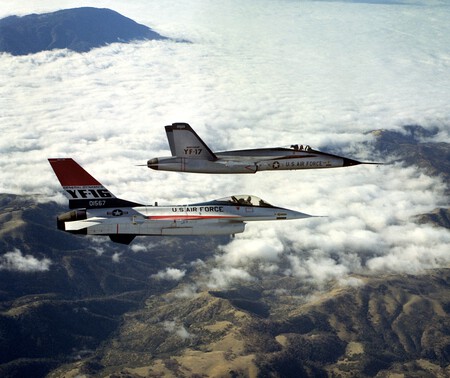
The F-16 was born from an internal discussion in the United States about the drift towards increasingly larger, more complex and more expensive fighters. In the early 1970s, the United States Air Force promoted the programa Lightweight Fighter to see if a lighter plane could gain maneuverability and be more affordable without sacrificing efficiency. The YF-16 prototype first flew in 1974 and, in January 1975, was selected in the Air Combat Fighter (ACF) competition, a decisive step towards production. The idea was simple: operational performance before unlimited ambition.
That philosophy translated into very specific design decisions. The F-16 opted for a compact airframe and controls fly-by-wire that allowed finer control and relaxed stability difficult to achieve with traditional systems. The cabin was also part of the approach, with a high visibility dome, a stick side and a reclined pilot position to better withstand G forces.
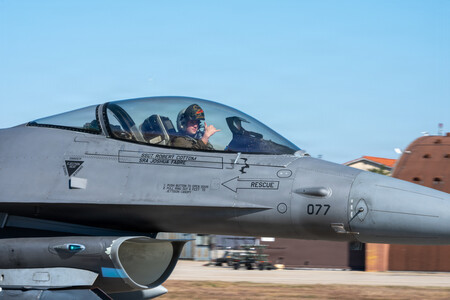
Over time, this approach focused on air-to-air combat expanded. The F-16 incorporated improvements in avionics, sensors and payload capacity that they pushed it towards a multi-role capabilitywith room for ground attack and increasingly demanding missions. In parallel, its international expansion was supported by cooperation, standardization and support programs between allies, which created a broad community of operators. That network remains one of the reasons the plane stays alive.
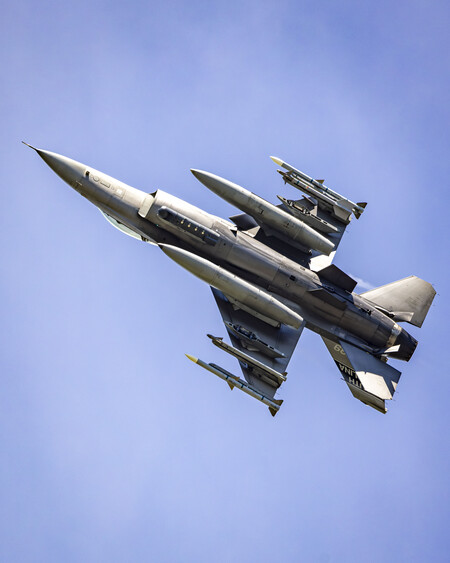
Almost continuous modernization is the bridge between the original design and the F-16 currently rolling off the production lines. In its most recent standards, such as the F-16V and the new Block 70/72, updated mission displays and computing, data link systems such as MIDS-JTRS and an APG-83 AESA radar appear as a central part of the equipment. These newly manufactured appliances are offered with a stated structural life of 12,000 hours.
Almost continuous modernization is the bridge between the original design and the F-16 currently rolling off the production lines.
Here the question stops being just technical and becomes operational. The F-16 continues to fit because it offers a relationship between capabilities, cost and availability that is difficult to match in many defense plans. It is a well-known aircraft, with acceptable maintenancescalable training and a mature logistics chain, something especially valuable in periods of tension and urgency. In addition, it facilitates interoperability with allies and the integration of Western weaponry in a predictable framework.
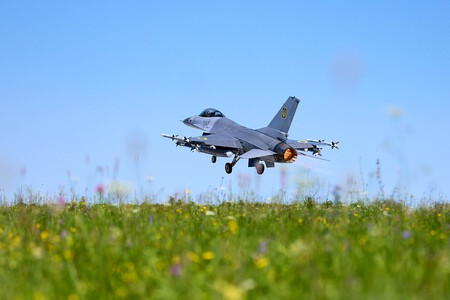
Recent contracts illustrate that pattern with names and numbers, and are often channeled through government agreements and programs like the United States’ Foreign Military Sales. Slovakia has been receiving new F-16 Block 70s since 2024. Bulgaria has also opted for this modernized aircraft. Taiwan maintains an order for 66 F-16Vs approved in 2019, with deliveries and testing affected by publicly acknowledged delays. Bahrain ordered 16 Block 70s and Jordan signed a letter of offer and acceptance for eight units.
The case of Ukraine introduces a different dimension. Here the F-16 does not arrive as part of a planned modernization, but as rexposed to an ongoing war and the need to reinforce air defense. Transfers have been made by the Netherlands and Denmark, and deliveries have been confirmed in phases with a limited level of detail for operational reasons. Beyond the exact figures, the jump is relevant because it introduces a platform compatible with Western doctrines, support and weapons in a real combat environment.
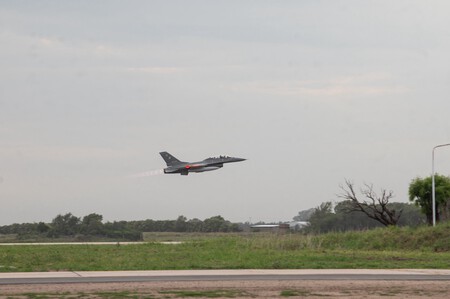
Argentina is a different example, but just as revealing. In this case, the F-16 arrives to fill a long gap in air defense capabilities and recover supersonic flight after years without an equivalent fleet. The operation is supported by the transfer of 24 used aircraft from Denmark, with deliveries in tranches, and the first batch of six aircraft arrived in December 2025. For Buenos Aires, the value is not only the plane, but also the training and support package that accompanies it.
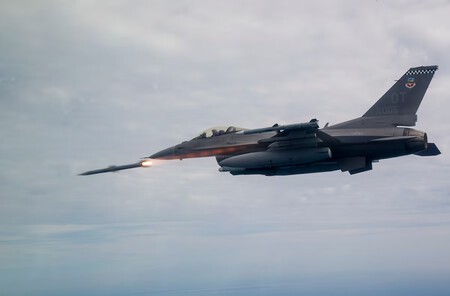
If we look at the current Western catalogue, the temptation is to think that the future has already been resolved. The F-35 has become the great bet of several allies and, in parallel, Eurofighter and Rafale have continued to grow with new variants, radars and weapons. The problem is that an air force is not measured only by the most advanced aircraft it can buy, but by how many it can sustain, train and deploy on a continuous basis. That’s where the balanced fleet model gains weight and the F-16 falls into place again.
And if we look one step further, the conversation is already in the sixth generation. The United States is working on NGAD, Europe is pushing FCAS and the United Kingdom has joined forces with Italy and Japan on GCAP, a proposal that aims to redefine sensors, connectivity and cooperation with unmanned systems. But they are programs with long calendars and a very high investment, in addition to the uncertainty inherent in any technological leap. In that gap, the F-16 maintains a clear space, because it offers real and available capacity while the future finishes arriving.
Images | United States Air Force (1, 2, 3, 4, 5,) | Volodymyr Zelenskyy | Ministry of Defense of Argentina
In WorldOfSoftware | The Comac C919 symbolizes China’s aerial dream: the trade war threatens to clip its wings in mid-takeoff