

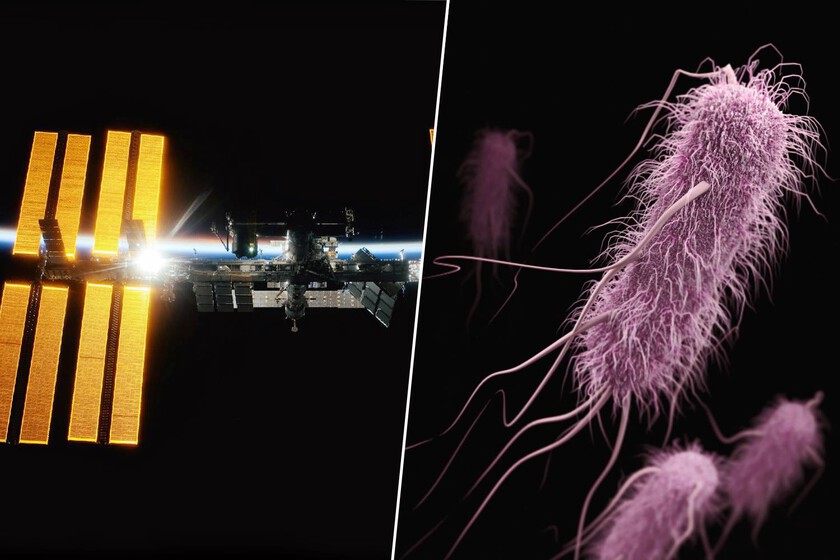
Humanity has a big problem right now that could condemn it to its disappearance: resistance to antibiotics. This forces science to be in a constant search for new treatments and also to raise awareness of the responsible use of drugs. And the latest place where they have found a new path of research is in space.
The study. A team of researchers from the University of Wisconsin-Madison has published in PLOS Biology the results of an experiment carried out aboard the International Space Station (ISS), demonstrating that the absence of gravity not only alters cellular behavior, but also accelerates evolutionary processes that would be unlikely on Earth.
Something that is undoubtedly very important, since it has been seen how the T7 phage, a virus that has the ability to infect bacteria to kill it, developed genetic mutations in space that would surely not have occurred on Earth. Some mutations that allowed us to attack a specific bacteria that would have been unthinkable on Earth.
A changing biology. On Earth, biologists are quite clear that if a virus binds to a bacteria and infects it, it can kill it. But to understand this you have to know that on our planet the interaction of these two elements in a liquid medium is facilitated by gravity. A key factor for both beings to collide within the medium.
On the International Space Station these forces disappear. The movement of the particles is almost exclusively reduced to Brownian diffusion, that is, the random movement of the particles. And here it was seen that this had a great impact on the kinetics of the infection.
What happened. The first thing that could be seen is that the bacteria’s ability to divide to give new ‘children’ was reduced, causing it to increase up to four hours, making it difficult for the virus and the bacteria to meet. However, after 23 days of culture on board, the infection was successful.
In this way, the viral population not only reached the bacterial population, but the selective pressure of the environment forced the virus to optimize its attack mechanisms with different mutations.
Genetic engineering. By analyzing the DNA of viruses that arrived from space, the research team discovered the evolution that had taken place. In this way, it was seen how it had mutated in record time in different genes that are key, such as the one it uses to synthesize the ‘legs’ with which it anchors itself to a bacteria.
The most relevant thing is that these mutations were not random, but a direct response to the lack of frequent contacts. Having fewer opportunities to collide with a bacteria because they replicated less, the virus evolved to be more efficient at adsorption (the process of adhering to the cell surface) once it made contact.
For its part, the bacteria E. coli also responded to environmental stress. The analyzes showed mutations in the genes mlA y hldEresponsible for maintaining the integrity of the outer membrane and the synthesis of lipopolysaccharides. This suggests that the bacteria attempted to “shield” their surface both to resist microgravity and to prevent phage entry, creating a molecular arms race different from the one on Earth.
Its importance. Once this has been proven, the question is clear: why do we care? The key is that the researchers used virus variants that evolved in space and pitted them on Earth against uropathogenic E. coli strains that had developed resistance to the original T7 phage. And the result was spectacular: the mutated viruses killed these resistant bacteria.
This suggests that microgravity makes it possible to explore an “adaptive landscape” that is inaccessible under Earth’s gravity. On Earth, evolution pushes phages down already known “low resistance” paths. In space, extreme conditions force the virus to unlock alternative genetic pathways that we did not know about until now.

A new model. This discovery validates a hypothesis that has been brewing for years in astrobiology and biotechnology: space is not just a place for observation, but a unique manufacturing environment.
In this way, if we can use the EES, or future commercial stations, as incubators to direct the evolution of bacteriophages, we could generate a library of therapeutic viruses that are capable of defeating the superbugs that currently threaten global health systems. That is why it is not about artificial genetic engineering, but about using directed evolution in an environment where physical rules favor the appearance of exceptional biological traits.
Images | NASA CDC
In WorldOfSoftware | Manufacturing materials to produce chips in space is not science fiction. It is a very real plan that is already underway





.jpg "Can a Home Appliance Fix the Problem of Soft-Plastic Waste?")

