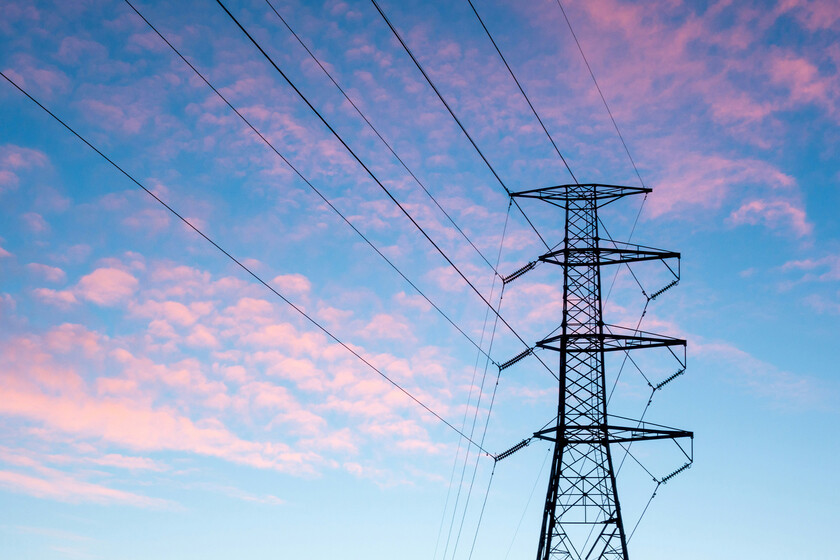
Over the last decade, Spain has accelerated the installation of wind and solar farms, especially in “emptied Spain”, with the promise of becoming Europe’s green laboratory. However, upon reaching 2026, the system has hit an invisible but insurmountable wall: the cables. The reason is a “broken bridge”, since clean energy is born in the countryside, but does not reach the cities or factories because the transportation infrastructure does not exist or is saturated.
The situation is critical. According to advance The Economistthe Spanish electricity grid has administratively “collapsed” and, for practical purposes, is closed to new projects. There is no longer room to accommodate new connection requests, which means that thousands of homes, data centers and industries are receiving a “no” answer when asking for a plug. Red Eléctrica’s technical documentation confirms this paralysis with endless lists of nodes subject to a capacity contest, from Algeciras to Arrigorriaga, evidencing a blockade that runs through the entire peninsula.
The “D-Day” that never came. The trigger for this crisis has a date and time. The electricity sector was anxiously awaiting February 2, 2026, the day on which the National Markets and Competition Commission (CNMC) was to publish the new access capacity maps, the “traffic light” that indicates where there is more consumption. But the maps did not arrive.
In a last-minute maneuver, the CNMC has postponed the publication until Monday, May 4, 2026. The decision responds to a critical alert launched by the system operator (REE) on January 26: under the new and strict technical criteria, “approximately 90% of the nodes in the transportation network would have zero access capacity.”
The problem is deeper. On the one hand, the application of the “dynamic criterion” has revealed that more than 9 GW of already authorized demand—mainly data centers and electrolyzers—might not be sufficiently robust against “voltage dips” (sudden drops in voltage), which forces the tap to be turned off for safety. On the other hand, consensus is non-existent: Red Eléctrica and the distributors have only managed to agree on the reference values in 26% of the interconnection nodes, a figure that in the case of some distributors plummets to just 11%.
A traffic jam with real consequences. Far from being a mere dispatch procedure, it has devastating consequences for the real economy. The energy cap has become the new brake on brick: last year only 12% of connection requests for new urban developments were granted. The Asprima employers’ association estimates that some 350,000 homes are at risk of not being able to be built, not due to lack of land or money, but due to the simple lack of electrical power.
The impact has specific faces. An example presented in The Economist is that of the Costa del Sol, where the delay in the construction of a substation in Estepona and its associated line keeps the quality of supply and the connection capacity of a total of 72 families in suspense.
The investment war. There is a chronic lack of investment in basic infrastructure. While Europe invests on average 70 cents in networks for every euro of renewable generation, Spain remains at just 30 cents. This has unleashed an open war. The large electricity companies (Aelec) accuse Red Eléctrica (Redeia) of having invested below what was planned, causing the current precariousness.
Redeia defends itself forcefully, ensuring that it has quadrupled its investment to exceed 1.5 billion in 2025. In addition, the system operator uses devastating quality data to deny the poor state of the network: the average annual interruption time is just 0.46 minutes, a value 30 times better than the 15 minutes required by regulations.
The speculative bubble. Amidst the chaos, speculation flourishes. The CNMC is finalizing a complete report—a kind of “forensic” audit—to put order in the system. According to Expansionthere are access requests for 67,100 MW, an exorbitant figure that is equivalent to half of all the installed power in the country. The regulator suspects that there are massive duplications and “ghost” projects that hoard nodes for the sole purpose of reselling permits, blocking access to real industries.
Three months of heart attack. Given the seriousness of the scenario, the sector now faces a three-month truce, until May, to try to avoid the total closure of the network.
- Express legal route. The recent Sustainable Mobility Law has introduced an “emergency mechanism” that allows changing the purpose of positions at substations. That is, unlock spaces reserved for generation that are not used and assign them to consumption quickly.
- “Amnesty” for Data Centers. To prevent the flight of digital investment, the Government has activated a grace measure for 2026: it has eliminated the requirement that forced data centers to consume in “off-peak hours” (at night) to receive aid, recognizing that solar energy has changed the reality of prices and that said requirement no longer made technical sense.
- Cost for the citizen: fixing the network will not be free. The proposal for 2026 includes an increase in tolls (4%) and charges (10.5%) in the electricity bill to finance these investments and the “reinforced mode” of operation, necessary to guarantee stability after the incidents of 2025.
Crisis of institutional trust. Despite the extension, legal uncertainty is latent. Electricity companies fear that industries that already had access granted could lose it when the new, more restrictive criteria are applied. Óscar Mosquera, an expert in the sector, warns on LinkedIn about a “regulatory breakdown.” “The network is no longer just infrastructure, it is an institution,” says Mosquera. His diagnosis is lapidary: “A system that invites investment and then does not connect is not prudent, it is incoherent. That is the true country risk.”
While the administration looks for solutions, real demand does not wait for the bureaucracy. Joaquín Coronado highlights that electricity demand has grown by 3.7% at the start of January 2026, exceeding the official forecasts of the CNMC itself. The Spanish economy tries to accelerate, but physical reality prevents it.
A country disconnected from its own future. Spain finds itself at an ironic and dangerous crossroads. After years of titanic effort to lead the green transition and attract digital reindustrialization, the country discovers that its nervous system—the electrical grid—has suffered a thrombosis. As a summary of the business sources consulted by The Economist: “The plans are very nice, but they have to be built.” The battle of the coming months will not only be technical, about volts and amps; It will be a political and economic battle to decide who enters and who stays out of the electric future. Because there is no point in having the sun, the wind and projects if at the end of the day, there is nowhere to plug them in.
Image | Unsplash
WorldOfSoftware | Spain, Europe’s renewable laboratory, runs into the gas wall: 2025 broke the dream of cheap electricity