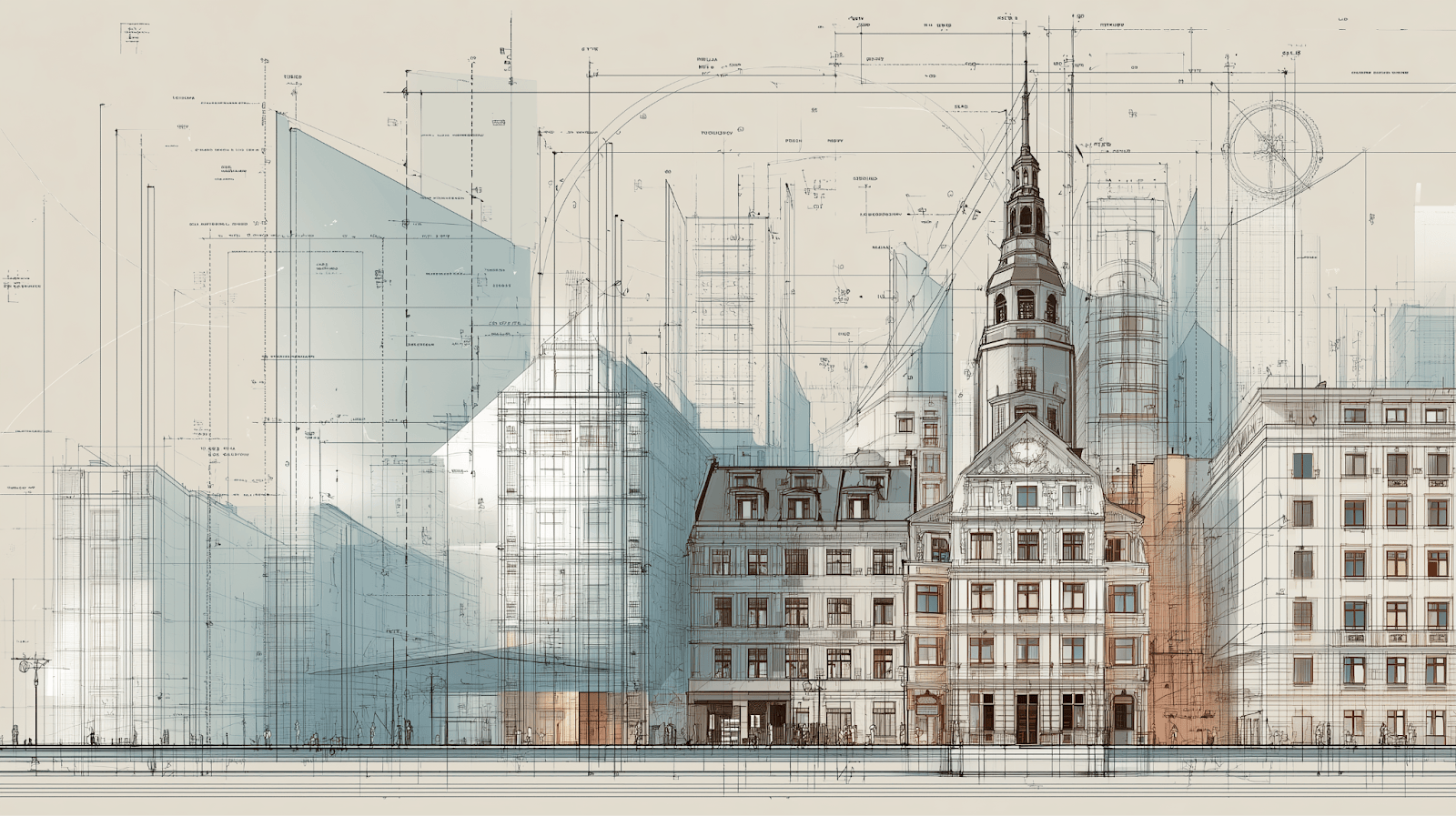
Architectural Designer and AI researcher Samuvel Benhursha is formalizing a constraint-first workflow for AI-assisted architectural transformation, validated through peer-reviewed publication, invited teaching, competition recognition, and public exhibitions.
Generative AI can now produce architectural imagery in seconds. A few words, a reference image, and an algorithm will deliver a dramatic skyline, a futuristic museum, or a reimagined temple glowing at sunset. The results are often visually striking. But speed has a side effect: it can flatten the layered obligations that make architecture more than image—hierarchy, climatic intelligence, structural reasoning, and cultural memory.
Over the past two years, architectural designer and independent AI researcher Samuvel Benhursha has been developing a different posture toward generative systems. Rather than beginning with prompts, he begins with architecture. In his view, generative AI should not replace architectural thinking; it should follow it. The model is not the origin of the design process but the final translator in a disciplined chain of constraints that can be articulated, measured, and repeated.
That position is articulated most formally in a 2025 IEEE conference proceeding titled “Transformation of Traditional Architecture Design into Timeless Architecture Designs through Generative Adversarial Networks,” listed with DOI 10.1109/ICCAMS65118.2025.11233879 and tied to ICCAMS proceedings. The research reframes “traditional-to-timeless” transformation not as stylistic remixing, but as a structured computational process. Cultural references are not aesthetic ornaments; they are encoded parameters. Modern performance expectations—clarity of form, environmental responsiveness, spatial sequencing—are introduced deliberately rather than visually implied.
At the algorithmic level, the research employs Generative Adversarial Networks (GANs)—the adversarial learning paradigm in which a generator and discriminator iteratively refine outputs against one another. Rather than using GANs as engines of visual novelty, the framework embeds architectural constraints directly within that adversarial structure. Architectural elements are translated into computational feature representations before transformation, allowing identity to be preserved while performance conditions evolve.
The paper’s validation section references PSNR, SSIM, and RMSE—metrics more commonly associated with imaging and signal reconstruction. The numbers themselves are not presented as spectacle. Their presence signals something quieter: an attempt to shift architectural AI from novelty toward accountability. If transformation cannot be compared across iterations, it cannot be refined responsibly. By embedding quantifiable similarity and reconstruction metrics into architectural experimentation, the work suggests that generative transformation can be evaluated as a measurable computational process rather than celebrated as stylistic surprise. In an era where building performance and climate responsiveness are increasingly urgent concerns, disciplined transformation methods carry implications beyond aesthetics.
An independent technical evaluation written in early 2026 reinforces that interpretation. Techjays CEO Philip Clements Samuelraj notes that “controlled parameter integration within generative modeling is not commonly formalized in applied design research,” and further describes the framework as clearly structuring architectural transformation as a measurable computational process. The emphasis is not on aesthetic preference, but on procedural clarity and methodological formalization.
The research has also moved beyond publication into academic dialogue. In February 2026, Mohamed Sathak A.J. Academy of Architecture in Chennai invited Benhursha to deliver an official virtual guest lecture based on his IEEE research. The session addressed generative AI in architectural transformation, climate-responsive reinterpretation of traditional elements, and the integration of computational design methods into contemporary architectural thinking. The invitation demonstrates that the research has been recognized as a structured and transferable methodology suitable for academic discourse.
If the IEEE paper establishes a scholarly base, Benhursha’s broader practice translates that base into a procedural workflow he calls “A Generative Framework Integrating Form, Landscape, and Cultural Time.” The framework rejects prompt-first image making. Instead, it requires a sequence of architectural commitments before any visual generation occurs.
The process begins with narrative intent and socio-cultural program. It then establishes an ecological–architectural polarity—whether architecture behaves as ecosystem, whether landscape is embedded within structure, or whether built form dissolves into terrain. Landscape context and atmospheric temporality follow: season, weather, light conditions, and geographic identity. Historical constraints and typological clarity are defined before a single image is generated. An anchor element is introduced and evaluated through a structured design lens addressing compositional coherence and spatial emphasis. Materials, cinematic viewing strategy, and layered narrative structure are encoded before the workflow moves into generation and narrative calibration.
In this structure, generative AI becomes a rendering engine for prior reasoning. The workflow insists that architectural identity precede visual amplification. Outputs are not isolated frames but expressions of a constrained system that integrates form, landscape, and cultural time.The framework has been implemented in professional architectural practice, including integration into applied design workflows.
Beyond research and exhibition contexts, Benhursha’s architectural experience grounds this methodology in built practice. He previously worked at Solomon Cordwell Buenz (SCB), where he applied AI-informed workflows during the development of projects such as 533 Kirkham, integrating computational experimentation into real-world architectural coordination. He is currently part of the AI development committee at Jensen Architects, where he contributes to internal research initiatives and explores the incorporation of constraint-first AI methodologies into office-wide design workflows. This professional engagement positions his work not only as theoretical research, but as an evolving framework tested within active architectural production environments.
Public recognition of this approach has appeared in competitive and exhibition contexts. In the Arch Hive AI Architecture Competition 2023 themed “Artificial Nature,” Amazing Architecture lists Benhursha as Third Place winner for “Journeying through the Nexus of Aquatic Futurism, Paleobiology, Marine Life, and Ecological Consciousness.” Jury commentary described the project as translating deep marine imagination into a coherent architectural language across massing, façade articulation, and visitor sequencing—indicating evaluation of spatial logic rather than surface novelty.
Technology media has also intersected with the research trajectory. A 2025 TechBullion article by Samuvel Benhursha, “Can Buildings Think? – Rethinking Space, Movement, and Crowd,” explores adaptive architecture in which sensing systems and AI-driven analysis inform responsive spatial strategies.
The argument situates generative AI within a broader conversation about buildings that sense occupancy, respond to environmental change, and evolve as intelligent spatial systems.
In 2024, Benhursha was also invited to serve as a juror for the Arch Hive International Architectural Visualization Competition, reflecting peer recognition of his expertise in AI- integrated architectural methodologies.
His research and design philosophy have further been featured in Architectural Digest in the contributor piece “Making Buildings Talk: The AI-Powered Transformation of the Urban Environment,” where he discusses how AI can extend beyond image production to influence adaptive, communicative urban systems.
Exhibitions have brought the imagery to public audiences outside professional journals. Visual Art Journal’s “Seventh Times Square Billboard Showcase” in October 2025 listed Benhursha among featured artists whose works appeared on Times Square screens. In Seoul, Art Innovation Gallery’s “AFTERGLOW” exhibition at Parnas Media Tower presented large-scale digital works in a billboard format. During Miami Art Week 2025, the “Mi Ami” floating LED installation curated by Art Innovation Gallery navigated between Miami Beach and Downtown Miami, with Benhursha included on the roster of participating artists.
He also presented a solo exhibition in Athens in collaboration with Arrival Gallery, further expanding his international curatorial presence. In each setting, AI-generated architectural imagery was presented at urban scale, situating experimental methodology within civic visual culture. He was directly invited for gallery exhibitions in London, Milan, and Brighton.
Parallel to academic and exhibition recognition is an unusually large digital audience. Benhursha’s public Instagram profile indicates more than 850k followers, an audience size more typical of media platforms than individual architects and a sustained monthly reach exceeding one million views. His audience includes several internationally recognized architecture studios and global design publications, reflecting peer-level engagement beyond general public visibility.Independent features in Digital Arts Blog and Visual Art Journal describe a practice that merges professional architectural training with generative experimentation. The scale of engagement suggests sustained public interest in architectural storytelling when it is grounded in coherent rules of form, landscape logic, and cultural time.
For architecture, the central question is no longer whether generative tools will be used. They are already embedded in practice. The more consequential question is whether AI will amplify architecture’s responsibilities—or quietly bypass them. Benhursha’s body of work proposes a directional answer: begin with constraints, encode cultural and environmental logic, and allow generative systems to operate downstream of architectural reasoning. In that model, AI-assisted design becomes something that can be reviewed, debated, taught, and iteratively improved— not merely consumed as accelerated content.
:::tip
This story was distributed as a release by Jon Stojan under HackerNoon’s Business Blogging Program.
:::