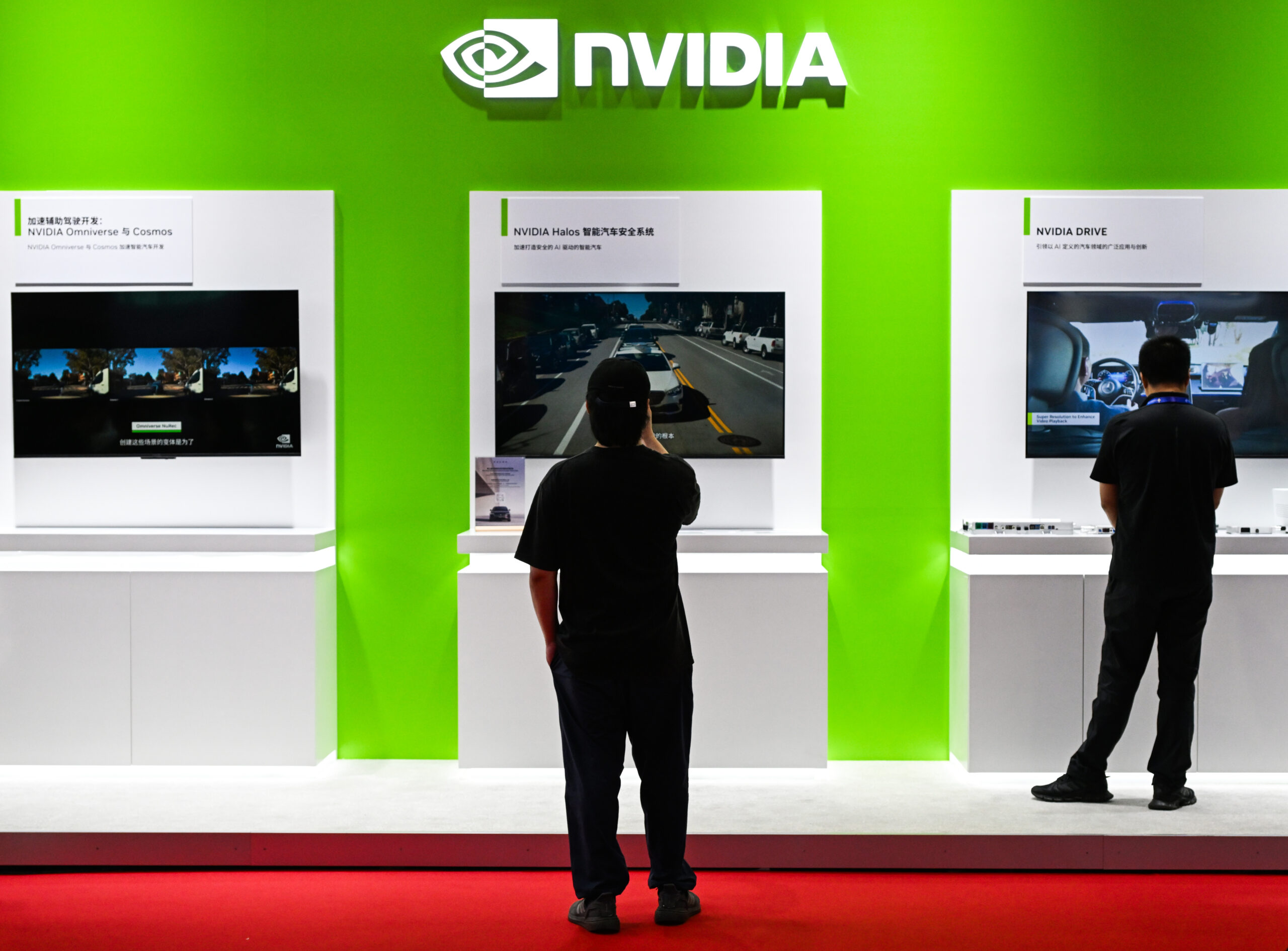
WASHINGTON—In a Truth Social post on Monday that shook up the global tech race, US President Donald Trump announced his approval for Nvidia to sell its H200 (“Hopper”) series chips to “approved customers” in China, with the United States receiving a 25 percent cut of the revenues.
This marks the latest pendulum swing in the administration’s approach to export controls on advanced artificial intelligence (AI) chips. In July, Trump allowed the sale of Nvidia’s less powerful H20 chips to China with a 15 percent revenue share requirement, pulling back from an April announcement that his administration would ban the sale of those same chips. Even the same morning of Trump’s announcement, the US attorney’s office in Houston trumpeted the disruption of a smuggling operation focused on exporting H200 and the older H100 chips to China.
In his post on Monday, Trump said that Chinese President Xi Jinping “responded positively” to the decision; on Tuesday a spokesperson for China’s foreign ministry dodged a question about the deal. If Xi is on board, this is significant, since when the H20 controls were lifted, China’s Cyberspace Administration banned Chinese firms from purchasing H20s, citing security concerns. Whether Xi took this step to protect domestic chip manufacturers or as a bet to unlock higher-performing exports (such as the H200s) remains unclear.
While the H200 far surpasses the capabilities of the H20, it’s still a generation behind Nvidia’s cutting-edge Blackwell chips and will soon be overshadowed by the forthcoming Rubin architecture. Prior to meeting with Xi in October, Trump floated the idea of allowing Blackwell exports. But following the meeting, Trump said that the topic did not come up. Notably, Monday’s announcement stops short of allowing the export of Blackwell chips.
The Trump administration’s rationale
The Trump administration’s calculus comes down primarily to economics and the belief that projecting US technology abroad strengthens national power. Allowing the export of H200s to China will provide Nvidia access to the world’s largest single market and likely ensures that the next generation of Chinese AI runs on US hardware.
Proponents of this approach claim this move could slow the development of China’s indigenous AI capabilities by cutting off revenue to companies such as Huawei as sales divert to Nvidia. Under Xi’s leadership, China has undertaken a concerted national strategy to build a domestic chip manufacturing capability and break free from dependence on Western technology.
The 25 percent cut from sales to the US government gives the administration another means to tout benefits to the taxpayer. Still, recent reports of a special security review that the chips will undergo before export raise questions about how processes will be structured to legally charge this fee. Expect more from the administration in the coming days on how it will navigate this novel approach.
By approving exports of H200 chips but not Blackwell chips, the administration is attempting to strike a compromise position between those who see the advantages of strengthening Nvidia’s global market share and those worried about eroding the United States’ AI advantage.
The real implications
The United States and China are locked in an existential race for AI supremacy. Until now, the United States’ one true advantage has been access to cutting-edge compute.
In recent years, China has proven that it can build frontier models that rival the performance of the leading models in the United States. It produces top AI talent and has cultivated a vibrant AI start-up ecosystem. Chinese companies have access to the same data as their US counterparts while also benefiting from internal data, such as that stemming from China’s surveillance state and widespread AI deployment. China also has a leg up in terms of energy generation, producing more than twice the electricity that the United States did in 2024.
Where the United States maintains a definitive edge is on aggregate computing power. As of mid-2025, the US share of global AI computing power reached 74 percent, with China at only 14 percent. Aggregate computing power is critical for training new frontier models, supporting the widespread use of AI and new applications of the technology, and exploring new architectures and pathways toward more powerful systems. Recent reporting finds that much of the compute used by companies such as OpenAI is in service of research.
Allowing Chinese companies to purchase H200 chips will significantly degrade this advantage. Chinese companies will likely pursue a strategy of scale, networking H200 chips into clusters that could rival the performance of Blackwell chips, albeit with a higher price tag. This is a strategy already widely employed in China to maximize the performance of their domestically produced, lower-end chips. With access to H200 chips, Chinese firms will be positioned to train the next generation of models and provide cloud-computing services beyond their borders. This would put them into competition with US providers for international market share and fundamentally undermine the Trump administration’s goal of establishing the US AI tech stack as the global standard.
Estimates for how far China’s domestic chip manufacturing capability lags that of the United States range from five to fifteen years. Currently, China cannot produce at scale to meet domestic demand. The Trump administration has estimated, for example, that major Chinese tech giant Huawei can only produce 200,000 of its Ascent AI chips this year, which is only 1-2 percent of estimated US production. Access to H200s could bridge this gap, allowing Chinese AI companies to compete globally until domestic manufacturing capability has reached parity. At which point, they would almost certainly move away from Nvidia.
From a national security perspective, many fear that H200 chips will not only bolster Chinese industry but also the People’s Liberation Army’s defense capabilities. Given China’s civil-military fusion doctrine, restricting sales to approved corporate entities likely won’t prevent military use.
Finally, the question remains whether Nvidia has the capacity to serve the Chinese market without eroding its ability to meet demand from US companies. Already, surging demand from data center build-outs is putting stress on the supply chain, and research universities are struggling to procure chips to support crucial research and education efforts.
As China moves forward to aggressively integrate AI into every aspect of its economy and society, as outlined in its recent “AI plus” initiative, providing the computational fuel to realize this vision will supercharge the United States’ strongest AI competitor, significantly endangering the Trump administration’s own global AI ambitions.