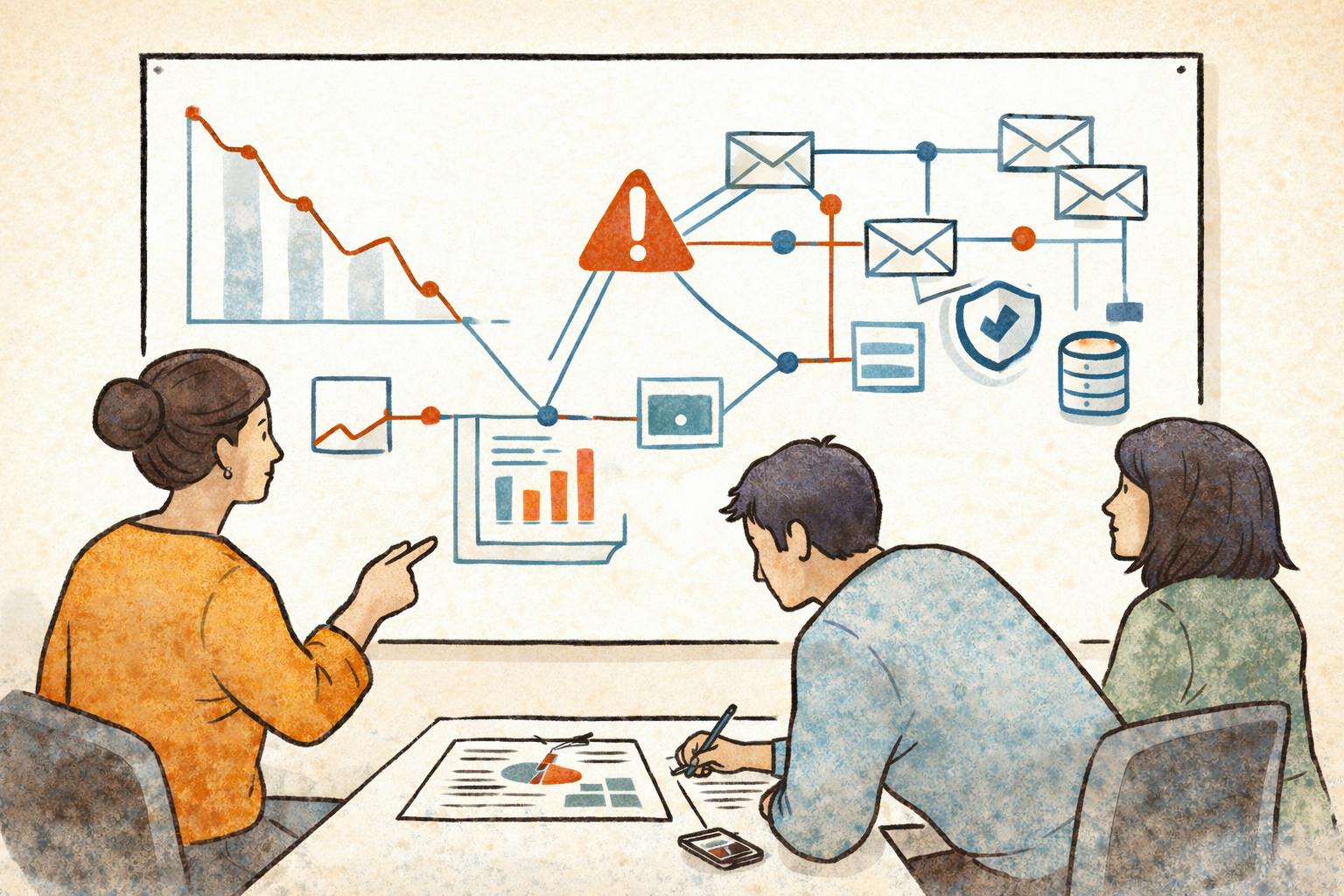
When marketing emails fail, they almost never fail loudly.
The campaigns are queued. Dashboards look fine. Open rates dip a little, then a little more. Someone suggests testing a new subject line. Another person tweaks send time.
What’s actually breaking isn’t copy or creative.
It’s trust. And trust erodes quietly.
I learned this running marketing technology and operations at Nextdoor, where we send hundreds of millions of emails a year to neighbors and businesses around the world. Some campaigns can exceed 25 million emails in a single push. Our contact base is well over 50 million profiles.
At that scale, email isn’t just a channel. It’s shared infrastructure. And once you lose trust with inbox providers, you don’t get it back with a better copy.
The Moment Email Became an Operations Problem
When I stepped into the role, the stack itself was strong.
We used Iterable for lifecycle journeys across neighbors and businesses. Segment and Databricks sat underneath as the data backbone. SendGrid powered critical streams, with reporting and monitoring layered on top.
On paper, it looked solid.
In practice, ownership was fragmented. List hygiene lived in too many places. Transactional and marketing traffic shared more reputation than they should have. Suppression rules existed, but not always consistently enforced.
Nothing was “on fire.” That was the problem.
At this scale, one misconfigured campaign doesn’t just hurt that campaign. It quietly degrades the reputation of everything sharing that sender. By the time you notice, you’re already paying interest.
The real question wasn’t “How do we send more email?”
It was: how do we make email a channel we can trust without putting our sender reputation at risk?
You Can’t A/B Test Your Way Out of Bad Plumbing
This is something I emphasized in my Iterable webinar recently and I still believe it strongly:
“You cannot optimize your way out of broken infrastructure”
The first phase of the work wasn’t glamorous. It was identity, authentication, and isolation.
We drew hard boundaries between things that had different risk profiles:
- transactional versus marketing traffic
- neighbors versus SMB and advertiser programs
- high-velocity experiments versus proven, high-volume journeys
That meant separate sub-users, tighter routing, and making sure spiky campaigns couldn’t drag critical flows down with them.
We also stopped treating authentication like a checkbox.
SPF, DKIM, and DMARC became shared infrastructure, not something set once and forgotten. New sending domains had a documented process. Warm-ups were deliberate. Alignment between visible From domains and authenticated domains was enforced, not assumed.
This is where partnering closely with SendGrid Pro Services helped. We audited reputation and traffic patterns together, set realistic goals for high-volume marketing streams, and put monitoring in place that caught issues before mailbox providers did.
Within about six months of working this way, a key marketing sub-user stabilized around ~99.7–99.9% delivery, and spam complaint rates dropped by roughly half.
It wasn’t clever. It was boring, careful work.
If Unsubscribe Is Hard, Spam Is Easy
One of the strongest signals mailbox providers have is whether people hit “report spam.”
And users don’t do that because your copy is bad. They do it because they feel ignored.
So we spent an uncomfortable amount of time on unsubscribes and preferences.
The goal was simple and annoyingly hard to implement: if someone unsubscribes anywhere , Gmail, footer link, in-product it should update the same preference, in the same place, and stick.
Under the hood, that meant wiring List-Unsubscribe headers to a real preference center. Making sure one-click ISP unsubscribes flowed back through Segment and into our data lake. Auditing how Iterable’s unsubscribe state lined up with product-level notifications and fixing mismatches.
This work cut way down on “I unsubscribed but you still email me” tickets. More importantly, it removed a major source of spam complaints that were quietly damaging reputation.
We also got very intentional about suppression.
Hard bounces were permanently suppressed. Soft bounces were allowed only a few times before suppression kicked in. Long-term dormant profiles were removed from active marketing after 90 – 180 days, depending on region and program.
Yes, that meant sending fewer emails.
But the people who remained actually wanted them.
Smaller Lists, Better Outcomes
Once we stopped emailing people who didn’t want our messages or couldn’t receive them, segmentation finally started to matter.
List hygiene became part of our operating rhythm, not a quarterly cleanup project. Reactivation had its own strategy and guardrails instead of being tacked onto every campaign.
With a cleaner base, we leaned into behavioral and predictive signals:
recent activity, lifecycle stage, advertiser intent, and predictive goals inside Iterable.
In one campaign, a predictive audience about one-third the size of a broad list drove more than twice the conversions. That result stuck with me.
Good deliverability isn’t just about who you avoid.
It’s about earning the right to email the people who matter more often.
Designing for Humans and Filters
Once infrastructure and data were stable, we turned back to the emails themselves. But deliverability stayed the lens.
We built a shared design and deliverability playbook:
- mobile-first, single-column layouts
- clear hierarchy from subject to CTA
- one primary action instead of three competing ones
- text that stood on its own even if images were blocked
The goal wasn’t rigid templates. It was giving marketers a reliable starting point that both humans and spam filters tolerated well.
We also leaned into what makes Nextdoor different: local relevance, real neighbors, real trust signals. High engagement feeds inbox models just as much as clean infrastructure does.
Monitoring Is a Habit, Not a Dashboard
Even good systems decay.
Filters change. Laws change. Teams change.
Deliverability became a standing agenda item. Monthly reviews with vendors. Clear thresholds for concern. Runbooks for what to do when something drifted.
We also re-evaluated our testing stack and landed on tooling that gave better coverage at a fraction of the cost, which freed the budget for actual lifecycle work instead of monitoring overhead.
The pattern here is consistent with something I said in the webinar:
tools don’t fix strategy, but the right tools make bad signals impossible to ignore.
What “Good” Looks Like at Scale
After a few years of iteration, refactors, and some uncomfortable debugging sessions, email stopped feeling fragile.
We were sending hundreds of millions of emails a year through Iterable across neighbors and businesses. Deliverability stayed consistently in the high-99% range for core marketing streams. Spam complaints dropped meaningfully. New journeys and international expansion didn’t feel risky by default.
Email went from “a thing we worry about” to something we could confidently use in growth conversations.
The Throughline
This is something I keep coming back to, whether I’m talking about AI systems or email infrastructure – when systems are designed without respect for how humans behave, they fail quietly.
High-deliverability email isn’t about obsessing over a single campaign. It’s about how infrastructure, consent, data, content, and monitoring reinforce each other over time.
For us, it came down to a simple promise – if a neighbor or business lets us into their inbox, we treat that access with respect at any scale.
If you’re responsible for email at this level, I’m always happy to compare notes.