You’ve used it millions of times without ever wondering why. The answer lies in a forty-year-old material constraint, and the inertia specific to the tech industry.
A cursor that did not always exist in this form
When Douglas Engelbart invented the mouse in 1964 at the Stanford Research Institute, the cursor was just a simple mark on the screen. No arrow, no angle, just a flashing dot or square. It was Xerox PARC which introduced the idea of an arrow-shaped cursor in the 1970s on the Alto, its internal research computer. The arrow is then straight, vertical, pointing upwards. Which seems logical.
When Apple developed the Macintosh in the early 1980s, the team inherited this convention. Problem is, the Mac screen displays 72 pixels per inch, a paltry resolution by today’s standards. At this scale, the smallest graphic element must be designed pixel by pixel, by hand. Susan Kare and Bill Atkinson are at it.
The right arrow did not pass the pixel test
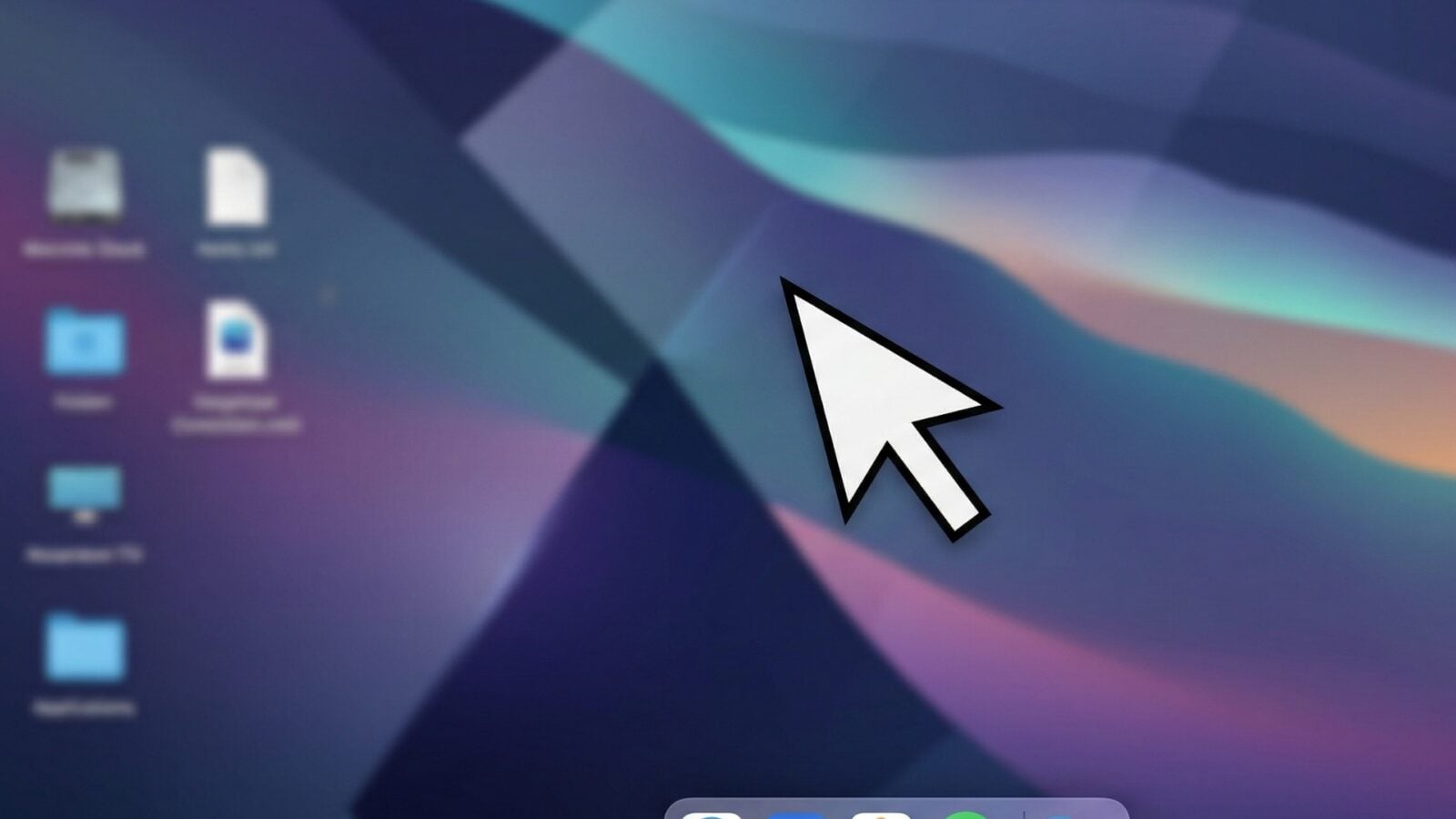
A perfectly straight vertical arrow, rendered at a very small size on a low-resolution black and white screen, produced a visually poor result. The line of the rod and the tip of the arrow merged into a mass of indistinct pixels. The eye had difficulty identifying the exact click point, the so-called “hotspot”, the single active pixel of the cursor.
By tilting the arrow about 45 degrees to the left, the result changed dramatically. The hotspot was in the upper left corner, visually isolated and perfectly readable. The diagonal also rendered better on a pixel grid than the strict vertical. It was a question of rendering, not aesthetics.
A provisional decision that has become a global standard
Apple made this choice out of pragmatism. Microsoft took the same convention for Windows, which sought to align with what users already knew. The others followed. The inclined cursor has become a de facto standard, without ever being the subject of a collective decision or an official document.
Today, on a Retina screen at 500 nits in 4K, the rendering constraint that justified this choice no longer exists for a long time. The arrow could point perfectly straight, cleanly, without the slightest technical problem. It does not do so, because no one has deemed it useful to change what everyone recognizes without thinking about it.
This is perhaps the best definition of a standard: a temporary solution to a solved problem, which we forgot to remove.
🟣 To not miss any news on the WorldOfSoftware, follow us on Google and on our WhatsApp channel. And if you love us, .