By using this site, you agree to the Privacy Policy and Terms of Use.
Accept
World of SoftwareWorld of SoftwareWorld of Software
  • News
  • Software
  • Mobile
  • Computing
  • Gaming
  • Videos
  • More
    • Gadget
    • Web Stories
    • Trending
    • Press Release
Search
  • Privacy
  • Terms
  • Advertise
  • Contact
Copyright © All Rights Reserved. World of Software.
Reading: Why OTFS Outperforms OFDM in High-Mobility Scenarios | HackerNoon
Share
Sign In
Notification Show More
Font ResizerAa
World of SoftwareWorld of Software
Font ResizerAa
  • Software
  • Mobile
  • Computing
  • Gadget
  • Gaming
  • Videos
Search
  • News
  • Software
  • Mobile
  • Computing
  • Gaming
  • Videos
  • More
    • Gadget
    • Web Stories
    • Trending
    • Press Release
Have an existing account? Sign In
Follow US
  • Privacy
  • Terms
  • Advertise
  • Contact
Copyright © All Rights Reserved. World of Software.
World of Software > Computing > Why OTFS Outperforms OFDM in High-Mobility Scenarios | HackerNoon
Computing

Why OTFS Outperforms OFDM in High-Mobility Scenarios | HackerNoon

News Room
Last updated: 2025/12/04 at 8:06 AM
News Room Published 4 December 2025
Share
Why OTFS Outperforms OFDM in High-Mobility Scenarios | HackerNoon
SHARE

Table of Links

  • I. Abstract and Introduction
  • II. Related Work
  • III. Modeling of Mobile Channels
  • IV. Channel Discretization
  • V. Channel Interpolation and Extrapolation
  • VI. Numerical Evaluations
  • VII. Conclusions, Appendix, and References

V. CHANNEL INTERPOLATION AND EXTRAPOLATION

Motivated by the fact that the channel changes much slower and thus more predictable in the D-D domain, we will in this section investigate how we can exploit the predictability for channel interpolation and extrapolation, so that the channel training overhead can be reduced.

A. Channel Interpolation with SFT

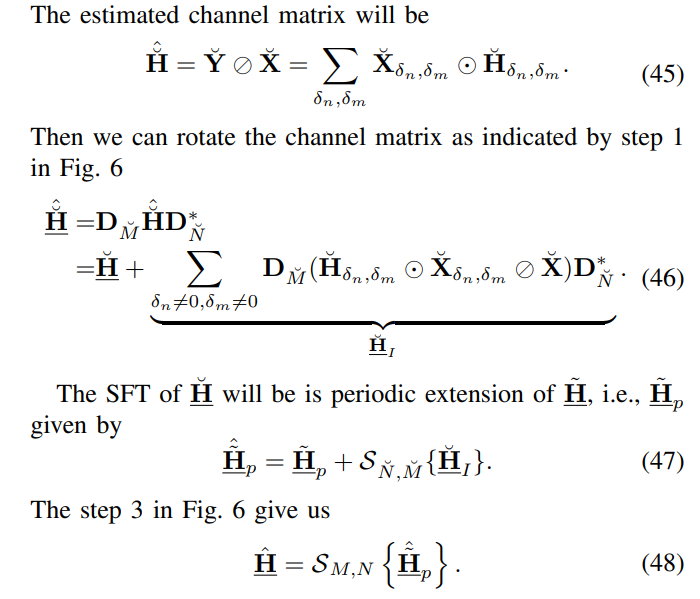
By assuming bi-orthogonality (or ignoring the ISCI, equivalently), the signal model can be simplified as

Consider a vehicular speed at 100 m/s, and the WSSUS channel model, Fig. 4 shows one realization of the wireless channel in T-F domain. In Fig. 4, the carrier frequency is
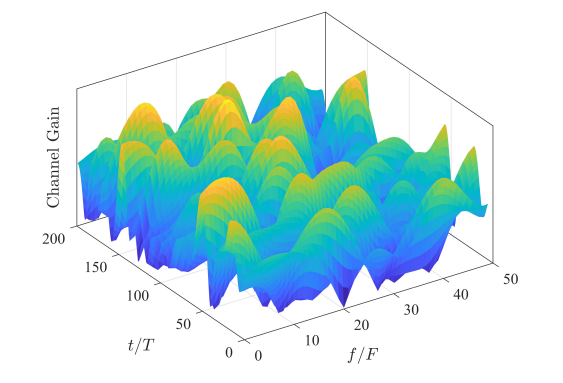
Fig. 4: Demonstration of the doubly-selective fading channel in time-frequency domain, with bi-orthogonality.

30 GHz, with a sub-carrier spacing of 200 kHz, total bandwidth of 10 MHz, and 1 ms frame length (or 200 symbols). As we can see, the channel changes very fast over both time and frequency, and the channel gains can be significantly different even between adjacent T-F slots. This example demonstrates the necessity of OTFS in highly dynamic channels.
Remarks: The above discussions hold for both discrete and continuous D-D profiles. For discrete D-D channel model, these discussions hold even when the Doppler shifts and delays of different paths are not exactly on the D-D grids in general.

B. A Pipelined Implementation
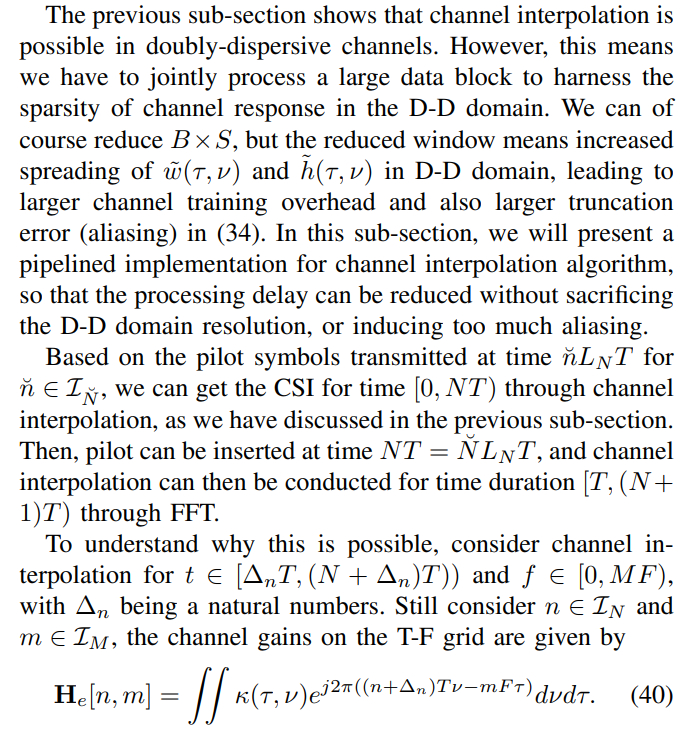
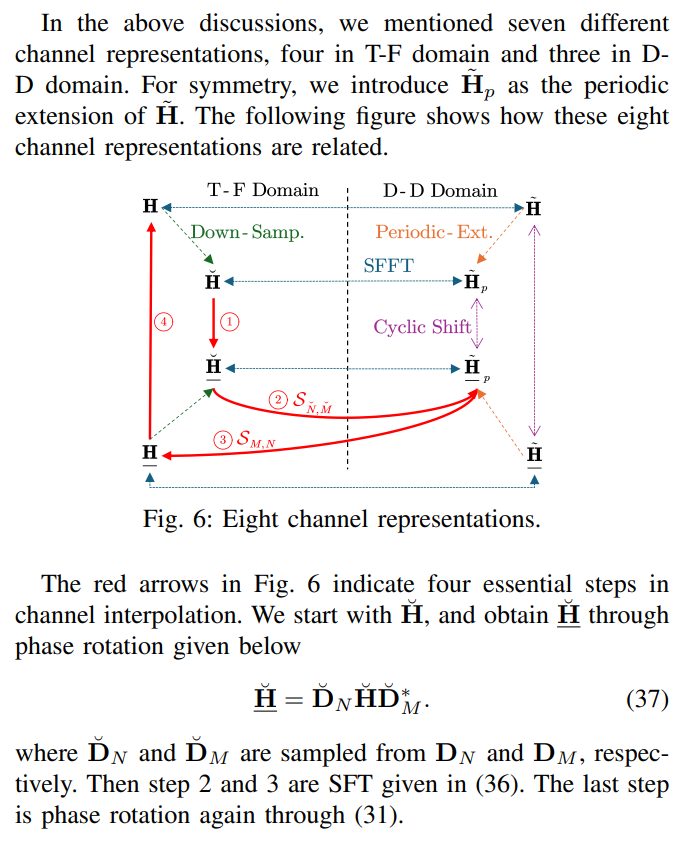
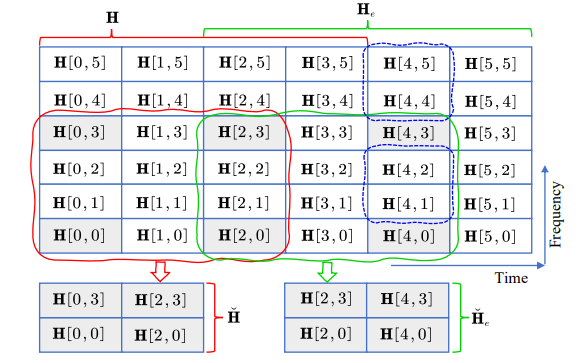
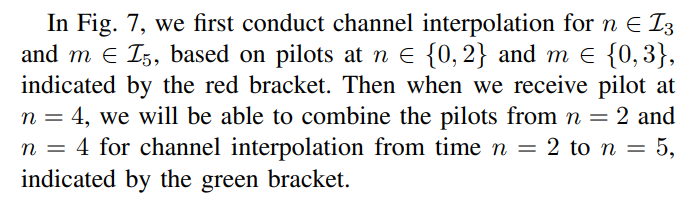
Fig. 7: Illustration of pipeline implementation of the channel interpolation, with N = 4, M = 6, LN = 2, LM = 3.

C. Channel Extrapolation and Tracking

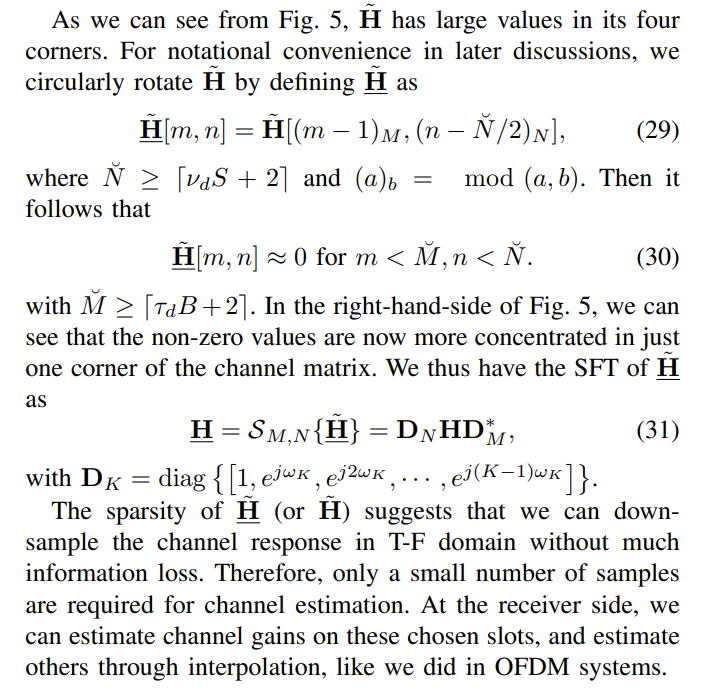
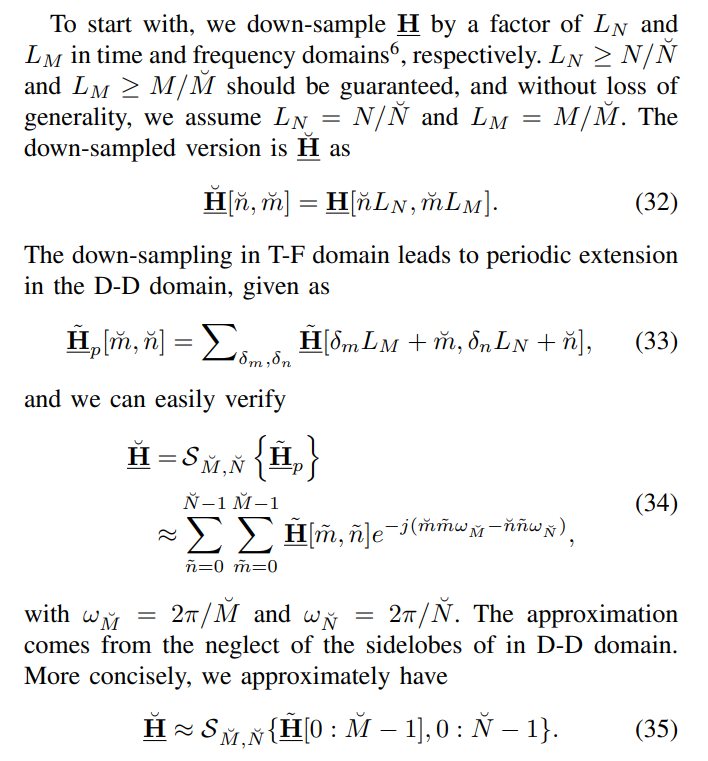
In Fig. 7, note that the data received at n = 4, i.e., encircled by the blue curves, cannot be demodulated immediately, because they have to wait for the pilot at time 4. However, based on the previous discussions, we should be able to use the previously estimated CSI for channel prediction. Specifically, we can employ the estimated CSI from time 1 and 3 for channel interpolation for time 1 to 4. From a different point of view, this is extrapolation. This also implies the possibility of channel tracking, and we further reduce the channel training overhead by inserting pilot less frequently. The idea is illustrated in Fig. 8.
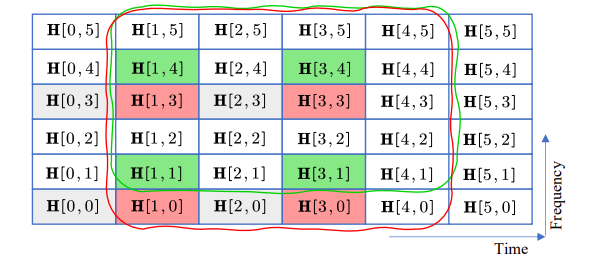
Fig. 8: Data-aided channel extrapolation.

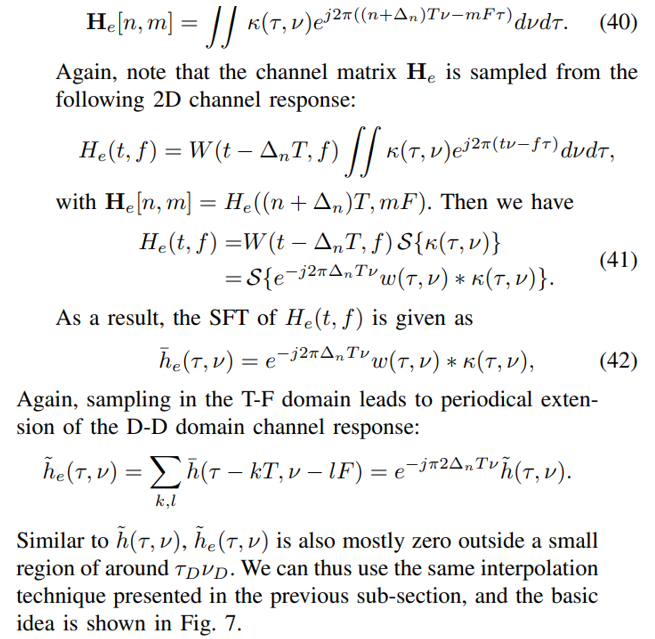
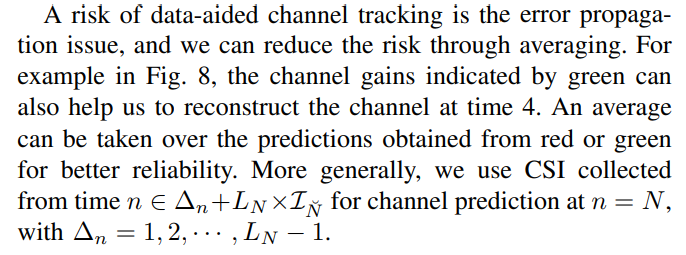
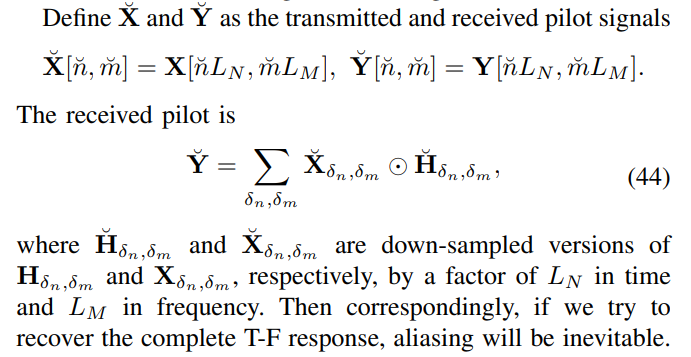
With pilot transmitted at time n = 0 and 2, frequency m = 0 and 3, channel interpolation can be conducted for time 0 ≤ n ≤ 3 and frequency 0 ≤ m ≤ 5. Then, we can use channel gains at n ∈ {1, 3}, m ∈ {0, 3}, i.e., the slots indexed by red, for channel interpolation between n = 1 and 4, encircled by red. We can thus estimate the channel gains at time 4 and 5, without waiting for the pilot. The processing delay can thus be further reduced to one symbol duration.

D. Error Analysis

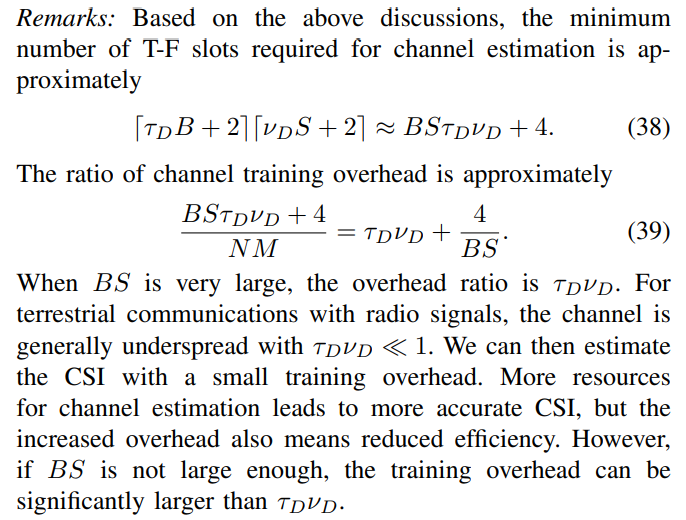
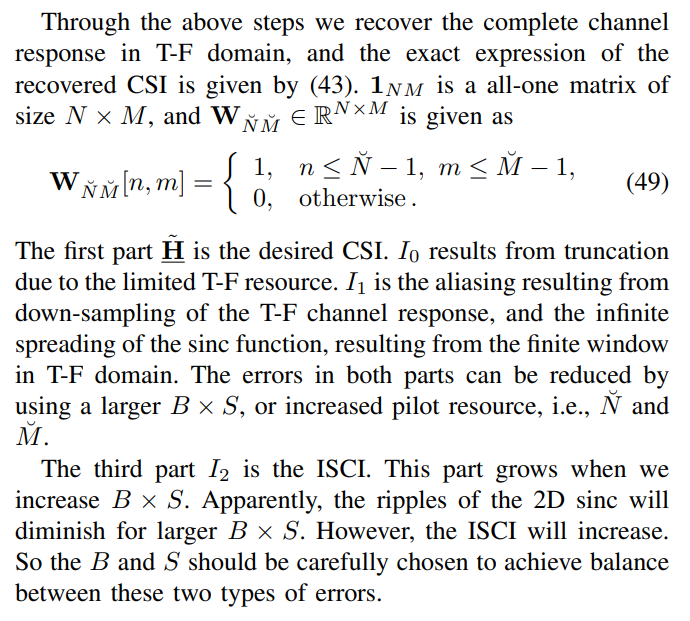
The interpolation inevitably leads to error, because the D-D domain channel has infinitely large spread due to the finite support in T-F domain, manifested by the 2D sinc function in D-D domain. Besides, the bi-orthogonality of the signal no longer holds after going through the doubly-dispersive channel. In this sub-section, we will try to quantify the channel estimation errors resulting from aliasing and ISCI
:::info
Authors:

(1) Zijun Gong, Member, IEEE;

(2) Fan Jiang, Member, IEEE;

(3) Yuhui Song, Student Member, IEEE;

(4) Cheng Li, Senior Member, IEEE;

(5) Xiaofeng Tao, Senior Member, IEEE.

:::


:::info
This paper is available on arxiv under CC BY-NC-ND 4.0 license.

:::

[6] Without loss of generality, we assume that M/LM and N/LN are integers. This can be guaranteed by choosing T and F properly.

Sign Up For Daily Newsletter

Be keep up! Get the latest breaking news delivered straight to your inbox.
By signing up, you agree to our Terms of Use and acknowledge the data practices in our Privacy Policy. You may unsubscribe at any time.
Share This Article
Facebook Twitter Email Print
Share
What do you think?
Love0
Sad0
Happy0
Sleepy0
Angry0
Dead0
Wink0
Previous Article A Startup Says It Has Found a Hidden Source of Geothermal Energy A Startup Says It Has Found a Hidden Source of Geothermal Energy
Next Article The EU is probing Meta over WhatsApp’s AI chatbot restrictions The EU is probing Meta over WhatsApp’s AI chatbot restrictions
Leave a comment

Leave a Reply Cancel reply

Your email address will not be published. Required fields are marked *

Stay Connected

248.1k Like
69.1k Follow
134k Pin
54.3k Follow

Latest News

My favorite running shoe of 2025 just got an upgrade for winter — meet the Adidas Adizero Evo SL ATR
News
Netflix Stops Allowing Streaming From Phone to TV: How to Watch Now
News
Tired of Learning 50 New Concepts to Build a Form? Say Hello to Lighthouse for PHP | HackerNoon
Computing
Here’s how Waabi teaches self-driving trucks to navigate safely
Software

You Might also Like

Tired of Learning 50 New Concepts to Build a Form? Say Hello to Lighthouse for PHP | HackerNoon
Computing

Tired of Learning 50 New Concepts to Build a Form? Say Hello to Lighthouse for PHP | HackerNoon

5 Min Read
Linux 6.19 Fixes A Thundering Herd Problem For Big NUMA Servers
Computing

Linux 6.19 Fixes A Thundering Herd Problem For Big NUMA Servers

2 Min Read
E-Waste Won’t Be Solved by Disposal: It Starts With Design
Computing

E-Waste Won’t Be Solved by Disposal: It Starts With Design

0 Min Read
ThreatsDay Bulletin: Wi-Fi Hack, npm Worm, DeFi Theft, Phishing Blasts— and 15 More Stories
Computing

ThreatsDay Bulletin: Wi-Fi Hack, npm Worm, DeFi Theft, Phishing Blasts— and 15 More Stories

22 Min Read
//

World of Software is your one-stop website for the latest tech news and updates, follow us now to get the news that matters to you.

Quick Link

  • Privacy Policy
  • Terms of use
  • Advertise
  • Contact

Topics

  • Computing
  • Software
  • Press Release
  • Trending

Sign Up for Our Newsletter

Subscribe to our newsletter to get our newest articles instantly!

World of SoftwareWorld of Software
Follow US
Copyright © All Rights Reserved. World of Software.
Welcome Back!

Sign in to your account

Lost your password?