I just survived another holiday season, which means I just survived the same conversation about eight times. It goes something like this: “So you work on robots, are they going to take all our jobs?” My family ranges from 35 to 70 and almost every one of them hit me with some version of this. I’d put on a different mask, adjust what’s worthy of the conversation, and nod along. But after hearing it enough I thought deeply about it and wanted to look at prior events in history.
I get it, when Geoffrey Hinton gets on mainstream media to spread warnings, that lands hard on someone who isn’t in the thick of it. The media thrives on fear, and you rarely see the promising progress of robotics publicized outside of niche circles. But I am in the thick of it – and from the inside, the picture looks very different than what you might see in the mainstream media.
Looms, Riots, and Wardrobes
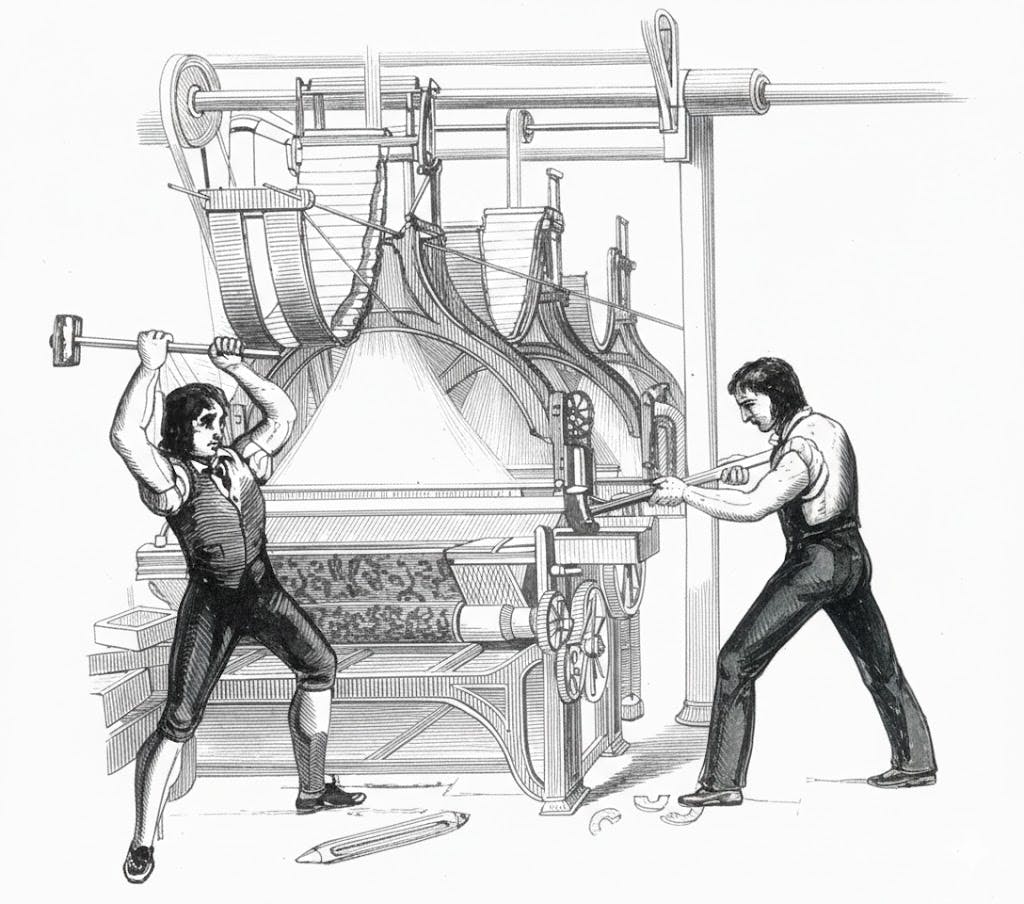
In 1811 a group of English textile workers called the Luddites started destroying mechanical looms. Their fear was rational – these machines genuinely could do the work of several people. What they couldn’t predict was what cheap cloth would do to demand.
Before the power loom, most people owned one or two outfits. Clothing was expensive because it was labor intensive. But as mechanized weaving drove production costs into the floor, people didn’t just buy the same amount of cloth for less money. They bought way more of it. Suddenly a working family could afford a wardrobe. This explosion in demand didn’t just preserve jobs in textiles – it birthed entirely new ones. Fashion design, retail, garment manufacturing at scale, textile marketing, global logistics to move it all around. The clothing industry today employs orders of magnitude more people than it did before the loom. The machine didn’t subtract work. It moved it somewhere the Luddites couldn’t have imagined.
This happens so consistently that economists have a name for the fear itself: the lump of labor fallacy. It’s the assumption that there is a fixed amount of work in the economy, and if a machine picks some of it up there’s less left for us. Sounds logical. Is also wrong, almost every time.
ATMs were supposed to kill the bank teller. Instead, they made it so cheap to run a branch that banks opened more of them. The number of US bank tellers actually grew for decades after ATMs showed up. The job shifted from counting cash to selling financial products, but it didn’t vanish. Spreadsheets didn’t eliminate accountants either. They multiplied the applications of financial reasoning so dramatically that there are now more people doing analytical work than ever before.
What I See From the Inside
Here’s the part that’s hard to explain at a holiday dinner: the robots I’ve worked on don’t slot into an existing human’s role. They normally make previously impossible things possible. At Zipline, autonomous drones deliver blood and medical supplies to remote clinics in Africa in under 30 minutes. Nobody was doing that job before. The infrastructure simply did not exist. The whole operation is new – drone engineers, flight operators, logistics coordinators, client integration specialists. Hundreds of roles that weren’t a thing five years ago, serving people who previously had no access to critical medicine.
Similarly the Neuralink robot moves with such high precision and speed, that it isn’t even possible as a surgeon. This leads to safer and quicker surgeries. On automotive lines automation on the line isn’t about cutting heads – it’s about building cars at a price point that expands the market. More buyers means more service centers, more charging infrastructure, more downstream jobs of every kind. When Henry Ford put the Model T on an assembly line he didn’t shrink the auto industry – he created it.
Having a robot always available to help out, changes the dynamic of the home and means that homes can say constantly clean and organized, instead of waiting for the weekend.
The Mechanism Is Always the Same
Automation reduces the cost of producing something. Cheaper production means lower prices. Lower prices mean more people buy it. More demand creates more overall activity, and that means more work for humans – just not the same work.
David Autor at MIT has been studying this pattern for years. His research shows that about 60% of workers in 2018 were employed in job types that didn’t exist in 1940. We are terrible at imagining jobs that don’t exist yet, but great at imagining the ones that might disappear. This asymmetry is where the fear comes from.
Avoiding Stagnation
I’m not going to pretend transitions are painless. People do lose specific jobs to machines and the adjustment can be brutal even when the big picture works out. That’s real and worth taking seriously.
But the alternative is worse. The precautionary principle taken too far means blocking the very progress that creates new opportunity. If the Luddites had won, we would still be hand-weaving cloth and most people would still own two shirts. Slowing down doesn’t protect anyone, it just delays the inevitable while also delaying the benefits.
I think about this from a first principles perspective. The economy is not a zero sum game. When you make something more efficiently, you free up resources – time, money, labor – that flow into whatever comes next. That “whatever comes next” is where new industries, new companies, and new careers show up. Nobody in 1811 predicted fashion week. Nobody in 1975 predicted that ATMs would lead to more bank branches. And I guarantee nobody today can predict the industries that cheap, capable robots will create 20 years from now.
So no, my robots are not coming for your job. If history is anything to go by, they are more likely to create it.