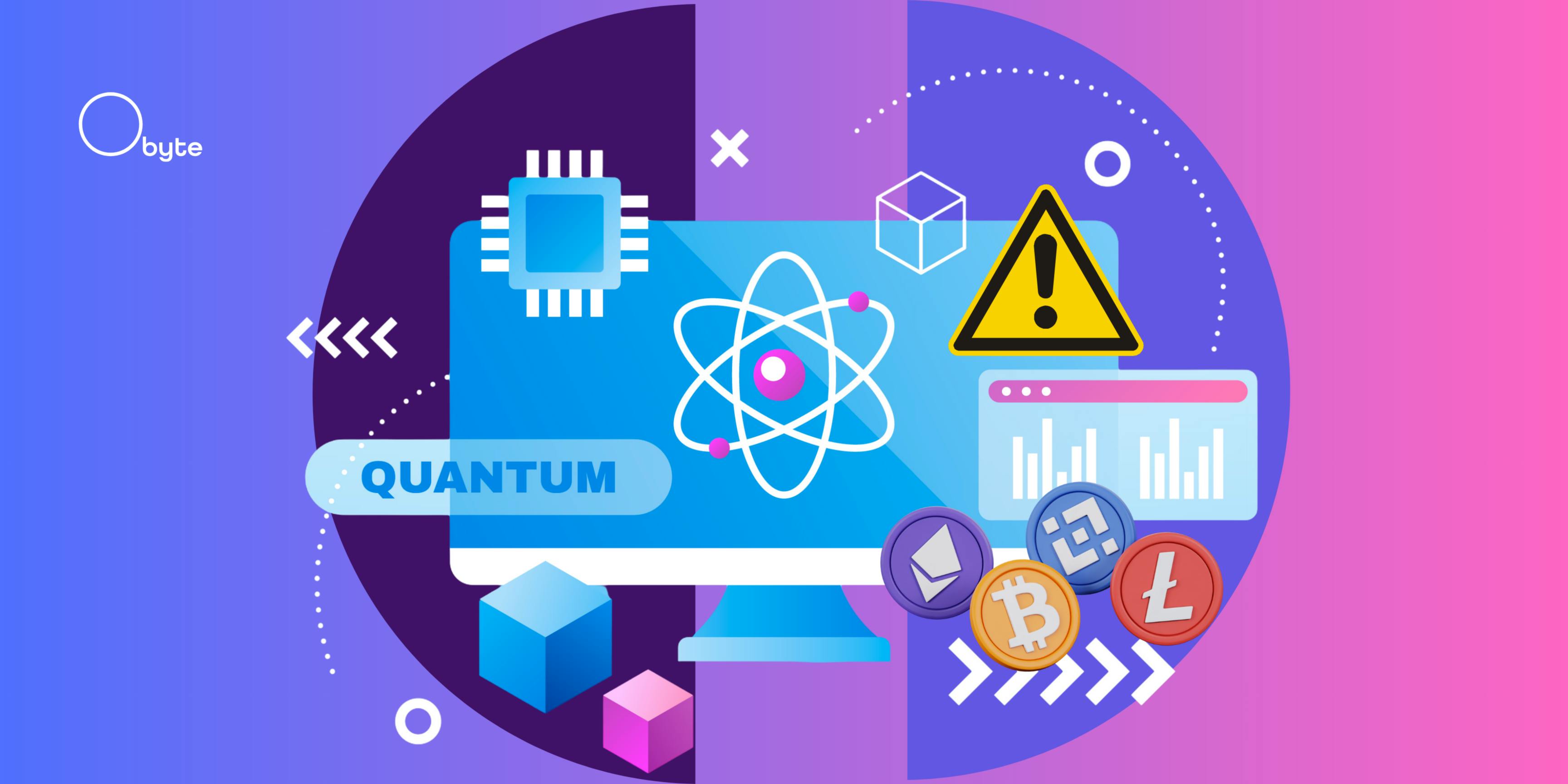
“Quantum” sounds like something taken straight from science fiction when you first hear it. If you deep-dive a bit, it becomes even weirder. It makes you wonder about the nature of existence and time itself. Quantum mechanics describes (or tries to describe) the behavior of matter and light, and technology related to it is trying to take advantage of that (odd) behavior. If fully developed, it’d be powerful stuff. It’d threaten the existence of cryptocurrencies and many other systems as well.
Quantum computing is often linked to broken passwords, cracked codes, and the collapse of digital security. It sounds like a gloomy future, but let’s learn a bit more about it.
What is Quantum Computing?
Do you know something about Schrödinger’s cat, which is simultaneously alive and dead inside a mysterious box? Well, that’s quantum theory. In a quantum system, particles aren’t ‘X’ or ‘Y’, but multiple things at the same time (superposition). They can also be linked to others and act in tandem (entanglement), regardless of distance or even time between them. As Professor John G. Cramer explained, “a particle may be entangled with a second particle that did not even exist when the first particle was created, detected, and disappeared.”
Yeah, well, this is funny and complex. What we need to know is that funny performance is being applied in computing to someday go beyond the limits of binary systems. Our current computers use bits (the smallest unit of digital data) to create and secure everything. They can represent and act as a single value, either 0 or 1. Quantum computing would use qubits instead, which can represent multiple states through superposition and interact through entanglement.
As you may guess, this simultaneity allows working with a gigantic number of possibilities at the same time. Quantum computers wouldn’t outperform today’s laptops in every task, but they shine in narrow areas such as factoring large numbers or searching vast mathematical spaces. That creates problems for current digital security systems, such as public key cryptography, which rely on the difficulty of navigating those spaces.
n Why Crypto (and Everything Digital) is at Risk
As their name suggests, “crypto-currencies” are entirely built with cryptography. They use some neat math tricks to create complex puzzles to secure our data. These puzzles rely on huge numeric spaces, meaning there are so many possible answers that guessing the right one would take longer than the age of the universe. In theory.
To be more specific, cryptocurrencies use public-key cryptography (or asymmetric cryptography). This is a system that uses two linked keys: a public key that can be shared openly, and a private key that must stay secret. The public key is used to create or verify messages, while the private key proves ownership and authorizes actions. It works to sign transactions and prove that funds belong to a specific holder without revealing the private key.
Another big building block is hash functions. A hash is an algorithm designed to mingle data, and it turns any input into a fixed-length output, like a digital fingerprint. They’re used to link blocks together, secure mining or transaction approval, and generate wallet addresses. Hashes are hard to reverse and hard to collide, meaning finding two inputs with the same output is extremely difficult.
But maybe not if you have a powerful enough quantum computer, working with billions, trillions, or almost endless potential results at the same time. Your private keys could be solved from only your public keys (wallet address), for instance. And this concern doesn’t stop with crypto. Banks and financial firms worldwide rely on similar cryptographic systems to secure transactions and protect accounts. Secure websites use public key cryptography through HTTPS to keep logins and payments private.
If quantum computers can break these systems, the impact spreads across finance, commerce, and the most basic use of the Internet. It’d be kind of a digital apocalypse.
n Are Your Funds at Risk Now?
The short answer is no. And they won’t be for a while. There are some quantum computers around, but they’re still giant beasts with few uses and a lot of bugs. Quantum technology isn’t the easiest one to develop or scale. Shor’s algorithm, for instance, is one of the most notable quantum algorithms in stock, and it was first presented back in 1994. Thirty-two years ago, even before cryptocurrencies, and quantum computing is still in diapers today.
Currently, some of the largest superconducting processors are reported with roughly 1,000+ qubits on a single chip (like IBM’s Condor and parallel systems), and other technologies have similar counts in that ballpark. Beating binary systems would need millions of qubits, though, because they’re still not, let’s say, “perfect” qubits, but “noisy” qubits.
Here’s a short video illustrating this.
You see, qubits are extremely sensitive to heat, radiation, and tiny interactions with their environment. This interference makes them lose their quantum state, causing calculation errors and unstable results. That’s quantum noise: random disturbances (almost anything, really) that sabotage qubits.
To reduce this noise, systems use extreme cooling, shielding, better qubit materials, and quantum error correction, where many noisy qubits work together to form one reliable logical qubit. These measures work, but only partially. The problem isn’t close to being fully solved and remains one of quantum computing’s main bottlenecks.
Now, all of this doesn’t mean that we should just ignore the potential threat quantum computing is to crypto and today’s digital systems. We have time, and we need to prepare. n
A Silver Lining
To be fair, cryptographers aren’t just sitting back as quantum computing looms. One major line of defense is post-quantum cryptography, which is already designing algorithms that resist classical and quantum attacks. Bitcoin developers, for instance, have suggested potential upgrades that would allow quantum-resistant signature schemes. On a more experimental level, QANplatform is building chains around quantum-resistant cryptography from day one.
Even more futuristic ideas exist, as some research initiatives combine blockchains and quantum communication. We still haven’t figured out how to use these systems, which would use things like quantum entanglement across time, but that isn’t surprising, as these ideas are still just that: ideas. However, they’re showing that the ‘quantum threat’ can inspire entirely new security models, rather than only patches.
We should say that Obyte, despite being a DAG (Directed Acyclic Graph) and not having miners or “validators”, is still built on public-key cryptography and hash functions —as most cryptocurrencies. It may not be quantum-proofed yet (and no crypto network really is), but our developer team is active and releasing new versions frequently. It’s quite possible that we’ll change to a more difficult hashing algorithm and quantum-safe digital signatures in the future.
Zooming out, quantum computing may end up acting more like a catalyst than a wrecking ball. It gives crypto the opportunity to be clear of legacy assumptions, improve key management, and adopt more advanced systems before other industries. The outcome is a more resilient and proactive ecosystem. If crypto was born out of adversarial thinking, quantum pressure gives it a new and interesting opponent to outgrow. n
:::info
Featured Vector Image by Freepik
:::